



In modern fulfillment and distribution operations, automation is no longer a futuristic concept—it is a competitive necessity. Among the many technologies reshaping warehouses, the cross-belt sorter stands out as one of the most impactful systems for high-speed, high-accuracy order sorting.
But while its operational benefits are widely acknowledged, one question consistently dominates boardroom discussions and capital investment meetings:
Can a cross-belt sorter deliver a return on investment fast enough to justify its high upfront cost?
This article takes a deep, practical look at how to evaluate the return on investment (ROI) of a cross-belt sorting system, what factors influence payback time, and whether “short-term payback” is realistically achievable in today’s logistics environment.

Understanding the Cross-Belt Sorter in Real-World Operations
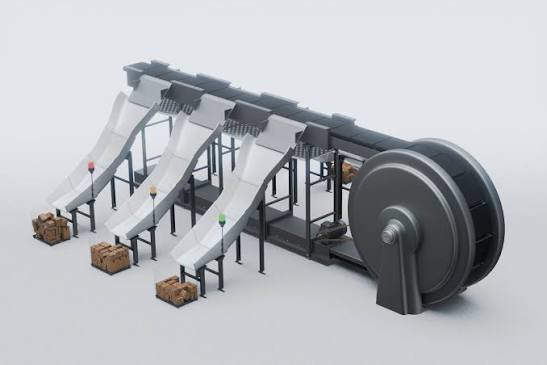
A cross-belt sorter is an automated material handling system designed to sort items quickly and accurately into designated chutes or destinations. Each carrier on the system has a small, independently controlled belt that can discharge items to either side.
Where It’s Commonly Used
Cross-belt sorters are widely deployed in:
- E-commerce fulfillment centers
- Parcel distribution hubs
- Apparel and retail logistics operations
- Postal and courier sorting facilities
- Airport baggage handling systems
What makes this technology valuable is its combination of:
- High throughput capacity
- Exceptional sorting accuracy
- Ability to handle a wide variety of item sizes and shapes
- Continuous operation with minimal manual intervention
However, these advantages come with significant capital expenditure, which makes ROI analysis essential before adoption.
What Drives the Investment Cost?
To evaluate payback, we first need to understand what contributes to the initial investment.
1. Equipment and System Design
The core sorter system includes:
- Cross-belt carriers
- Loop conveyor structure
- Induction and feeding stations
- Divert chutes or destinations
- Control and software systems
System design complexity increases cost significantly, especially for large facilities with hundreds of destinations.
2. Installation and Infrastructure
Installation often requires:
- Structural modifications to warehouse floors or mezzanines
- Electrical upgrades
- Network and control system integration
- Safety compliance engineering
These “hidden costs” can sometimes represent 20–40% of the total investment.
3. Software and Integration
Modern systems rely heavily on:
- Warehouse management systems (WMS)
- Real-time control software
- Scanning and tracking systems
- Data analytics and optimization tools
Integration complexity can heavily influence both cost and deployment time.
4. Training and Transition Costs
Even highly automated systems require:
- Operator training
- Maintenance team upskilling
- Process redesign
- Temporary productivity loss during ramp-up
Where ROI Actually Comes From
A cross-belt sorter does not generate ROI directly—it creates operational efficiencies that translate into financial gains.
Let’s break down the major sources of return.
1. Labor Cost Reduction
Labor is often the largest operating expense in fulfillment centers.
A cross-belt sorter reduces labor costs by:
- Replacing manual sorting roles
- Reducing walking time
- Minimizing error correction effort
- Consolidating multi-step processes
In high-volume operations, labor reduction alone can account for a substantial portion of ROI.
For example:
- A manual sorting line may require 30–80 workers per shift
- An automated sorter may reduce that requirement by 40–70%
Even with higher-skilled technicians replacing some roles, total labor cost often drops significantly.
2. Throughput Increase
Speed is a major financial lever.
Cross-belt systems can process:
- Thousands to tens of thousands of items per hour
Higher throughput means:
- More orders processed per day
- Faster shipping cycles
- Ability to handle peak demand without overtime or temporary staffing
This often translates into:
- Increased revenue capacity without expanding facility size
- Reduced need for additional warehouse locations
3. Accuracy and Error Reduction
Manual sorting introduces:
- Mis-sorts
- Shipping errors
- Returns and reverse logistics costs
Cross-belt systems improve accuracy dramatically, reducing:
- Customer service costs
- Return handling expenses
- Replacement shipments
Even small improvements in accuracy can generate meaningful savings at scale.
4. Space Optimization
Automation allows businesses to:
- Reduce manual staging areas
- Optimize vertical space usage
- Consolidate workflows into tighter layouts
This can delay or eliminate the need for facility expansion—a major hidden ROI driver.
5. Scalability Without Linear Cost Growth
Traditional operations scale linearly:
- More orders require more workers
- More workers require more space and supervision
Automated systems scale differently:
- Throughput increases without proportional labor growth
This non-linear scaling is a critical long-term financial advantage.
How to Calculate ROI for a Cross-Belt Sorter
A practical ROI model typically includes:
Step 1: Total Investment Cost
Include:
- Equipment purchase
- Installation
- Software integration
- Training
- Facility modifications
Step 2: Annual Operational Savings
Common savings categories:
- Labor cost reduction
- Reduced overtime
- Lower error correction costs
- Reduced facility expansion needs
- Energy efficiency improvements
Step 3: Payback Period Formula
A simplified formula:
Payback Period = Total Investment ÷ Annual Net Savings
For example:
- Investment: $8,000,000
- Annual savings: $2,000,000
Payback period = 4 years
Step 4: ROI Over System Lifespan
Most systems are evaluated over 10–15 years:
Total ROI = (Lifetime Savings – Total Investment) ÷ Investment
This provides a more realistic picture than short-term payback alone.
Can It Really Pay Back in the Short Term?
Now we arrive at the central question: short-term payback.
The answer depends heavily on operational context.
Short-Term Payback (2–3 Years) Is Possible When:
- High Throughput Volume
- Extremely high order volume improves utilization efficiency
- High Labor Costs
- Regions with expensive labor markets see faster returns
- 24/7 Operations
- Continuous usage maximizes asset productivity
- Peak Season Pressure
- Heavy seasonal spikes justify automation investment
- Severe Inefficiencies in Manual Sorting
- Existing operations with high error rates or bottlenecks benefit more dramatically
Medium-Term Payback (3–5 Years) Is Most Common
For most mid-to-large logistics operations, this is the realistic range.
Reasons include:
- Moderate labor savings
- Partial automation rather than full replacement
- Integration complexity
- Ramp-up period before full efficiency is reached
Long-Term Payback (5+ Years) Occurs When:
- Order volumes are unstable or low
- Labor costs are relatively low
- System is underutilized
- Poor process design limits efficiency gains
Hidden Factors That Impact Payback Speed
ROI calculations often look clean on paper but vary in reality due to operational factors.
1. Utilization Rate
A sorter running at 90% utilization pays back significantly faster than one running at 50%.
2. System Downtime
Maintenance and unexpected downtime reduce effective throughput.
Even small downtime differences can impact ROI timelines.
3. Process Alignment
If upstream and downstream processes are not optimized, the sorter becomes a bottleneck rather than a solution.
4. Peak vs. Average Volume
Many systems are justified based on peak demand, but ROI depends on average daily usage.
5. Scalability of Business Growth
If order volume grows quickly, ROI accelerates naturally.
Comparing Cross-Belt Sorters to Alternative Solutions
To understand ROI properly, it helps to compare alternatives.
Manual Sorting
- Low initial cost
- High long-term labor cost
- Poor scalability
- High error rate
Semi-Automated Systems
- Moderate cost
- Moderate efficiency gains
- Limited scalability
Cross-Belt Sorters
- High upfront investment
- High efficiency
- Strong scalability
- Low long-term operating cost
The trade-off is clear: higher upfront capital for long-term operational advantage.
Strategic Value Beyond ROI
Some benefits are not easily captured in financial formulas.
1. Customer Experience
Faster and more accurate fulfillment improves:
- Delivery speed
- Order accuracy
- Customer satisfaction
2. Competitive Positioning
Automation can determine whether a company can compete in:
- Same-day delivery markets
- High-volume retail environments
- Seasonal demand surges
3. Workforce Stability
Automation reduces dependence on:
- Seasonal hiring
- High turnover labor pools
Practical Scenarios: When Investment Makes Sense
A cross-belt sorter is typically justified when:
- Daily order volume consistently exceeds medium-to-high thresholds
- Labor costs are rising or unstable
- Warehouse expansion is not feasible or too expensive
- Operational bottlenecks are limiting growth
When It May Not Be the Right Choice
It may not be ideal if:
- Order volume is low or unpredictable
- Business model is highly flexible with frequent layout changes
- Capital expenditure capacity is limited
- Operations are seasonal with long idle periods
Final Verdict: Is Short-Term Payback Realistic?
A cross-belt sorter can achieve short-term payback, but only under specific conditions—typically high-volume, high-efficiency, and labor-intensive operations.
For most organizations, a 3–5 year payback period is a realistic expectation, while highly optimized environments can push that closer to 2–3 years.
However, focusing only on payback speed misses the broader strategic picture. The true value of a cross-belt sorter lies in its ability to:
- Scale operations without proportional labor growth
- Improve accuracy and customer satisfaction
- Support long-term competitive positioning
- Enable faster fulfillment capabilities
In other words, the question is not only “How fast will it pay back?” but also:
“Can the business grow efficiently without it?”
For many modern logistics operations, the answer to that second question increasingly determines whether automation is optional—or essential.