
The apparel retail industry has never been more complex than it is today. With the rise of e-commerce, fast fashion cycles, omnichannel fulfillment, and global supply chains, retailers are under constant pressure to deliver more products, in more variations, to more customers—faster and with fewer errors.
One of the biggest operational challenges in this environment is handling multi-SKU (Stock Keeping Unit) orders, where a single customer order may include different sizes, colors, styles, or even product categories. Traditional manual sorting systems struggle to keep up with this level of complexity, leading to delays, picking errors, and rising labor costs.
This is where the cross-belt sorter system has become a transformative solution for modern apparel logistics.
Often described as the backbone of high-speed automated distribution centers, cross-belt sorters are redefining how fashion retailers process, sort, and ship multi-specification orders at scale.
In this article, we will break down how cross-belt sorters work, why they are so effective for apparel retail, and the key operational “secrets” that allow businesses to maximize their performance.
The Apparel Retail Challenge: Why Multi-SKU Orders Are So Difficult
Unlike single-item logistics, apparel fulfillment involves extreme variability.
A single order might include:
- A size M black T-shirt
- A size 32 blue jeans
- A medium red hoodie
- A pair of white sneakers in size 9
Each item has different:
- Storage locations
- Picking paths
- Handling requirements
- Packaging rules
Key operational challenges include:
1. High SKU density
Modern apparel warehouses often manage tens of thousands—or even hundreds of thousands—of SKUs.
2. Frequent order fragmentation
One order is rarely picked from one location. It is distributed across multiple zones.
3. Seasonal demand fluctuations
Fashion demand changes rapidly, requiring flexible sorting capacity.
4. High return rates
Apparel has one of the highest return rates in e-commerce, increasing reverse logistics complexity.
5. Tight delivery expectations
Customers now expect next-day or even same-day delivery.
Traditional manual sorting systems cannot handle this scale efficiently.
What Is a Cross-Belt Sorter?
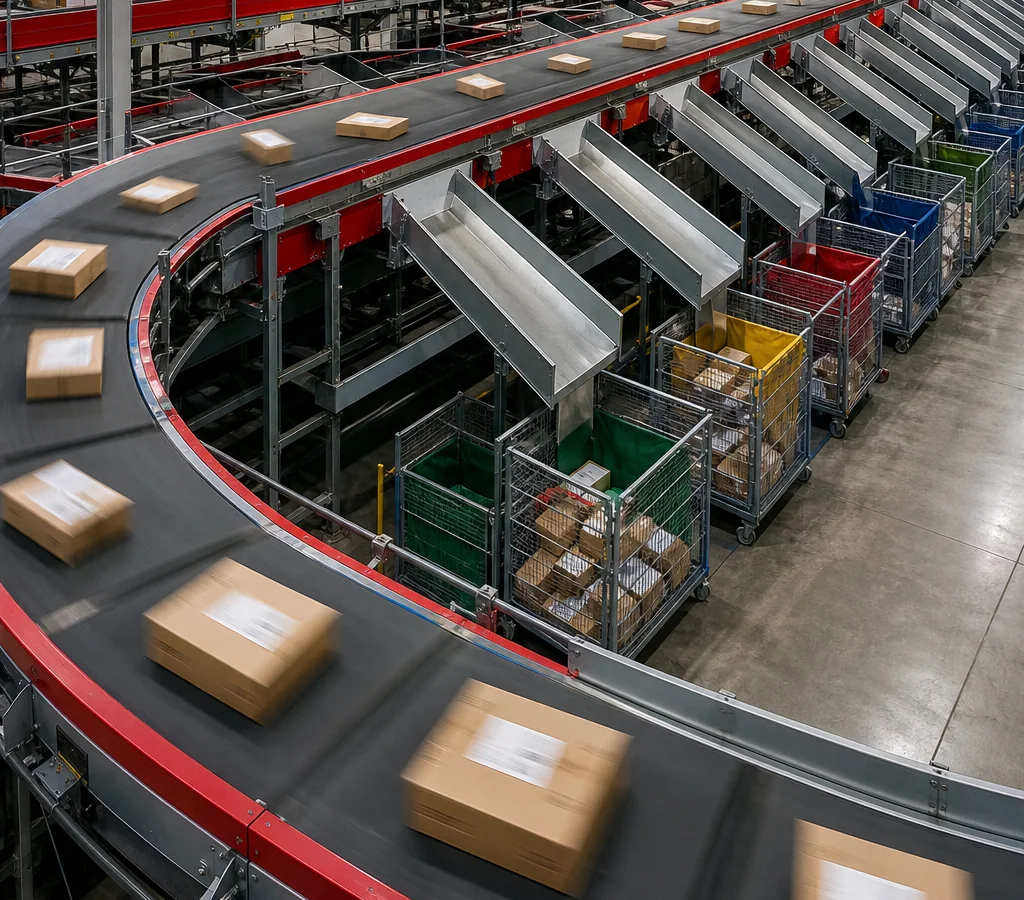
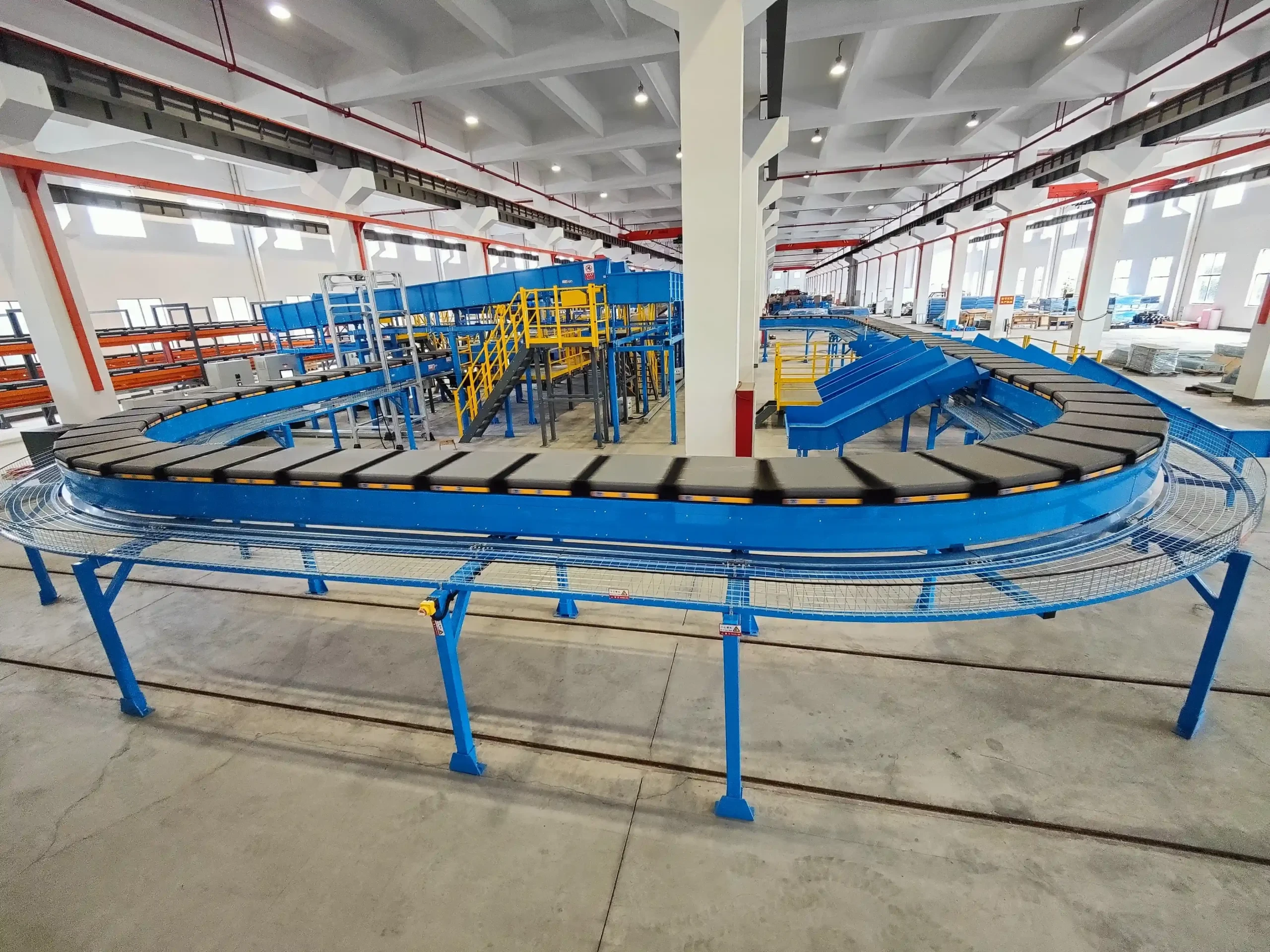
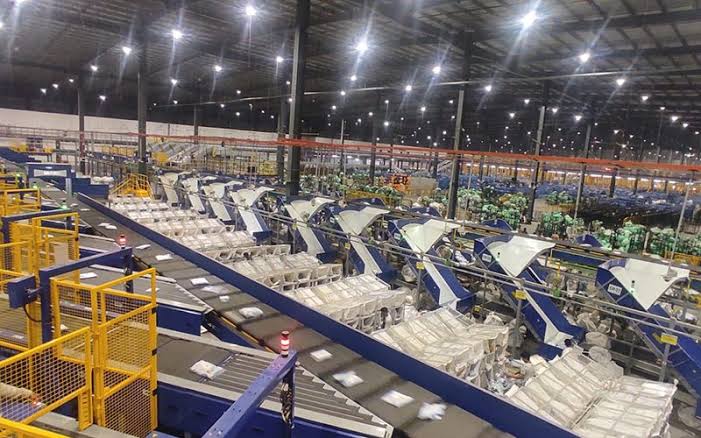
A cross-belt sorter is an automated material handling system designed to sort items at high speed into designated destinations using small conveyor belts mounted on a continuous loop.
Each individual “carrier” on the system has a small belt that can move left or right to discharge items into specific chutes.
Basic components include:
- Main loop conveyor system
- Individual cross-belt carriers
- Barcode or RFID scanning system
- Automated induction points
- Sorting chutes or drop zones
- Control software system
How Cross-Belt Sorters Work in Apparel Fulfillment
The process is highly synchronized and data-driven.
Step 1: Item identification
Each apparel item is scanned using:
- Barcode labels
- RFID tags
- Vision recognition systems
This links the item to a specific order and destination.
Step 2: Automated induction
Items are placed onto the sorter system via induction points.
At this stage:
- The system verifies item identity
- Confirms destination logic
- Assigns routing path
Step 3: High-speed transport
Items travel on the main loop conveyor.
Unlike traditional conveyors, cross-belt systems:
- Maintain continuous motion
- Reduce bottlenecks
- Support high throughput rates
Step 4: Precision sorting
When an item reaches its designated chute:
- The small cross-belt activates
- The item is gently discharged
- It lands in the correct bin or shipping lane
Step 5: Consolidation
Sorted items are grouped by order:
- Complete orders move to packing stations
- Partial orders are staged for completion
Why Cross-Belt Sorters Excel in Apparel Retail
Cross-belt sorters are particularly effective for fashion logistics because they handle complexity with precision.
1. Multi-directional sorting capability
Unlike tilt-tray systems or manual sorting, cross-belt systems can:
- Sort to hundreds of destinations simultaneously
- Handle dynamic routing changes in real time
2. Gentle handling of delicate items
Apparel items such as:
- Lightweight fabrics
- Accessories
- Folded garments
require non-damaging handling.
Cross-belt systems use controlled discharge, minimizing product damage.
3. High throughput efficiency
Modern systems can process:
- Thousands of items per hour
- Continuous 24/7 operation capability
This is essential for fast-fashion retailers and peak-season demand.
4. Scalability for seasonal peaks
During sales events or holiday seasons:
- Sorting capacity can be maximized
- Labor dependency is reduced
- Bottlenecks are minimized
The “Secret” Behind High Conversion Efficiency in Sorting Operations
While the technology is powerful, the real performance advantage comes from operational strategy.
Here are the key secrets leading apparel retailers use to maximize cross-belt sorter efficiency.
Secret 1: Smart SKU Grouping Before Sorting
Instead of feeding items randomly into the system, high-performing warehouses:
- Group items by order density
- Pre-batch high-frequency SKUs
- Reduce random distribution patterns
This increases sorting predictability and reduces congestion.
Secret 2: Dynamic Order Prioritization
Not all orders are equal.
Advanced systems prioritize based on:
- Delivery deadlines
- Shipping zones
- Customer tier (e.g., VIP orders)
- Inventory availability
This ensures high-value orders move faster through the system.
Secret 3: Balanced Induction Flow
One of the most common mistakes in sorting centers is uneven induction.
If too many items enter the sorter at once:
- System congestion occurs
- Sorting accuracy decreases
- Bottlenecks form at discharge points
Best practice is maintaining a balanced flow rate across all induction stations.
Secret 4: Zone-Based Warehouse Architecture
Efficient apparel operations divide warehouses into zones:
- Fast-moving SKUs (A-zone)
- Medium turnover items (B-zone)
- Slow-moving inventory (C-zone)
Cross-belt sorters perform best when upstream picking zones are aligned with this structure.
Secret 5: Real-Time System Feedback Loops
Modern sorter systems integrate with warehouse management systems (WMS) to provide:
- Live item tracking
- Error detection alerts
- Throughput monitoring
- Automatic rerouting adjustments
This creates a self-correcting operational environment.
Integration With Warehouse Management Systems (WMS)
Cross-belt sorters do not operate in isolation.
They are tightly integrated with digital warehouse ecosystems.
Key integrations include:
- Order management systems (OMS)
- Inventory management systems (IMS)
- Transportation management systems (TMS)
This integration allows:
- Real-time order visibility
- Accurate stock allocation
- Automated replenishment triggers
Handling Multi-SKU Apparel Orders Efficiently
Multi-SKU orders are the biggest strength test for any sorting system.
Key strategies include:
1. Order decomposition logic
Large orders are broken into individual item flows before sorting.
2. Parallel processing
Items from the same order may be processed in different zones simultaneously.
3. Order recombination logic
At the end of the line:
- Items are automatically regrouped
- Orders are verified before packing
Reducing Errors in High-Volume Sorting
Even with automation, errors can occur if systems are poorly configured.
Common issues:
- Mis-scanned barcodes
- Incorrect label assignment
- Overloaded sorting chutes
- Poor item spacing
Prevention strategies:
- Dual verification scanning
- Automated weight checks
- AI-based anomaly detection
- Regular calibration of sensors
The Role of AI in Modern Cross-Belt Sorting
Artificial intelligence is increasingly integrated into sorting systems.
AI applications include:
- Predictive flow optimization
- Demand forecasting for SKU distribution
- Real-time congestion management
- Adaptive routing adjustments
AI allows systems to learn from operational data and improve efficiency over time.
Labor Optimization and Workforce Transformation
Cross-belt sorters do not eliminate labor—they transform it.
Instead of manual sorting, workers focus on:
- System monitoring
- Exception handling
- Quality control
- Packing optimization
This leads to:
- Higher productivity
- Reduced physical strain
- Fewer repetitive tasks
Cost Efficiency and ROI Considerations
While cross-belt sorter systems require significant upfront investment, they deliver long-term value through:
- Reduced labor costs
- Lower error rates
- Faster order fulfillment
- Higher throughput capacity
- Improved customer satisfaction
For high-volume apparel retailers, ROI is often achieved through operational scale advantages.
Common Mistakes When Implementing Cross-Belt Sorters
1. Underestimating SKU complexity
Not all apparel catalogs are suitable for simple sorting logic.
2. Poor warehouse layout planning
System performance depends heavily on spatial design.
3. Ignoring training requirements
Operators must understand both hardware and software systems.
4. Overloading early-stage systems
Gradual ramp-up is essential for stability.
Future Trends in Apparel Sorting Automation
The next generation of cross-belt systems will likely include:
- Fully autonomous robotic induction
- Vision-based item recognition without barcodes
- AI-driven predictive routing
- Cloud-based warehouse orchestration
- Modular expandable sorter systems
These innovations will further reduce friction in apparel logistics.
Final Thoughts
The apparel retail industry is evolving rapidly, and logistics systems must evolve with it. Cross-belt sorters have become a cornerstone technology for managing the complexity of modern multi-SKU order fulfillment.
However, the real power of these systems does not come from hardware alone. It comes from how intelligently they are integrated into warehouse operations, how effectively workflows are designed, and how consistently data is used to optimize performance.
For apparel retailers aiming to scale in a competitive market, cross-belt sorter systems are no longer a luxury—they are becoming a necessity.
When combined with smart operational strategies, they transform chaotic order flows into streamlined, predictable, and highly efficient fulfillment systems that can support the demands of modern consumers.
In a world where speed and accuracy define customer satisfaction, mastering automated sorting is not just an advantage—it is a foundation for long-term success.