

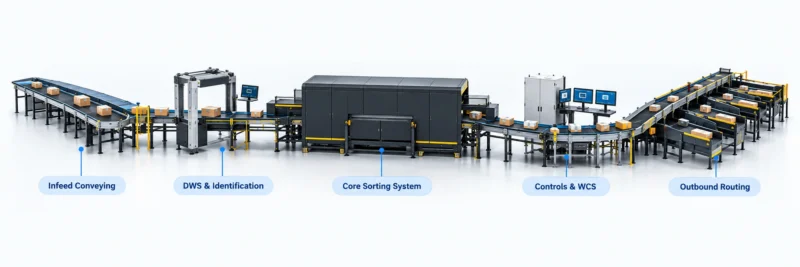


Choosing a sorter family is usually framed as a budget question, and it is really a parcel-profile question. The same operation can justify any of the three families depending on item size, weight, throughput and how gently the items must be handled. Buyers who start from the parcel profile end up with a machine that fits; buyers who start from price end up with a machine that constrains the operation for a decade. This guide compares the three families on the variables that decide.
Key Takeaways
- Parcel profile — size, weight, fragility and rate — decides the family; budget only decides the model.
- Cross belt leads on throughput and gentle handling; swivel wheel on footprint and cost.
- Narrow belt sits between them and is the common mid-volume answer.
- Item envelope limits are physical, not negotiable — oversize items need a different family or manual handling.
- Compare on the same peak-hour rate and the same item mix, or the comparison is meaningless.
The Three Families at a Glance
Each family diverts items from a moving carrier by a different mechanism, and the mechanism sets its limits.
| Family | Diversion mechanism | Strength | Limiting factor |
|---|---|---|---|
| Cross belt | Item crosses between two belts at the discharge point | Highest throughput, gentle handling | Highest capital and largest footprint |
| Narrow belt | Angled belts steer the item off the carrier | Balanced throughput and cost | Throughput ceiling below cross belt |
| Swivel wheel | Wheels swivel to push the item sideways | Compact, low cost, gentle | Limited to lighter, smaller items |
The individual guides go deeper: narrow belt sorters, swivel wheel sorters and cross belt sorter sizing.
Throughput and Item Envelope
The two constraints that eliminate families fastest are rate and item envelope.
| Factor | Cross belt | Narrow belt | Swivel wheel |
|---|---|---|---|
| Throughput ceiling | Highest | Mid | Lowest of the three |
| Item weight | Widest range | Mid range | Lightest items only |
| Item size | Handles larger items | Mid range | Smaller items |
| Gentle handling | Very good | Good | Very good |
| Footprint | Largest | Mid | Most compact |
The envelope rows are physical limits, not preferences. An item heavier or larger than the family’s envelope will not sort correctly regardless of budget, and the failure mode is usually jams and mis-sorts rather than a clean rejection. The sortation context is set out in our parcel sortation overview.
Matching Family to Parcel Profile
Read the profile, then read the answer.
| Parcel profile | Likely family | Reasoning |
|---|---|---|
| High rate, mixed sizes, high volume | Cross belt | Only family with the throughput ceiling and the envelope |
| Mid rate, standard parcels | Narrow belt | Best balance of throughput and capital |
| Low rate, light small items, tight space | Swivel wheel | Compact and low cost where envelope allows |
| Fragile or high-value items | Cross belt or swivel wheel | Gentler diversion mechanisms |
| Mixed envelope including oversize | Cross belt plus manual or separate handling | No single loop handles the full mix |
The last row is the one buyers resist and most operations eventually need. A catalogue containing items outside any family’s envelope needs a second path — manual, chute-based, or a separate small loop — rather than a bigger machine.
Comparing Proposals Fairly
Three rules make proposals comparable. Fix the peak-hour rate, because a sorter sized for average fails at peak. Fix the item mix, including the largest and heaviest items, because the envelope eliminates families. And require the full installed scope, because the machine is one line in the budget — the composition is set out in our cross belt sorter budget guide.
One further question worth asking each vendor: what happens to items outside the envelope. A vendor with a defined reject and overflow path has thought about your actual catalogue; one who says “it will not happen” has not.
Frequently Asked Questions
Which sorter is best for high-volume parcel sorting?
Cross belt, for the highest throughput ceiling and the widest item envelope. It carries the highest capital cost and the largest footprint.
What is the difference between cross belt and narrow belt sorters?
Throughput ceiling and item envelope. Cross belt handles higher rates and larger items; narrow belt serves mid-volume operations at lower capital cost.
When is a swivel wheel sorter the right choice?
When items are light and small, the rate is modest, and floor space is constrained. Its compact footprint and low cost suit smaller operations.
How do I choose between sorter families?
Start from the parcel profile: peak-hour rate, item size and weight envelope, fragility and available footprint. Budget then decides the model within the family.
What happens to oversize items?
No single loop family handles the full envelope. Operations with oversize items need a defined reject path or a separate manual or chute-based route.
Which sorter handles fragile items best?
Cross belt and swivel wheel, because their diversion mechanisms are gentler. Narrow belt is acceptable for most standard parcels.
Should I compare sorters on price?
Not first. Compare on the same peak-hour rate, the same item mix and the full installed scope. Price comparison without those fixed is not a comparison.
Technical background: sorting systems, conveyor systems and material handling equipment explain the system context referenced above.