

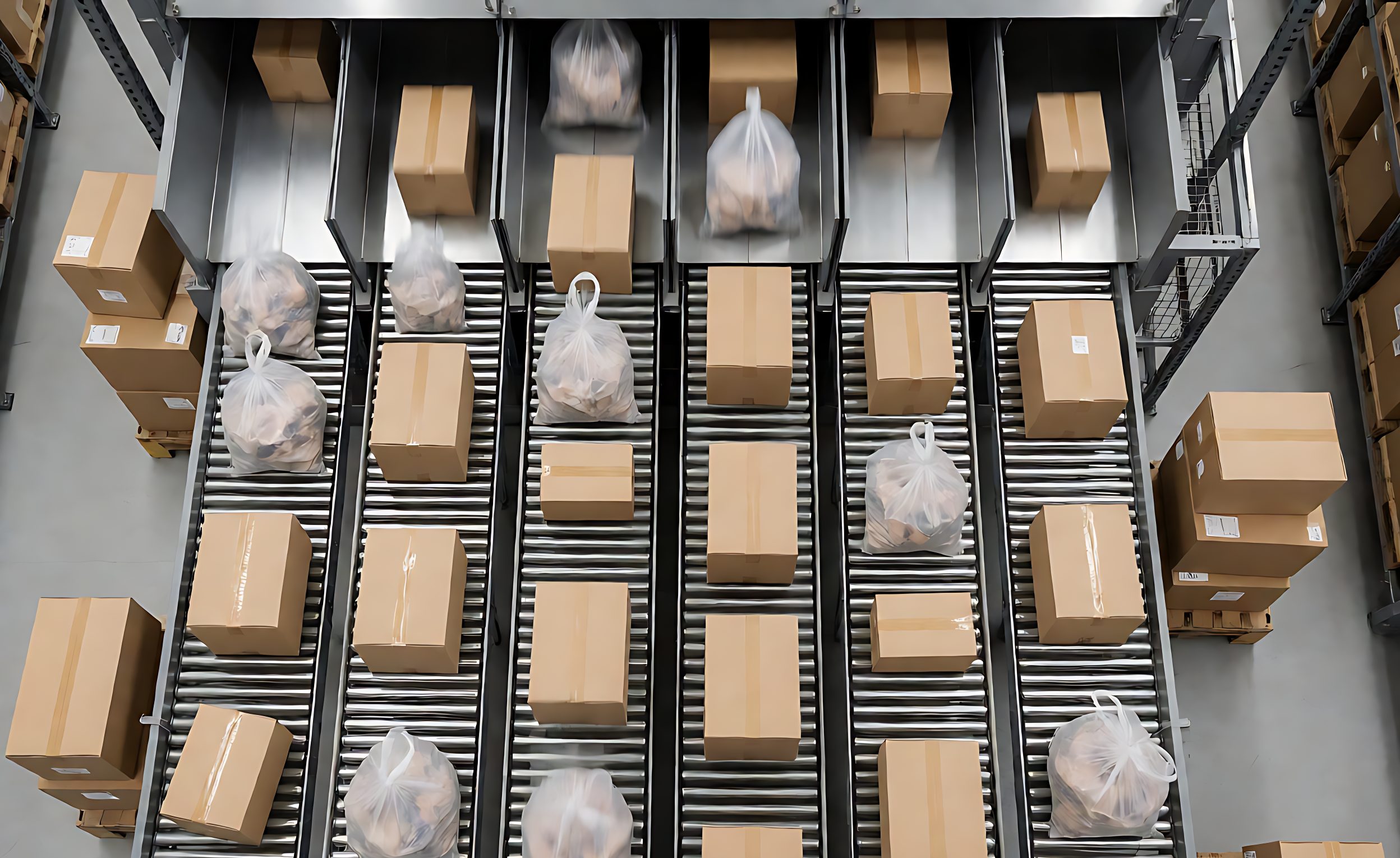
The capacity of our sorting systems guarantees rapid sorting of elements previously entered into the system
Sorting machines or automated sorting systems are used in picking environments where the movement of a relatively small number of reference objects is required relative to the total movement of units or bulk required during a defined picking period.
There are different types of sorting systems, the most commonly used one is the “shoe sorter” which is used in batch or unit picking systems and is called a “mini shoe sorter”.
If you need more information about our products, please feel free to contact us.
What is a sorting machine?
Benefits of automated sorting systems
Sorter system type
What is a sorting machine?
Sorting machines or automated sorting elements are also used in order picking environments, among other situations, where the movement of a relatively small number of references is required relative to the total movement of units or packages required in a given picking cycle.
Therefore, in recent years they have become systems that perfectly complement automated operations that require these classifications within intralogistics processes.
This type of system can sort products according to orders with greater precision, simplicity and operational accuracy.
Advantages of sorting systems:
Supplementing automated intralogistics operations with sorting or sorting systems means above all an increase in productivity and the ability to minimize preparation times.
Thanks to these elements, more orders can also be processed due to the speed at which sorting systems (such as sorters) work.
Simply put, a sorter is an automated system whose purpose is to sort packages according to their destination. Distribute each box arriving at the induction area to the corresponding destination to facilitate its consolidation.
Depending on the need, intralogistics processes may require manual, semi-automatic or fully automated preparation systems. But in any process, all logistics processes ultimately sort all prepared boxes according to their destination.
Since the sorter is an automated system with a wide range of applications, our engineering department continuously researches and develops in order to provide the market with the most suitable solution (in terms of cost, ergonomics, flexibility, adaptability, possibility of growth according to the volume aspects) requirements, type of load to be transported, etc…).
Sorting machine system type:
We have the following sorting machines:
Sort boxes of different sizes,
envelope,
plastic barrel,
folded clothes,
ETC. ,
Suitable for dry, refrigerated or frozen environments
Automated Sorting’s Advantages, Audited Honestly
The advantages of automated sorting are real and frequently inflated. The audited version:
| Claimed advantage | Audited reality | Condition that delivers it |
|---|---|---|
| “Massive throughput gains” | Real, capped by induction quality | Singulation staffed and calibrated |
| “Dramatic error reduction” | Real, measured per exception class | Logs reviewed, not just displayed |
| “Major labour savings” | Roles shift more than vanish | Retraining planned from day one |
| “Rapid payback” | Real at honest volumes | Forecast built from contracted demand |
The labour row deserves its honesty clause: automated sorting transforms labour from repetitive sorting hours to exception handling, maintenance and analysis hours — a composition change that operations which plan for it convert into capability, and operations which promise headcount cuts convert into morale problems. The induction row is the throughput truth-teller: the sorter meets its rate only as well as parcels are presented, and the cheapest rate improvement is usually upstream of the machine. Auditing claimed advantages before purchase — visiting references, asking for logs, checking the forecast’s basis — converts marketing into procurement, and the audited advantages, unlike the inflated ones, survive commissioning. The efficiency baselines behind the audit are in the numbers that moved, and the transformation mechanics in shift-by-shift transformation. Reference: automation benefits and limits and logistics operations.