The explosive growth of global e-commerce has fundamentally reshaped warehouse operations. Modern e-commerce fulfillment centers no longer deal solely with uniform, palletized shipments. Instead, they manage high-velocity, high-mix flows consisting of polybags, bubble mailers, custom-sized cartons, and irregular packaging. During peak promotional seasons, manual sorting quickly becomes a bottleneck, leading to shipping delays, increased labor costs, and mis-sorting errors.
Implementing an automated parcel sorting system is the most effective way to scale throughput, reduce dependency on manual labor, and maintain order accuracy. However, selecting the right system is a complex engineering and procurement decision. Choosing an incompatible system can lead to damaged parcels, high recirculation rates, and costly operational downtime. This guide breaks down the technical, operational, and financial dimensions of selecting a warehouse sorting system engineered for real-world e-commerce operations.
Sorting System Selection Matrix
Before diving into individual technologies, logistics managers must evaluate how different types of parcel sorting equipment compare across key operational benchmarks. The table below outlines the general capabilities of the primary automated sortation systems used in modern fulfillment centers.
| Technology Type | Typical Throughput (PPH) | Parcel Profile Compatibility | Footprint Efficiency | Sorting Accuracy | Relative Initial Capital (CAPEX) |
|---|---|---|---|---|---|
| Cross Belt Sorter | 8,000 – 25,000+ | Excellent (Polybags, cartons, mailers, flats) | Medium (Requires loop/linear track clearance) | High (>99.9%) | High |
| Narrow Belt Sorter | 5,000 – 12,000 | Good (Rigid cartons, structured mailers) | High (Linear, space-saving design) | High (>99.5%) | Medium |
| Swivel Wheel Sorter | 2,000 – 6,000 | Moderate (Flat-bottomed cartons, heavy boxes) | High (Modular, easy to integrate) | Moderate to High | Medium-Low |
| Put Wall System | 1,000 – 3,000 | Excellent (Small items, cosmetics, apparel) | Very High (Very compact footprint) | High (With Put-to-Light validation) | Low |
Performance Note: Sorter capacities listed above represent engineering estimates. Actual operational throughput is heavily influenced by the average parcel length, the efficiency of induction lines (manual vs. automated), barcode print quality, WMS handshake latency, and the ratio of soft-packaging vs. rigid cartons in the product mix.
Critical Factors When Evaluating a Parcel Sorting System
When selecting a parcel sorting system for an e-commerce facility, engineering teams must look beyond theoretical throughput numbers and evaluate how the machinery interacts with daily operational variables.
1. Throughput Dynamics: Nominal Speed vs. Sustained Operational Capacity
Many system buyers make the mistake of designing their systems around average daily volumes. In e-commerce, order volume is highly volatile. A system that easily handles 3,000 parcels per hour on a quiet Tuesday in April will fail during November Black Friday promotions, when volumes can spike by 300% to 500%.
To determine your required sustained throughput, calculate your peak season daily volume, divide it by the active sorting hours, and add a safety buffer of at least 20%. For example, if your peak daily projection is 100,000 packages processed over two 8-hour shifts (16 operational hours), your system must maintain a sustained throughput of 6,250 parcels per hour (PPH). Because of induct gaps and scan errors, the physical system should be rated for approximately 7,500 to 8,000 PPH to ensure operational comfort.
2. The E-commerce Parcel Profile Mix
Unlike traditional retail logistics, where products arrive in uniform corrugated boxes, e-commerce parcels are highly irregular. Your automated system must process:
- Polybags & Bubble Mailers: Extremely popular due to low shipping costs. However, they lack structural rigidity, have shifting centers of gravity, and are prone to getting caught in gaps of traditional conveyor belts.
- Flats and Envelopes: Light and thin, requiring precise belt-to-belt transitions to prevent paper jams.
- Corrugated Cartons: Provide stable contact surfaces but vary widely in size and weight.
If your product mix contains more than 30% polybags, mechanical divert systems like pusher arms or basic pop-up wheels can cause packages to spin, slip, or jam. In such scenarios, a positive displacement system like a cross belt sorter is highly recommended, as it carries the parcel on an individual conveyor cell and discharges it using active belt movement, completely independent of the package’s shape or material.
For operations dealing with a high percentage of small to mid-sized parcels and looking to save on warehouse space, linear sorting options like narrow belt sorters offer a balanced combination of linear footprint and reliable handling for both flat-surfaced cartons and stable polybags.

3. Scanning, Weighing, and Dimensioning (DWS) Integration
A parcel sorting system is only as fast as its data capture module. The sorting system must accurately identify, measure, weigh, and route each item in real time. This requires a robust Dimensioning, Weighing, and Scanning (DWS) system integrated directly at the induction point.
In high-speed operations, a 5-side or 6-side camera scanning tunnel is standard. E-commerce labels are often applied hastily, resulting in barcodes that are wrinkled, partially obscured, or facing downwards. Multi-sided scanning ensures that the barcode is captured regardless of package orientation, keeping manual intervention and recirculation rates to an absolute minimum.
4. Control Systems and Software Integration (WMS/WCS)
The physical sorting mechanism is controlled by a Programmable Logic Controller (PLC) which must communicate seamlessly with your Warehouse Control System (WCS) and Warehouse Management System (WMS). When a package passes through the DWS system, its barcode is scanned and matched with a database query. Within milliseconds, the WMS must return a routing decision to the WCS, instructing the PLC exactly when and where to trigger the divert mechanism.
Ensure that your system provider utilizes open communication protocols (such as TCP/IP, EtherNet/IP, or Profinet) and provides robust APIs that allow easy integration with standard WMS platforms. Delayed handshakes can result in missed diverts, increasing recirculation traffic and lowering overall system capacity.
Choosing the Right Sorting Technology for Your Operation
Let’s examine the three most common automated parcel sorting systems, analyzing their mechanical principles, advantages, and ideal deployment scenarios.
Option A: Cross Belt Sorters (High-Throughput & High-Flexibility)
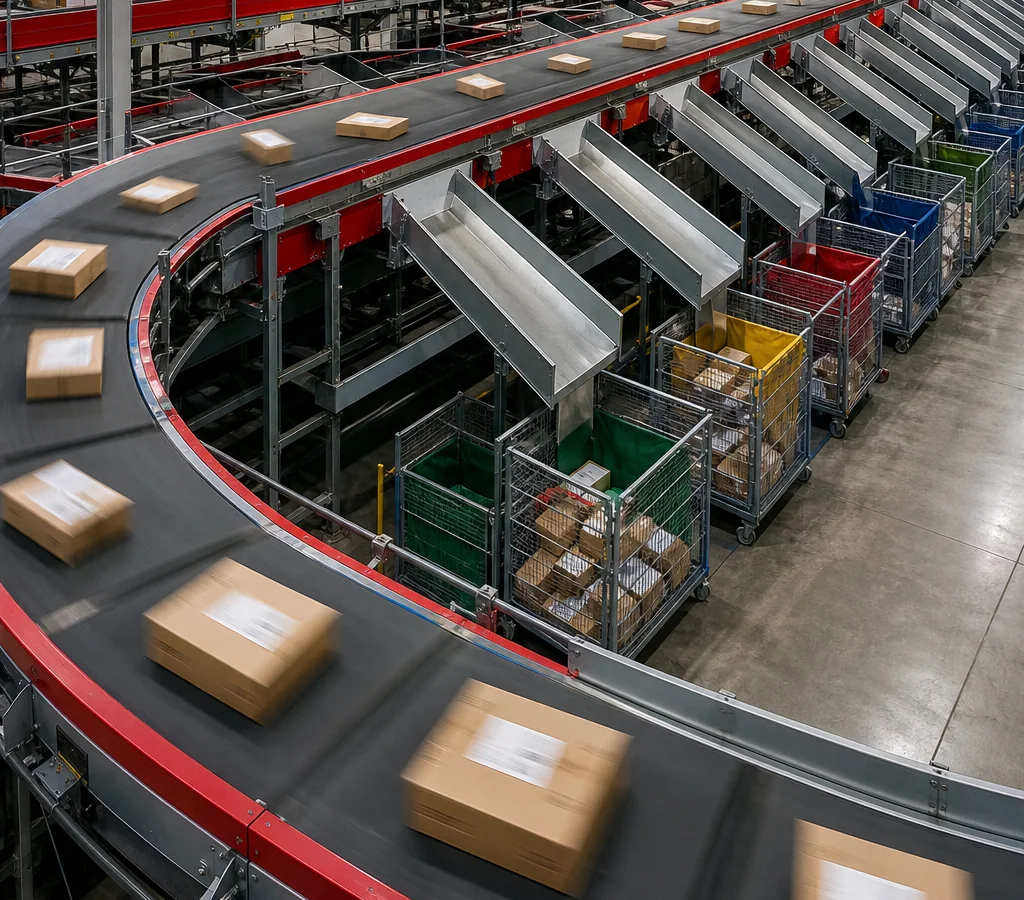
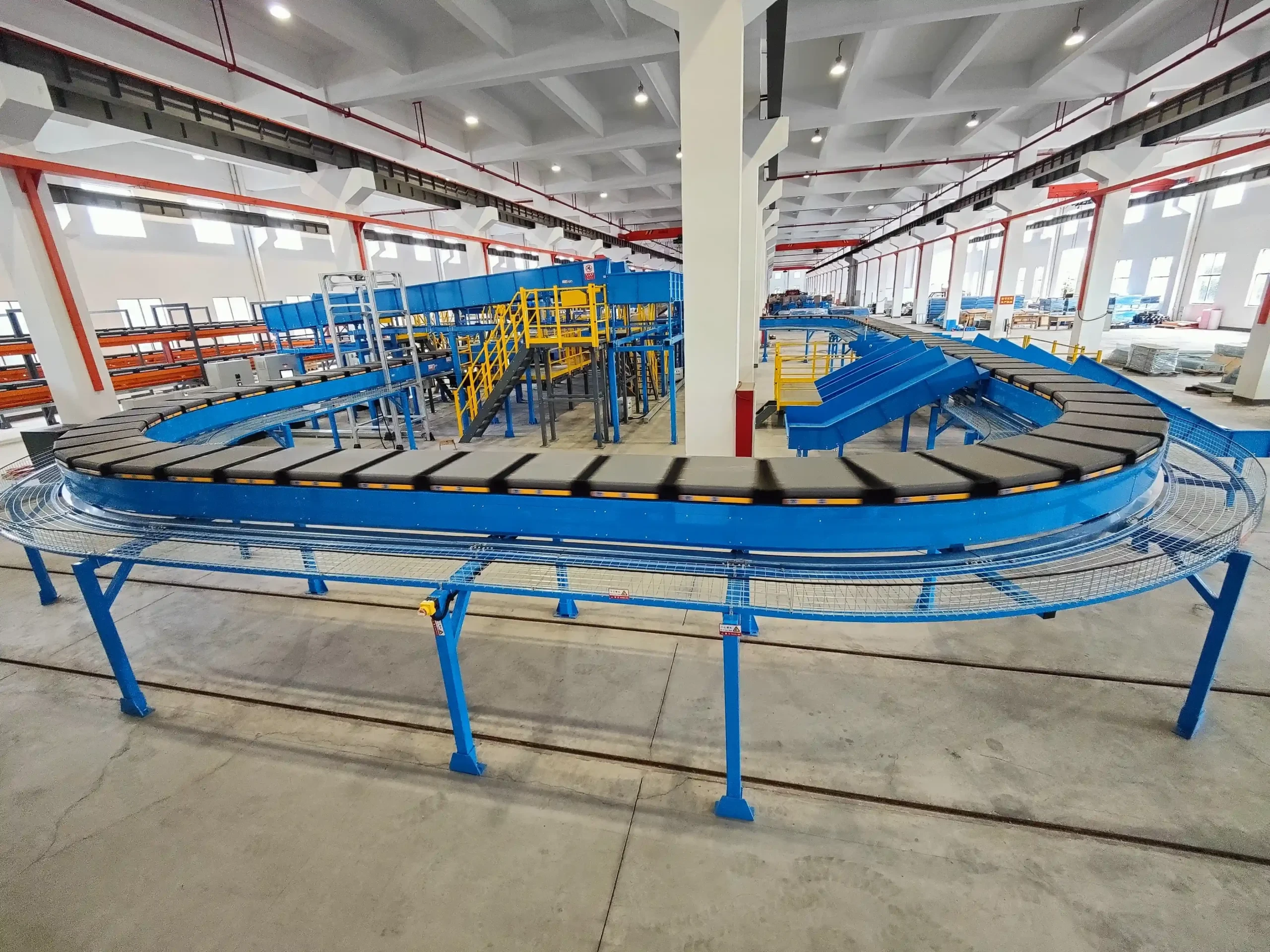
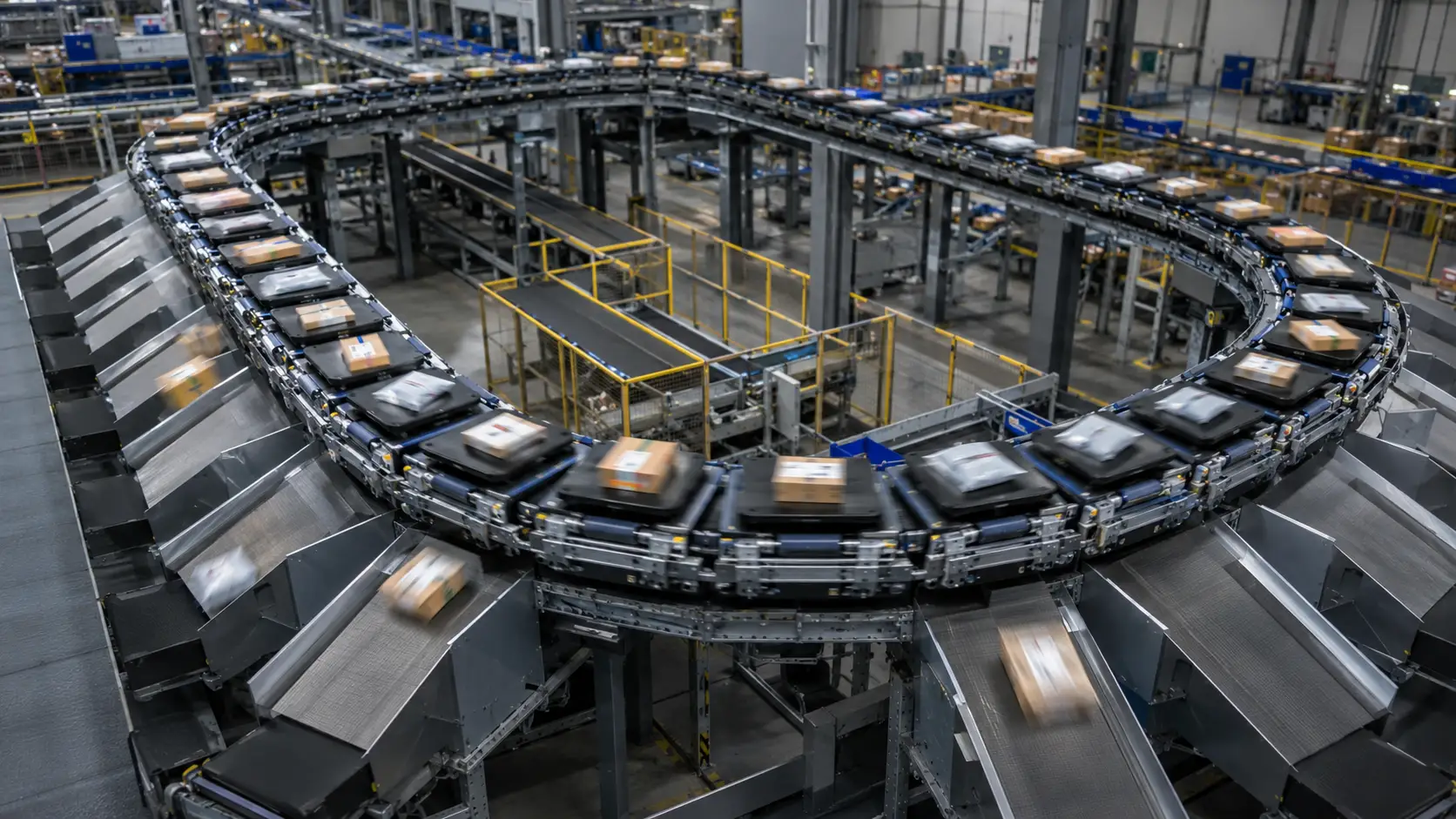
A cross belt sorter consists of a chain of individual motorized belt carriages (carriers) that run on a closed-loop track (either horizontal loop or vertical “over-under” loop). When a carrier aligns with the target discharge chute, the small belt on the carriage runs perpendicular to the main travel direction, actively driving the parcel into the chute.
- Standard Throughput: Typically starts around 7,000 PPH for compact layouts and can scale to over 20,000 PPH in high-speed, multi-induction hub configurations. For instance, the industry benchmark for high-speed cross-belt platforms often ranges up to 25,000 PPH under optimized conditions.
- Best Suited For: Large-scale e-commerce fulfillment centers, regional 3PL hubs, and courier sortation hubs with high volumes and a highly diverse packaging mix (including fragile items, round containers, and polybags).
- Operational Advantage: Extremely gentle on fragile products. The active driving force ensures highly precise discharge, allowing for tighter chute spacing and a more compact footprint for the discharge area.
If you are looking for specific configurations, systems like the TrueliSort TR500-1100 Cross Belt Sorter are engineered for heavy-duty parcel handling, featuring stable carrier dynamics and reliable 5-side scanning compatibility to support sustained peak operations.
Option B: Narrow Belt Sorters (Linear Footprint & Modular Pathing)
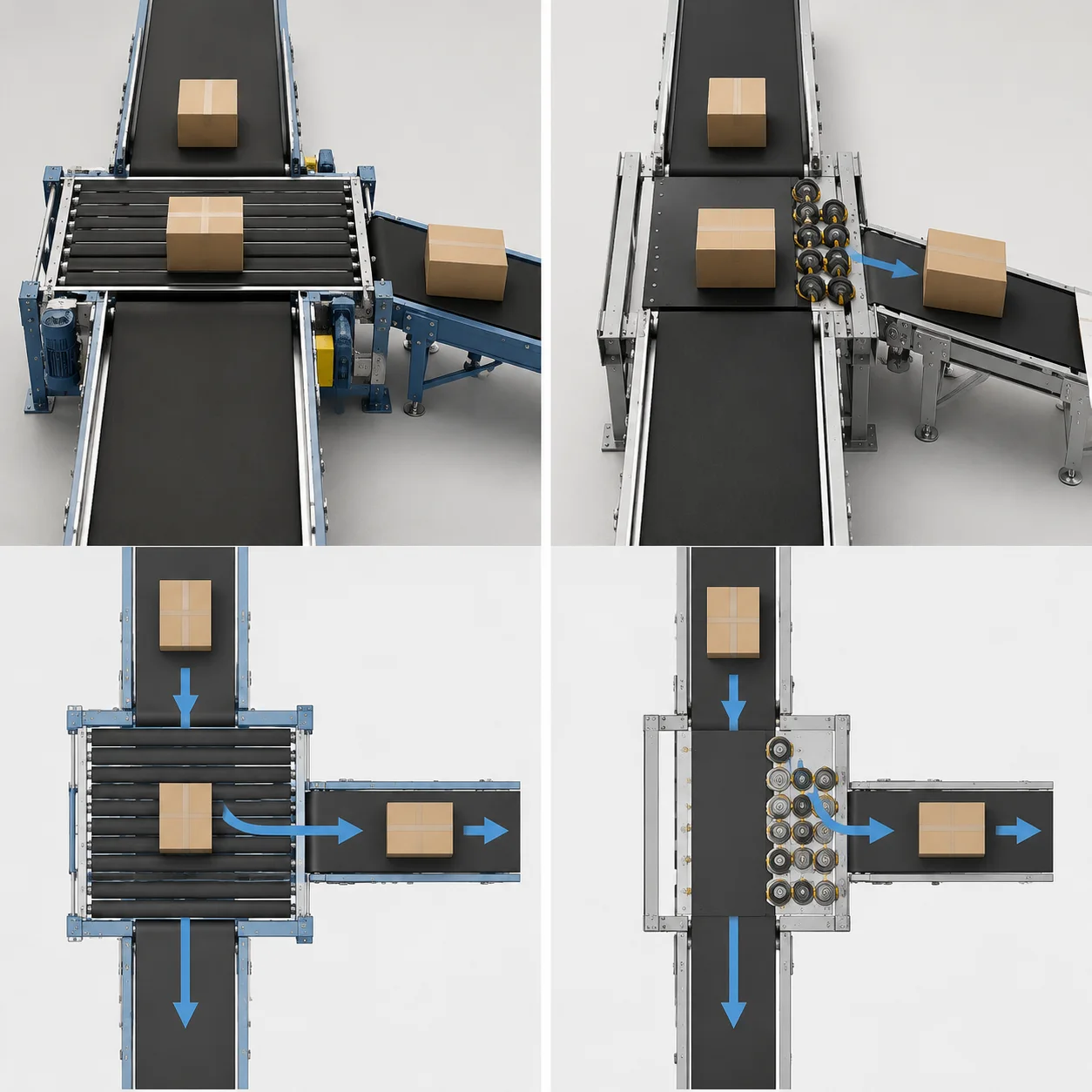
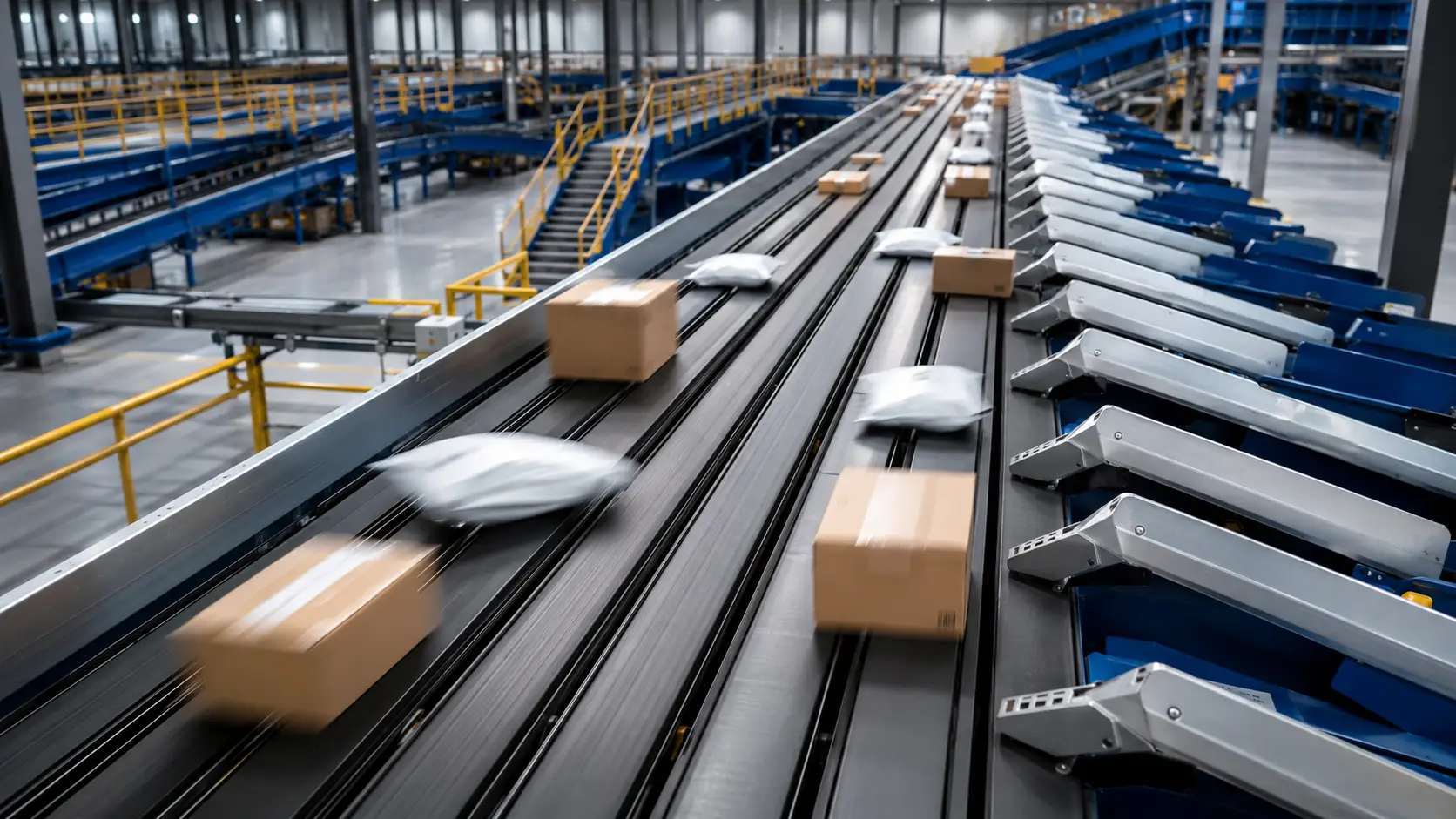
Narrow belt sorters (sometimes referred to as strip belt sorters) utilize multiple parallel narrow belts to transport items. Between these belts, popping divert mechanisms (such as small angled wheels or rollers) are installed. When a package reaches its target chute, the wheels pop up slightly, engage with the bottom of the package, and roll it off at a 30-degree or 45-degree angle.
- Standard Throughput: Generally ranges from 5,000 to 12,000 PPH depending on the divert angles and the average length of the parcels.
- Best Suited For: Linear warehouse layouts where space is restricted, and facilities that primarily process standard-sized cardboard cartons, rigid mailers, and plastic totes.
- Operational Advantage: Excellent cost-to-performance ratio. Because they run in a straight line, they are easier to fit alongside existing shipping docks and require less complex structural support than loop sorters.
For operations that require a compact linear configuration without compromising on speed, products such as the TrueliSort TR300-760 Narrow Belt Sorter provide an efficient, space-saving footprint with a 760mm chute width, optimized for medium-to-high throughput demands.
Option C: Swivel Wheel / Pop-up Wheel Sorters (Cost-Effective & Flexible)
Pop-up swivel wheel sorters are modular divert stations embedded directly within a standard roller or belt conveyor line. When a package needs to be diverted, rows of multidirectional wheels pivot to the target angle (typically 30, 45, or 90 degrees) and lift slightly to redirect the parcel onto a take-away conveyor.
- Standard Throughput: Typically runs at 2,000 to 6,000 PPH.
- Best Suited For: Step-one automation projects, small-to-medium 3PL operations, and decentralized last-mile distribution centers sorting heavier packages or rigid plastic totes.
- Operational Advantage: Highly modular and easy to relocate. If your layout requirements change, swivel wheel modules can be moved or added to other parts of the conveyor system with minimal structural reworking.
Pre-Purchase Data Checklist for B2B Operations Managers
Before engaging with an automated sorting system manufacturer like TrueliSort, your engineering team should compile the following operational data. Having these parameters ready accelerates the layout design phase and ensures a highly accurate system quote.
📋 Sorting Automation Engineering Checklist
- Sustained Peak Hourly Volume (PPH): The maximum volume the system must process during your busiest hour of the year, not the average daily volume.
- Physical Parcel Dimensions (Min/Max): Length, Width, and Height for all package types. (e.g., Min: 100x100x10mm; Max: 600x400x400mm).
- Weight Profile (Min/Max): The minimum and maximum weight of a single parcel (e.g., 50g to 35kg).
- Packaging Materials Mix: Precise percentages of corrugated cartons, bubble mailers, plastic polybags, and irregular shapes (irregular tubes, custom boxes).
- Number of Target Destinations (Chutes): The total number of sorting outputs required (e.g., sorted by carrier, ZIP code, route, or batch zone), plus at least one dedicated reject/no-read chute.
- Warehouse CAD Layout: A 2D or 3D DWG drawing of your facility showing support columns, ceiling heights, electrical panels, and existing racking systems.
- Data Interface Protocol: Your existing WMS/WCS system specs and preferred communication protocol (Web API, TCP/IP, or Database integration).
Key Supplier Evaluation Criteria for B2B Procurement
Investing in a parcel sorting system is a long-term capital commitment. The hardware itself is only one part of the equation; system integration, software coordination, and lifecycle technical support are what determine the project’s overall return on investment.
1. Factory-Direct Design and Custom Engineering Capabilities
Standard “off-the-shelf” sorters rarely fit perfectly into existing e-commerce centers. Every facility has unique architectural constraints, such as column spacing, low hanging mezzanines, or specific directional flow requirements. Partnering with a manufacturer that provides factory-direct custom design ensures that the sorting system is engineered to fit your physical space, optimizing every square meter of floor layout.
2. Testing and Validation Protocols (FAT & SAT)
A reliable supplier must have rigorous testing procedures before shipment and during commissioning. Ensure your supplier agreement includes:
- Factory Acceptance Testing (FAT): Assembling and running the sorter at the manufacturer’s facility using actual customer-provided test packages to verify physical mechanical integrity and basic sensor tracking.
- Site Acceptance Testing (SAT): Full system commissioning on-site, including complete software integration tests, continuous throughput stress testing, and error-recovery validation.
3. Lifecycle Technical Support and Spare Parts Availability
In e-commerce, every hour of sorting system downtime can result in thousands of dollars in lost revenue and missed shipping deadlines. Ask your prospective supplier about their after-sales support structure:
- Do they provide 24/7 remote diagnostic support for PLC and software issues?
- What is the lead time for critical replacement parts (such as carrier motors, belt assemblies, and optical sensors)?
- Do they offer preventive maintenance training for your local facility maintenance crew?
At TrueliSort, we specialize in factory-direct sorting system design, manufacturing, installation, and commissioning support, helping B2B clients globally navigate the transition from manual operations to robust automation.
Frequently Asked Questions
Q1: How do you calculate the actual throughput (PPH) needed for an e-commerce fulfillment center?
Actual throughput should be calculated based on your peak season daily volume divided by operational hours, adding a 20-30% buffer for peak surges. Do not design for average daily volume. If your peak day requires 80,000 parcels sorted in an 8-hour shift, your system must sustain a minimum of 10,000 parcels per hour (PPH), taking into account standard recirculation rates and induction efficiency.
Q2: Can a narrow belt sorter handle polybags and bubble mailers effectively?
Yes, but with limitations. While narrow belt sorters are highly efficient for rigid cartons, thin polybags, loose plastic wraps, and very light bubble mailers can sometimes get caught in the transitions or fail to divert cleanly if the friction coefficient is too low. For facilities processing more than 40% polybags, a cross belt sorter is generally recommended due to its positive, mechanical discharge mechanism.
Q3: What is the typical integration process between a parcel sorting system’s WCS and an existing warehouse WMS?
Integration is accomplished via API or TCP/IP socket communications. When a parcel passes the DWS (Dimension, Weight, Scan) station, the WCS captures the barcode and queries the WMS for the routing destination. The WMS returns a logical destination ID within milliseconds, which the WCS maps to a physical chute ID. The PLC then tracks the carrier and triggers the divert mechanism at the precise destination.
Q4: How does parcel singulation impact overall sorting system efficiency?
Singulation is critical because sorting systems require a minimum physical gap (pitch) between items to scan and divert them accurately. If parcels are fed side-by-side or double-stacked, the scanner will register a “no-read” or multi-packet error, leading to recirculation or manual reject handling. Automated singulators organize the chaotic flow of packages into a single, metered stream, maximizing the actual throughput of the sorter.
Plan Your Parcel Sorting Automation Project
Are you looking to eliminate manual bottlenecks and scale your e-commerce sorting throughput? Share your daily package volumes, peak hourly requirements, and warehouse CAD layouts with us.
The TrueliSort engineering team provides custom-tailored layout designs and factory-direct automated sorting solutions designed for real operations.
Contact TrueliSort to request a custom sorting system design or email our engineering department directly at business@truelisort.com.