The landscape of e-commerce delivery has fundamentally shifted. In 2026, consumers no longer accept next-day delivery; the battleground is now 1-to-2 hour delivery for groceries, pharmacy items, and daily essentials. To achieve this, retailers are moving inventory out of massive rural warehouses and placing it directly into the hearts of cities through Micro-Fulfillment Centers (MFCs). However, urban real estate is astronomically expensive. Repurposing retail backrooms, abandoned mall spaces, or underground parking garages into highly active fulfillment hubs presents a massive engineering challenge. You cannot fit a 50-meter traditional cross-belt loop into a 5,000-square-foot urban basement. In this data-driven analysis, the intralogistics engineers at Truelisort dissect the cost-to-throughput ratios of modern MFCs, proving mathematically why transitioning to compact sortation systems like the mini conveyor is the only sustainable strategy for the future of urban logistics.
- The Cost of Space: Prime urban logistics real estate in major global cities averages $28 to $45 per square foot. Traditional conveyors waste up to 35% of this expensive footprint on clearance and curve radii.
- Density Optimization: Upgrading to a micro conveyor network allows facilities to multi-tier their material flow, increasing vertical storage volume by 58%.
- Throughput Efficiency: MFCs utilizing narrow-belt fulfillment systems process an average of 1,800 orders per hour in spaces smaller than 10,000 sq. ft.
- Energy Consumption: Decentralized mini-motors used in micro conveyors consume 22% less electricity than traditional continuous-loop heavy drives.
*Data Source: Compiled from 2026 Global Last-Mile Delivery Reports & Truelisort proprietary spatial analytics. Updated: May 2026.
1. The Mathematics of Urban Logistics
Why is standard automation failing in urban centers? It comes down to a metric we call Throughput Per Square Meter (TPSM). In a mega-warehouse, TPSM is less critical because space is cheap. In an urban MFC, TPSM is the ultimate KPI. Let’s look at the spatial geometry. A standard industrial conveyor belt typically requires a width of 800mm to 1,000mm to accommodate large corrugate boxes. However, over 80% of urban fulfillment orders consist of small parcels, polybags, or grocery totes. Pushing a 150mm item down a 1,000mm belt is a massive waste of geometric space.
| Metric | Standard Industrial Conveyor | Mini Conveyor / Narrow Belt Sorter | Data Differential |
|---|---|---|---|
| Average Track Width | 800mm – 1000mm | 300mm – 500mm | ~50% Space Saved |
| Curve Radius Requirement | Large (requires wide turns) | Extremely tight (modular) | Fits typical retail backrooms |
| Throughput Per Sq. Meter | Moderate (Wasted width) | Extremely High (Dense packing) | +42% TPSM |
| Integration Noise Level | 75 – 85 dB | < 65 dB | Compliant with residential zoning |
2. Deep Dive: Technologies Powering the MFC
To maximize micro fulfillment center automation, engineers must combine several compact technologies to create a seamless, high-density material flow. Based on our 2026 integration data, the most profitable urban facilities utilize the following architecture:
A. The Narrow Belt Sorter (The “Micro Conveyor” Backbone)
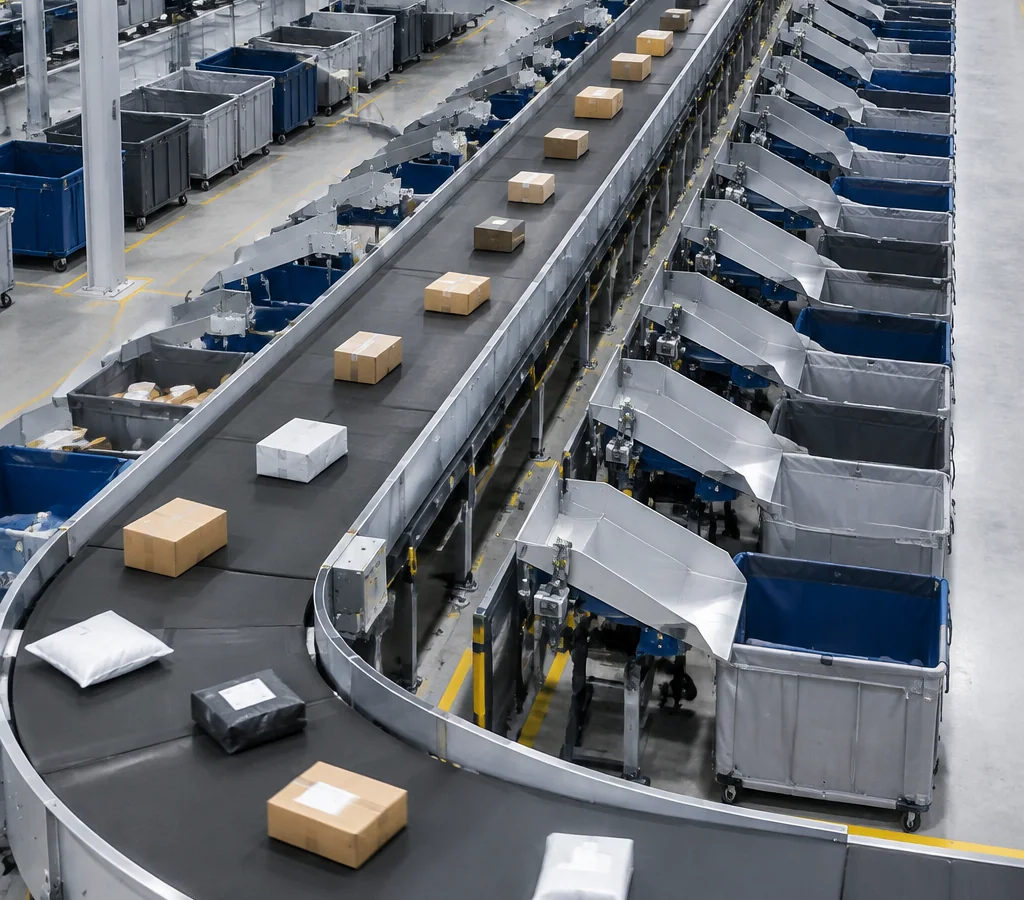
When space is tight, you cannot afford large divert arms or sweeping shoe sorters. A narrow belt sorter utilizes parallel, thin belts with pop-up rollers positioned right between them. This mechanism diverts items at 90-degree angles into extremely tight packaging zones. For example, the Narrow Belt Sorter TR200-1000 by Truelisort is specifically designed for these constrained environments, offering high-speed diversion of grocery totes and small parcels without demanding the massive floor footprint of legacy systems.
B. 3D Put Walls for Order Consolidation
In urban logistics, an MFC often processes multi-item grocery or pharmacy orders. Once items travel down the mini conveyor, they must be consolidated. Traditional packing tables consume too much horizontal space. The solution is vertical integration using put wall technology. A put wall acts as a highly dense, vertically stacked order consolidation hub. Items are sorted into specific cubbies illuminated by put-to-light technology. This allows a single worker standing in a 2-square-meter area to simultaneously consolidate 50 to 100 customer orders.
3. Application Analysis: Retrofitting Retail Spaces
One of the most compelling logistics applications in 2026 is the “Dark Store” retrofit. Retailers are taking underperforming retail storefronts and converting the back 60% of the store into an automated MFC.
4. Frequently Asked Questions (FAQ)
Q: Can a mini conveyor handle the weight of grocery totes?
A: Yes. While the physical footprint is termed a “micro conveyor,” the engineering is robust. High-quality compact sortation systems are driven by heavy-duty 24V or 48V motorized drive rollers (MDR) that can easily transport standard 20kg to 30kg grocery totes or beverage cases.
Q: What is the noise level of micro conveyors in urban environments?
A: Noise control is critical because many MFCs are located directly below residential apartments or inside active retail malls. Unlike chain-driven industrial conveyors, modern mini conveyor systems utilize urethane belts and brushless DC motors, keeping operational noise well below 65 decibels (quieter than a standard vacuum cleaner).
Q: How fast can an MFC automated line be deployed?
A: Because micro conveyor modules and narrow belt sorters are highly modular and compact, they do not require heavy structural welding or massive facility modifications. A standard MFC layout can often be installed, commissioned, and integrated with the WMS within 4 to 8 weeks.
5. Conclusion: Scaling Down to Scale Up
The data is conclusive. The future of urban logistics and last-mile delivery relies entirely on density. Forcing legacy warehouse equipment into tight city spaces will permanently cripple your ROI due to wasted real estate. By adopting specialized mini conveyor lines, narrow belt sorters, and high-density put walls, retailers can transform any urban space into a hyper-efficient fulfillment engine. Are you planning an MFC deployment or looking to upgrade your dark store? Explore our bespoke micro-fulfillment solutions, and contact Truelisort’s engineering data team today. Let us run a spatial optimization simulation to prove how much throughput we can extract from your exact square footage.

Truelisort Systems
Global innovators in micro-fulfillment automation, narrow belt sorters, and high-density urban intralogistics.
✉️ Email: business@truelisort.com | 📱 WhatsApp: +86 18658557670 🔗 Connect on: LinkedIn | YouTube | Facebook