
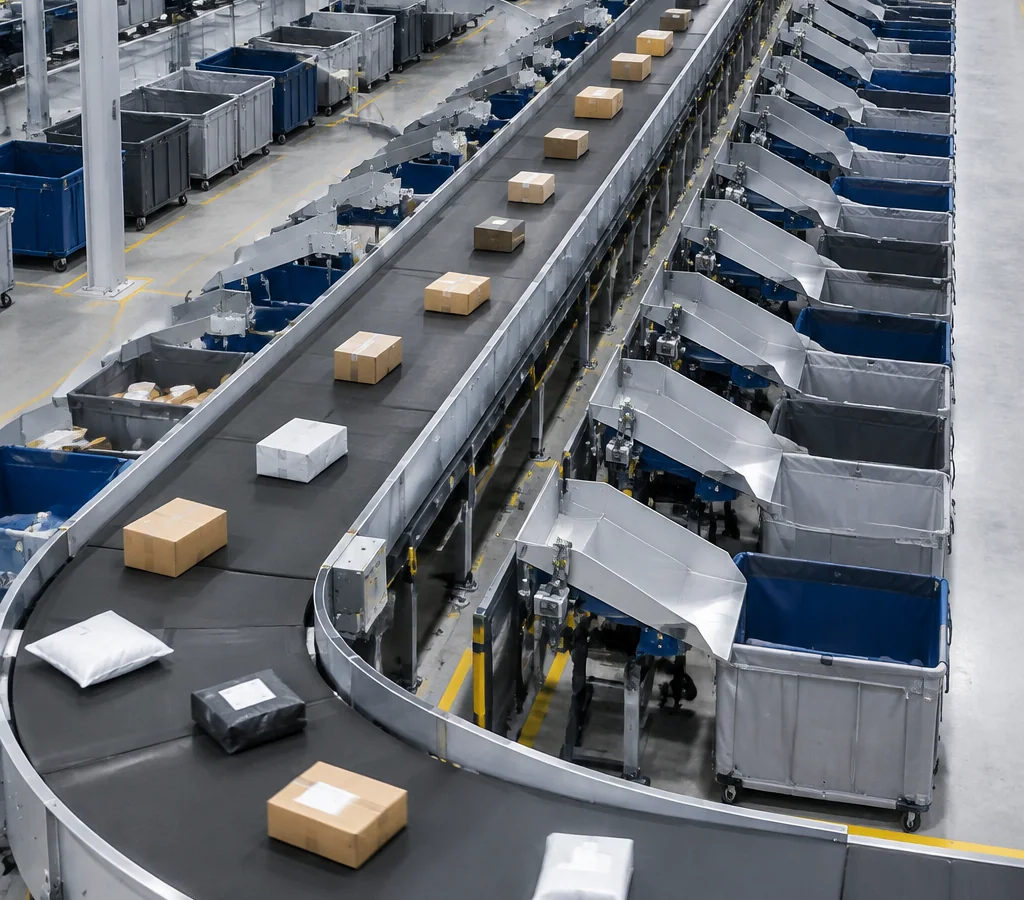
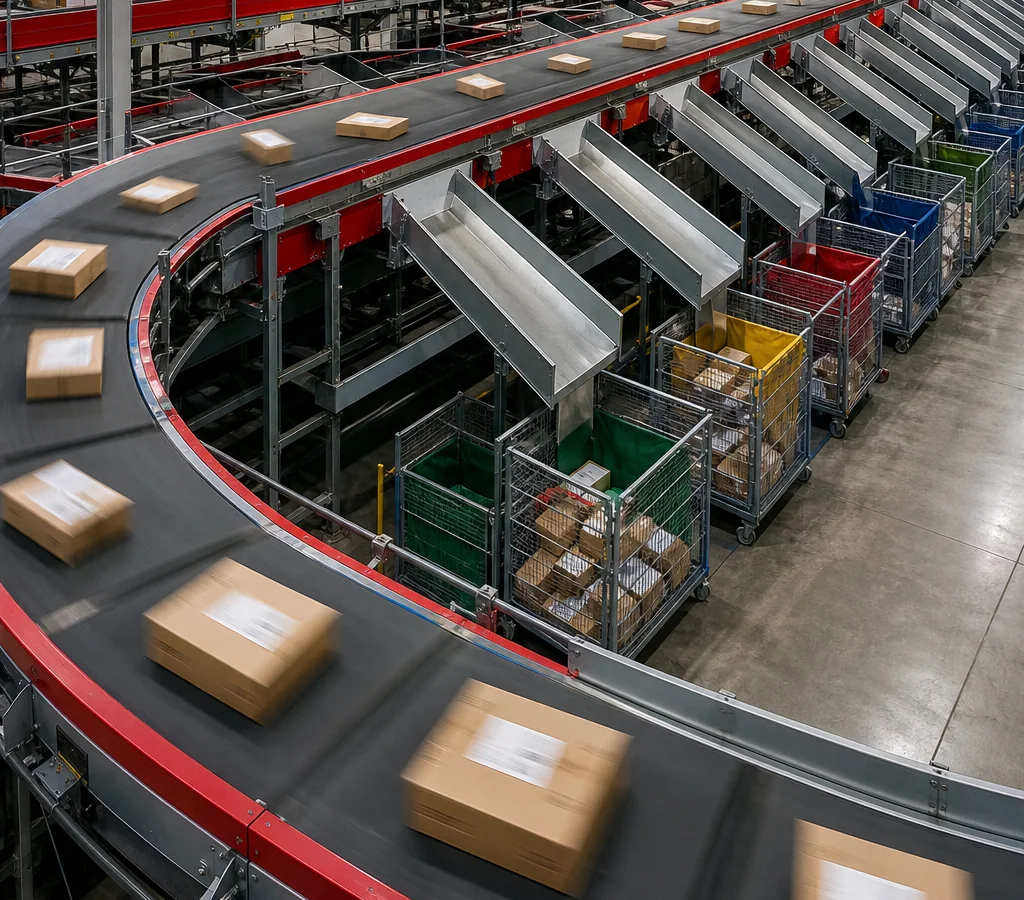
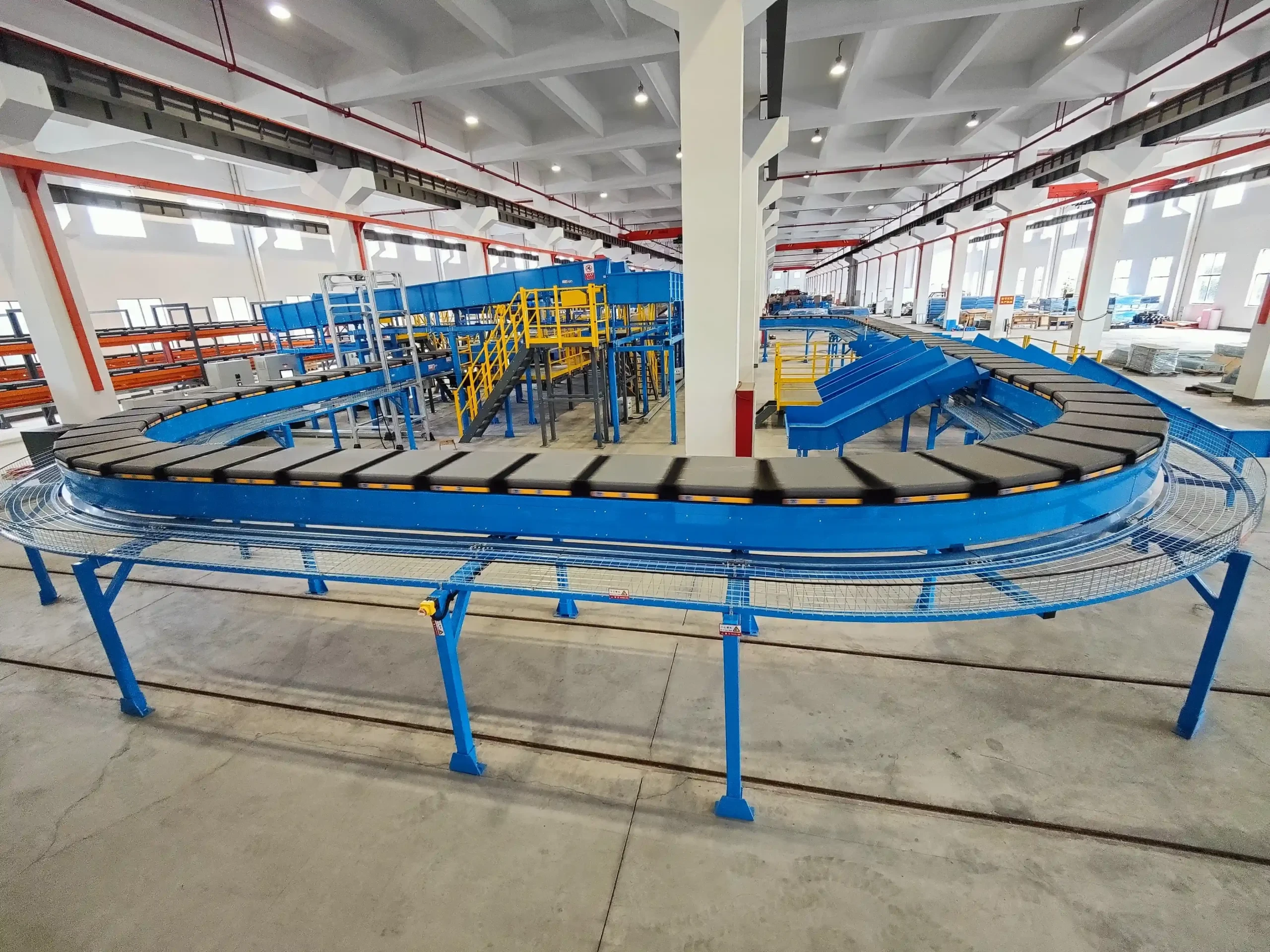
Warehouse automation systems in 2026 are best understood as a three-layer architecture rather than a single-product purchase: an AI and software layer that determines subsequent operations; a robotics layer that transports inventory and totes between process stages; and an automated sorting and conveyance layer that physically sorts packages based on orders, routes, or shipping destinations. AI, robotics, and automated sorting systems do not compete with one another; instead, each addresses a different set of bottlenecks. Investment decisions for specific facilities depend on a variety of factors: order characteristics; required throughput; the mix of package sizes and weights; the number of sorting destinations; available floor space and ceiling height; labor availability and costs; the ratio of peak to average business volume; and the condition of existing conveyance and software systems.
What “warehouse automation” covers in 2026
The term is used loosely, so it is worth separating the layers by the problem each one addresses.
- Decision layer (AI, WES/WCS, analytics): order release, wave and batch planning, slotting, sortation logic, carrier cut-off routing, vision-based identification, and predictive maintenance. It changes what happens and when, not the physical capacity of the building.
- Transport layer (robotics, conveyors, AS/RS): moving totes, pallets and parcels between storage, picking, consolidation and dispatch. It reduces travel, walking and manual handling.
- Sortation and handling layer (sorters, singulators, DWS, chutes, put walls): converting a mixed stream of parcels into organised outbound streams. It determines how fast and how accurately volume can be pushed through dispatch.
Most 2026 automation projects combine at least two of these layers. A sorter without a reliable induction and singulation process will not reach its rated throughput; a robotics fleet without a well-designed sortation and consolidation flow simply relocates the bottleneck.
What AI actually solves — and what it does not
In warehouse operations, AI is mainly a decision-quality and timing tool. Practical applications include demand and volume forecasting, wave and batch optimisation, dynamic order prioritisation, slotting recommendations, barcode and label reading under difficult conditions, damage or anomaly detection on conveyor lines, and condition monitoring on motors, bearings and sortation modules.
The limits are consistent across deployments:
- AI output is only as good as the data feeding it. Barcode read rates, event timestamps, master data accuracy and scan coverage set the ceiling.
- AI can rebalance work within existing physical capacity, but it cannot create throughput that the equipment does not have.
- Models need to be maintained as order mix, packaging and carrier requirements change. A one-time deployment is rarely a finished project.
For that reason, treating AI as the first purchase in a new facility is usually less effective than fixing the physical flow first and layering intelligence on top of measurable, well-instrumented processes.
What robotics solves in a fulfilment or distribution centre
Warehouse robotics applications typically focus on material transport (involving long-distance travel) and repetitive tasks, rather than the sorting process itself.
Common applications include Autonomous Mobile Robots (AMRs) for transporting shelving units or totes, “goods-to-person” picking stations, robotic palletizing and depalletizing, automated trailer or container unloading, and robotic piece picking in controlled environments.
Robotics are often highly suitable for picking operations that involve long travel distances, relatively stable SKU (Stock Keeping Unit) profiles with uniform specifications, and repetitive tasks where maintaining a stable workforce is challenging. Conversely, the suitability of robotics diminishes if items vary widely in shape, goods lack labeling, there is a vast number of SKUs with low picking frequency, or the warehouse lacks sufficient floor space for robot aisles and charging zones.
The interface between robotic systems and sorting systems is critical—a factor often underestimated in planning documents. If robots deliver totes to a “put wall” or staging buffer faster than the downstream sorting system can process them, a queue of robots will inevitably form.
What automated sorting solves — and which technology fits
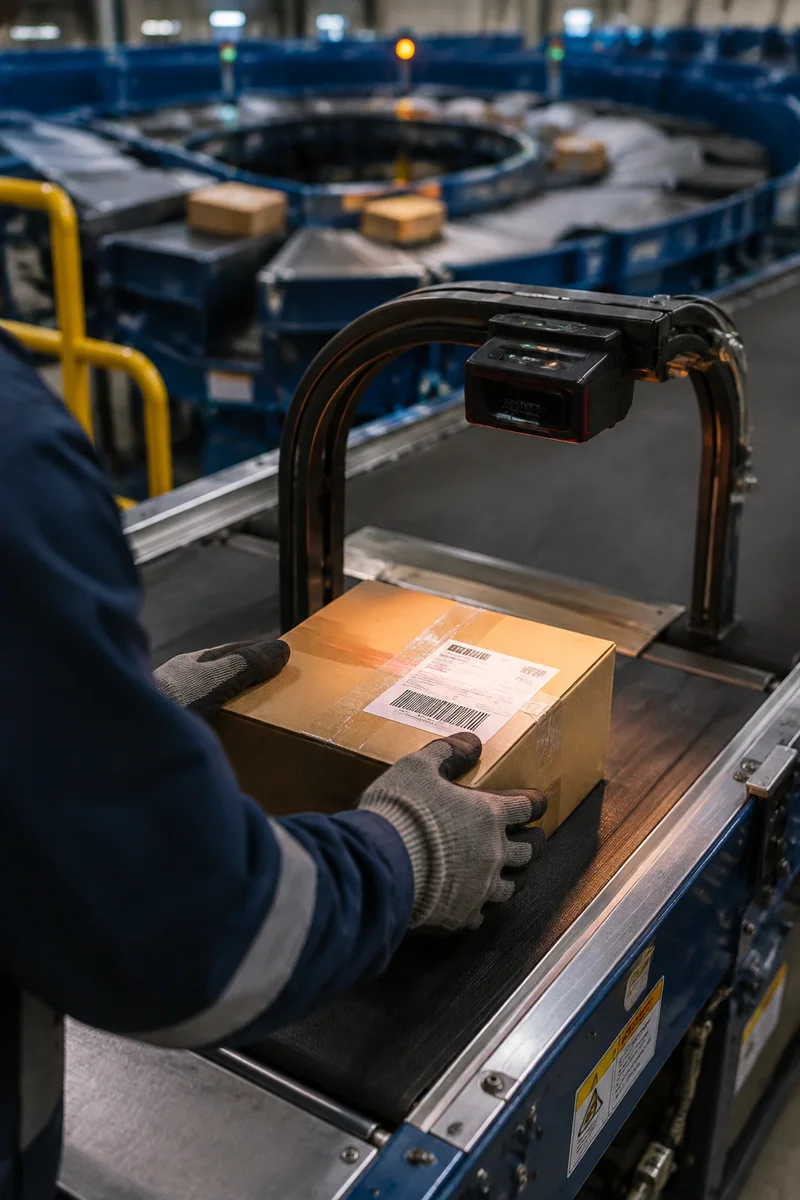
Automated sorting addresses the point where manual scanning, carrying and loading of parcels into outbound routes becomes the limiting factor. It is usually the layer with the clearest direct link to dispatch speed, sorting accuracy and headcount per parcel.
Several sorting principles are in common use, and they differ in parcel mix, destination count, footprint and maintenance profile rather than in overall “quality”:
- Cross belt sorters use individually controlled belts on each carrier to discharge items sideways at the target chute. They handle a wide range of item shapes and support high destination counts. See cross belt sorter systems for the technology overview.
- Narrow belt sorters use narrower belt surfaces to sort smaller, lighter parcels and flat items, often with a smaller footprint than full cross belt solutions.
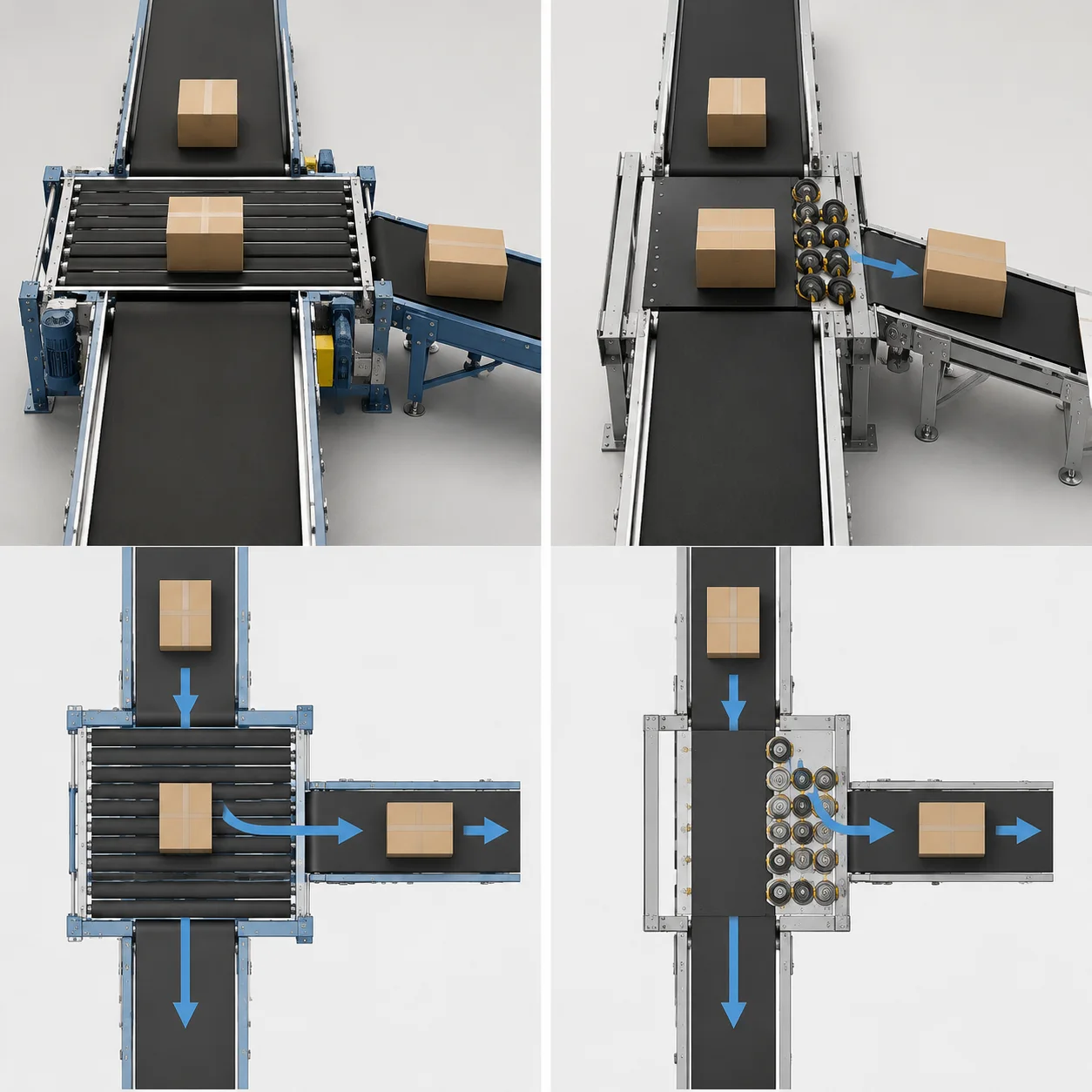
- Swivel wheel and pop-up wheel sorters divert parcels using rotating wheel modules. They are commonly used where parcels are relatively uniform and the destination count is moderate.
- Put wall and consolidation systems group sorted items into orders or batches rather than routes, and are frequently used in e-commerce order fulfilment.
Upstream of the sorter, parcel singulation and DWS (dimension, weight, scanning) equipment determine whether the sorter receives a clean, evenly spaced item stream. Downstream, chute and destination planning determines how easily sorted volume can be packed and loaded.
How the three layers work together in one flow
A typical 2026 automated outbound flow looks like this:
- Inbound and induction: parcels are unloaded, singulated and scanned; dimensions and weight are captured by DWS where required.
- Decision: the software layer assigns each item to a destination, order, batch or route, and sequences the release of work.
- Storage and transport: conveyors, AMRs or automated storage move items or totes to picking and consolidation points.
- Sorting: the sorter distributes items into chutes, bags or roll cages according to the routing plan.
- Consolidation and dispatch: packed volume is staged, labelled and loaded against carrier cut-off times.
- Feedback: scan events, exceptions and equipment signals feed back into planning and maintenance.
Each handover point is a potential constraint. In practice, throughput problems in 2026 installations are more often caused by mismatched handovers — induction, buffering, chute capacity — than by the sorter’s nominal speed.
How to judge which automation your warehouse needs
Start with the bottleneck, not with the technology. The table below maps common symptoms to the layer that usually addresses them.
| Main symptom | Layer to examine first | Typical directions |
|---|---|---|
| Long picking travel, low pick rate per hour | Robotics and software | AMR or goods-to-person, slotting and batch optimisation |
| Manual scanning and carrying at dispatch | Sortation and handling | Cross belt, narrow belt, swivel wheel or pop-up wheel sorters |
| Order consolidation and packing errors | Sortation and handling | Put wall, order consolidation buffers for e-commerce fulfilment |
| Sorter never reaches expected throughput | Upstream flow | Singulation, DWS, induction conveyor upgrades |
| Peak-season collapse despite adequate averages | Capacity planning and software | Peak-based sizing, surge buffers, flexible shift planning |
| Decisions lag behind actual conditions | Software | WES/WCS, real-time dashboards, exception handling |
Five inputs determine the answer more than any other factor: parcel size and weight distribution, packaging type and diversity, required throughput at peak rather than average, number of sorting destinations, and the physical constraints of the building (floor area, clear height, column grid, power and fire provisions). Labour cost and availability, existing conveyor layout and planned growth are the next tier.
A staged approach that usually de-risks the investment
- Measure before deciding. Collect at least several weeks of parcel profile data — dimensions, weights, packaging types, destination counts and peak curves. Automation decisions made on assumptions rather than measurements are the most common source of over- or under-sized systems.
- Design the sortation flow before selecting equipment. Chute counts, buffer sizes and induction points usually constrain the design more than the sorter model itself.
- Fix the physical bottleneck first. If induction or singulation is unstable, additional sorter capacity will not translate into dispatch speed.
- Add the software layer against defined use cases. Prioritise order batching, sortation logic and exception handling over broad analytics programmes.
- Plan modular expansion. Where growth is uncertain, a modular layout that allows added sortation modules, chutes or induction lanes avoids a full rebuild later.
For operators working inside an existing distribution centre rather than a new build, a warehouse and distribution centre automation review is often the practical starting point — see this outline of a warehouse automation and distribution centre solution.
Cost factors and ROI: what actually drives the investment
There is no standard price for warehouse automation, and any figure quoted without a parcel profile and layout is unreliable. The main cost drivers are:
- System length, number of carriers or modules, and number of destinations or chutes
- Throughput requirement at peak, which usually sizes motors, drives and controls
- Building works — flooring, mezzanines, clear height, power supply, fire and safety provisions
- Conveyor and induction scope, plus singulation and DWS equipment
- Software integration with WMS, WCS and ERP, including interface development and testing
- Installation, commissioning, operator training and ramp-up support
- Ongoing maintenance, spare parts strategy and service agreement scope
On the return side, the benefits that can normally be quantified before a project starts are labour hours removed from repetitive handling, sorting accuracy improvement, space released by replacing manual staging areas, and additional peak capacity. Benefits such as improved customer experience or reduced returns are real but harder to attribute, so they are usually excluded from the core business case.
Integration and data requirements
Automation projects typically involve a WMS, a WCS or PLC control layer, ERP for order and financial data, barcode or camera scanning, and weighing and dimensioning equipment. Two practical points come up repeatedly:
- Define who owns each interface. Sorting equipment suppliers, WMS vendors and integrators often each assume another party is responsible for a data handover.
- Test with real parcel data, not only test fixtures. Label quality, reflective packaging and irregular shapes are the conditions that break scan and sortation logic in production.
For facilities in 3PL operations, the integration layer also has to handle multiple client master data sets and changing routing rules — see this overview of 3PL sorting operations.
Common mistakes that reduce project returns
- Sizing the system on average rather than peak volume.
- Selecting equipment before completing a parcel profile and layout study.
- Underestimating induction, singulation and buffering, which then cap sorter performance.
- Treating AI as a substitute for a stable physical process.
- Planning destinations and chutes for today’s routing only, with no room for expansion.
- Leaving maintenance access, spare parts and service responsibility vague until after commissioning.
How TrueLiSort supports warehouse automation projects
TrueLiSort is a B2B manufacturer and system solution provider focused on automated parcel sorting systems, logistics automation equipment and customised sorting solutions. The company manufactures core sorting equipment in-house and combines that with sorting system engineering and integration, supplying either individual modules or complete systems.
Project scope is defined around the customer’s actual operation rather than a fixed catalogue configuration: parcel size and weight, packaging diversity, required throughput, number of sorting destinations, available warehouse space, building structure, existing conveyor layout, peak-season capacity, future expansion, and WMS, WCS, ERP and scanning integration. Product families include cross belt sorters, narrow belt sorters, swivel wheel sorters, pop-up wheel sorters, put wall systems, parcel singulators, belt and roller conveyors, DWS and scanning systems, and sorting chutes. A wider view of these capabilities is available under sorting system solutions.
Typical project workflow runs from requirement and parcel profile analysis, throughput evaluation and site layout analysis through system planning, equipment selection, sorting flow and chute design, layout drawings, manufacturing, factory assembly and testing, system integration, installation guidance, commissioning, tuning, operator training, and long-term spare parts and after-sales support. This makes TrueLiSort a suitable partner for new sorting facilities, expansion projects, replacement of manual sorting, automation upgrades and retrofit projects in existing warehouses and logistics hubs.
Frequently asked questions
Which warehouse automation technology should a mid-sized operation invest in first in 2026?
There is no single answer. If dispatch scanning and manual parcel handling are the constraint, automated sorting usually delivers the clearest measurable return. If picking travel and labour availability are the constraint, robotics or goods-to-person is often the right starting point. If decisions, batching and carrier routing are the constraint, the software layer comes first. The determining factor is which step currently limits throughput, which is established through parcel profile and process data rather than by technology preference.
Does AI replace the need for automated sorting equipment?
No. AI improves planning, prioritisation, identification and maintenance timing, but the physical separation of parcels into destinations still requires handling and sortation equipment. AI is most valuable when the physical process is already stable and instrumented.
How much does a warehouse automation project cost?
Cost depends on system length, number of destinations, peak throughput, building works, conveyor and induction scope, software integration, installation and service scope. Reliable figures require a parcel profile, a throughput target and a layout study; quotes issued without these inputs are usually not comparable between suppliers.
How long does implementation take?
Timelines vary with scale, building readiness, the number of interfaces to existing systems and whether the project is a new installation or a retrofit into a live operation. Retrofit projects into operating warehouses typically require additional phasing and cutover planning, which affects the schedule more than equipment manufacturing time.
Can existing sorting systems be upgraded rather than replaced?
Often yes. Common upgrade paths include adding sortation modules or chutes, increasing induction capacity, replacing control and scanning components, and re-engineering the upstream singulation and DWS flow. Whether an upgrade is more economical than a replacement depends on the condition of the existing structure, drives and controls, and on whether the current layout can support the target throughput.
Key takeaways
- AI, robotics and automated sorting solve different problems and are normally combined rather than compared.
- Automation decisions should start from the measured bottleneck and peak volume, not from average figures or technology trends.
- Induction, singulation, buffering and chute capacity frequently limit real throughput more than the sorter itself.
- Cost is driven by destinations, peak throughput, building works, integration scope and service requirements — not by a standard list price.
- Modular, phased investment with clear interface ownership between sorter supplier, WMS vendor and integrator is the most common way to keep project risk manageable.