
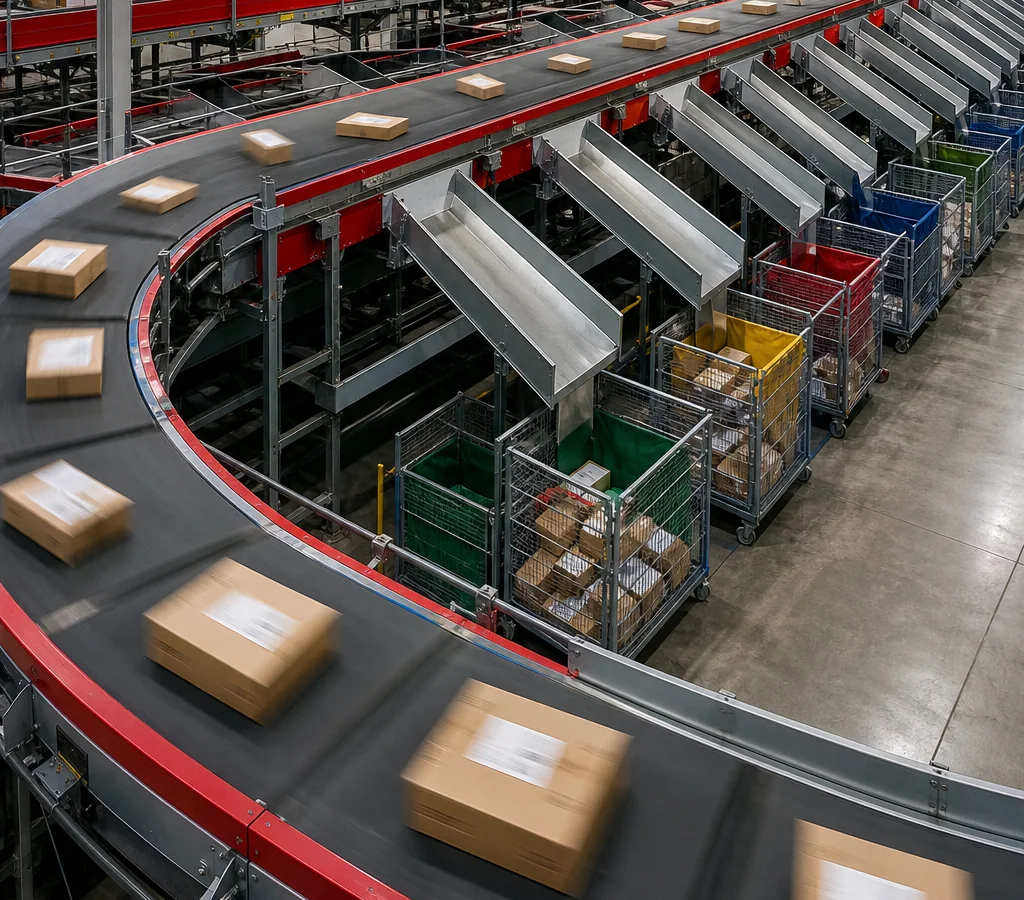
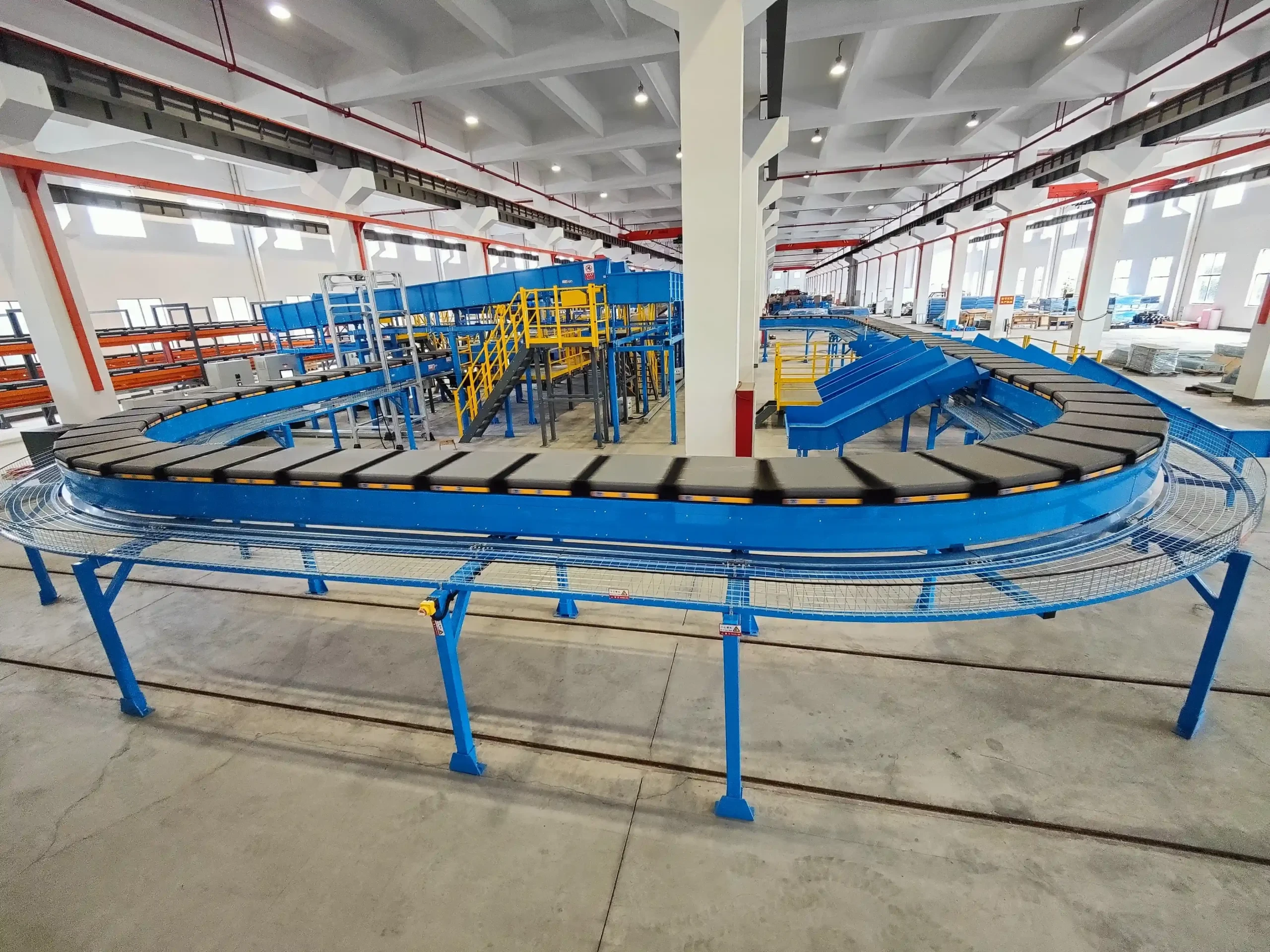
Warehouse automation improves modern fulfillment operations primarily by replacing manual sortation with a conveyor-based system that identifies, singulates and diverts each parcel to its destination automatically. In practice this means higher sustained throughput per shift, fewer mis-sorted parcels, less walking and lifting for operators, and better use of the floor space already available. The gains are largest where order or parcel volume is high, destination counts are growing, and manual sorting has become the bottleneck during peak periods.
Sorting is only one layer of warehouse automation, but in parcel, e-commerce and 3PL operations it is often the layer that determines how much of the rest of the investment can actually be used.
What a sorting system actually changes in a fulfillment operation
Manual sortation relies on people reading labels, deciding destinations and physically placing items into bags, cages or chutes. That process works, but it scales with headcount rather than with system capacity. An automated sorting system changes the operating model in four practical ways:
- Volume is decoupled from labor. Throughput is set mainly by conveyor speed, sorter capacity and induction rate rather than by how many sorters are on shift.
- Accuracy becomes a system function. Barcode scanning and software-driven diversion reduce the reading and placement errors that occur when people sort at speed.
- Flow becomes continuous. Parcels move through induction, scanning, sorting and chute discharge without being staged in batches.
- Space is used vertically and along a line. Sorting destinations can be distributed along the sorter loop or into put walls instead of occupying a large open floor area.
These changes affect labor planning, shift structure, and the number of destinations a facility can serve without expanding its footprint.
How an automated sorting line works
Most automated parcel sorting systems follow the same functional sequence, even when the equipment and configuration differ.
- Bulk unloading and feeding. Parcels are tipped or loaded onto a feed conveyor from bags, cages, carts or inbound vehicles.
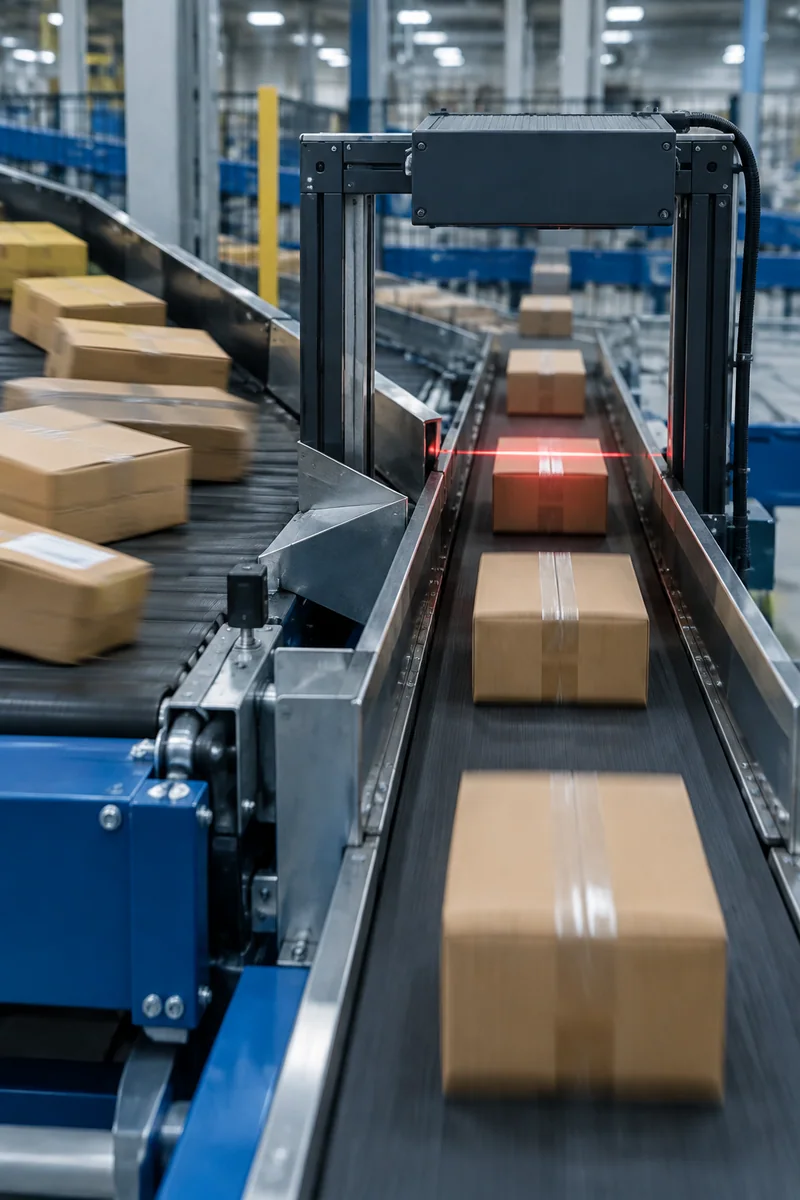
- Singulation. A parcel singulator separates a loose, overlapping stream into a single-file line with controlled gaps, which downstream scanning and diversion depend on.
- Identification. Barcode scanners — or a DWS system combining dimensioning, weighing and scanning — read each parcel’s label and pass the identity to the sorting control software.
- Induction. Parcels are transferred onto the sorter at a rate the system can maintain.
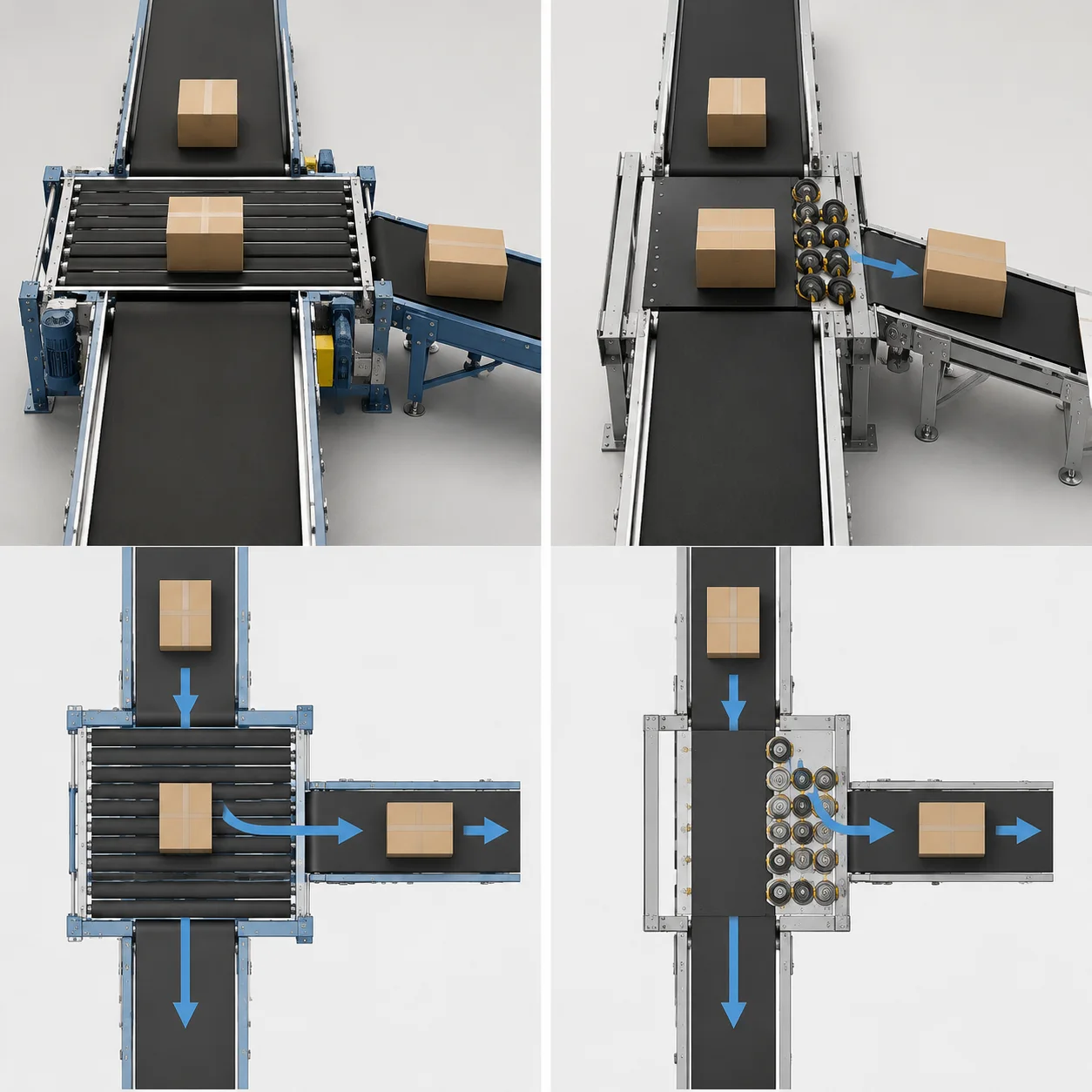
- Sorting and diversion. The sorter carries each parcel to its assigned destination and discharges it into a chute, container, bag or put wall position.
- Destination handling. Sorted output is consolidated, packed or dispatched, with exceptions routed to a specific exception lane.
Sorting accuracy depends on all six stages working together. A fast sorter will not compensate for unstable singulation or unreadable labels, which is why system design usually starts with the parcel profile rather than with the sorter itself.
Where sorting systems produce measurable improvements
Throughput and peak capacity
Automated sorters handle a continuous parcel stream, so capacity can be planned around a defined rate rather than around how many people can be recruited for a peak season. Peak scalability usually comes from running longer shifts, adding induction stations or adding sorter modules, depending on how the system was designed.
Sorting accuracy
Scan-based identification removes most label-reading errors, and controlled discharge removes most placement errors. Accuracy still depends on label quality, parcel presentation and how exception parcels are handled, so systems normally include an exception lane and a process for unreadable items.
Labor efficiency and working conditions
The labor that remains in an automated line tends to be concentrated at induction, exception handling, container exchange and quality control. This can reduce total headcount, and it also reduces repetitive manual handling — a factor that matters for injury rates, retention and shift flexibility.
Space utilization
Destinations can be arranged along a sorter loop, stacked in a two-level chute arrangement, or consolidated into a put wall. For facilities that are already short of floor space, this is often the deciding benefit rather than throughput alone.
Operating cost and predictability
Automation shifts cost from variable labor to fixed equipment, maintenance and energy. That makes operating cost more predictable per parcel, but it also means the investment has to be sized correctly — an oversized system carries the same fixed cost at low volume.
Sorting technologies and what they suit
Different sorter types handle different parcel mixes. The table below summarizes general fit; actual performance depends on the specific parcel profile, induced rate, destination count and system configuration.
| Technology | Typical fit | Strengths | Points to check |
|---|---|---|---|
| Cross belt sorter | Mixed parcel sizes and shapes, high destination counts | Each carrier diverts independently, so a wide range of destinations can be served on one loop | Parcel stability on the carrier and induction quality |
| Narrow belt sorter | Regular, relatively flat parcels and cartons | Continuous diverting along the line suits steady, uniform flows | Minimum parcel size and gap control |
| Swivel wheel sorter | Small to medium flat parcels | Compact diverting segments and flexible layout options | Bottom surface and weight distribution of parcels |
| Put wall | Order consolidation and multi-item orders | Consolidates many destinations into a small footprint with operator guidance | Picking flow upstream and software integration |
Large facilities often combine more than one technology — for example a high-speed sorter for main parcel flow and a put wall for order consolidation. This is a system design decision, not a single-equipment decision, and it is typically made after analyzing the parcel profile and the required destination count.
Integration: where sorting sits in the software stack
A sorting system is only as useful as the data it receives. Typical integration points include:
- WMS / WCS for destination assignment, wave or batch logic, and flow control
- ERP where order or shipment data originates outside the warehouse system
- Barcode and camera scanning for parcel identification, including multi-side reading
- DWS systems where dimension, weight and scan data are needed for billing, cubing or carrier compliance
- Existing conveyors and third-party equipment where automation is being added to a live facility
Integration is frequently the part of a project that determines the timeline. Deciding early how destination data will be generated and how exceptions will be reported reduces rework during commissioning.
How to judge whether sorting automation fits your operation
The decision usually comes down to a small number of factors. None of them alone is decisive.
- Parcel profile. Size range, weight range, packaging type and how uniform the mix is. Highly variable, soft or irregular parcels need more attention at singulation and induction.
- Sustained throughput requirement. The rate that must be held for the busiest realistic hour, not the average day.
- Number of destinations. More destinations generally favor sorter technologies that can divert independently along a loop or line.
- Available space and building structure. Floor loading, ceiling height, column positions and the existing conveyor layout all constrain the design.
- Peak-to-average ratio. Operations with sharp seasonal peaks gain more from scalable capacity, but also carry more idle capacity in off-peak months.
- Labor availability and cost. Where recruiting and retaining sorters is difficult or expensive, the case for automation strengthens.
- Accuracy and compliance requirements. Carrier penalties, service-level commitments or traceability requirements can make accuracy the primary justification.
- Budget and expansion plan. A modular design that starts at current volume and can be extended later often fits better than a system sized for a distant future target.
A structured sorting solution evaluation normally combines these into a throughput and layout study before any equipment is selected.
Planning and implementation sequence
Sorting projects follow a reasonably consistent order, whether they are new builds, retrofits or capacity expansions.
- Requirement and parcel profile analysis — what is being sorted, in what mix, at what rate, to how many destinations.
- Site and layout analysis — available space, building constraints, existing equipment and inbound/outbound flow.
- System planning and sorting flow design — singulation, scanning, induction, sorter selection, chute and destination planning.
- Layout drawings and engineering — mechanical, electrical and control design, including software interfaces.
- Manufacturing, factory assembly and testing — equipment built and verified before shipment where the project allows it.
- Installation, commissioning and tuning — on-site or remote support, followed by rate and accuracy tuning under real parcel conditions.
- Operator training and handover — induction practice, exception handling, container exchange and basic fault response.
- After-sales support — spare parts, maintenance planning and later capacity expansion.
For projects that must run during ongoing operations, phasing and temporary manual backup are usually planned up front. Related operating contexts are described in more detail for e-commerce fulfillment and 3PL operations, where sorting is often the central constraint.
Cost and ROI: what drives the numbers
There is no standard price for warehouse automation sorting systems, because the equipment is only part of the scope. The main cost drivers are:
- Sorter type, size and number of destinations
- Length and complexity of conveyor and feed systems
- Singulation, scanning and DWS scope
- Degree of software integration with WMS, WCS or ERP
- Building preparation, steel, platforms and civil work
- Installation, commissioning and training scope
- Spare parts, service agreement and long-term support level
On the benefit side, the calculation usually combines reduced sorting labor, avoided peak-season overtime or temporary staffing, fewer mis-sorts and their downstream cost, and the value of capacity that can be added without a building expansion. Because these inputs vary widely by operation, an ROI estimate is only meaningful when it is built from the facility’s own volume, labor and error data.
Limitations and when sorting automation is not the first step
Automated sorting is not automatically the right answer. It tends to fit less well when:
- Volume is low or highly irregular, so fixed equipment cost cannot be absorbed
- The parcel mix is extremely inconsistent in size, weight or packaging
- Upstream processes — receiving, picking or packing — are the actual bottleneck
- Available space or building structure cannot accommodate conveyors and chutes
- The destination count is small enough that manual or semi-automated sorting remains efficient
In these cases, improving upstream flow, label quality or layout may deliver more benefit per unit of investment than adding a sorter. Where automation is justified, it is common to start with a modular configuration and extend it as volume grows.
How TrueLiSort fits into a warehouse automation project
TrueLiSort is a B2B manufacturer and system solution provider specializing in automated parcel sorting systems, logistics automation equipment and customized sorting solutions. Rather than supplying only individual machines, the company designs complete sorting systems around a customer’s actual operation — including parcel profile analysis, throughput evaluation, layout and sorting flow design, equipment selection, chute and destination planning, and system engineering.
Core equipment such as cross belt sorters, narrow belt sorters, swivel wheel and pop-up wheel sorters, put wall systems, parcel singulators and conveyor systems is manufactured and tested in-house, and can be integrated with WMS, WCS, ERP, barcode and camera scanning, DWS, weighing and dimensioning equipment, and third-party warehouse equipment. Projects are typically delivered as turnkey sorting systems, customized sorting lines, modular equipment supply or automation upgrades, with installation guidance, commissioning support, operator training, spare parts and long-term after-sales support.
Customers are mainly professional B2B operators — courier and express companies, postal operators, e-commerce fulfillment centers, 3PL providers, distribution centers, logistics hubs and system integrators — building new sorting facilities, expanding existing operations, replacing manual sorting or upgrading legacy equipment. More detail on equipment and project scope is available on the product pages, and specific project questions can be raised through contact or the FAQ.
FAQ
What is the main benefit of automated sorting in a fulfillment operation?
It decouples throughput from headcount. Once the system is running at its designed rate, additional volume is handled by the sorter rather than by additional manual sorters, and accuracy becomes a function of scanning and software rather than of human reading speed.
How accurate are automated parcel sorting systems?
Accuracy depends on label quality, singulation stability, scan coverage and how exceptions are handled. Systems generally include an exception lane for unreadable or unidentified parcels, and real accuracy figures should be verified against the specific configuration rather than assumed.
How much does a warehouse sorting system cost?
The exact cost depends on sorter type, size, number of destinations, conveyor scope, singulation and scanning equipment, software integration, building preparation and installation scope. Because these vary by project, quotations are normally built from a layout and throughput study rather than from a standard price list.
Can a sorting system be added to an existing warehouse?
Yes. Retrofits and expansions are common, but they require an assessment of available space, floor loading, column positions, existing conveyor layout and the ability to keep operations running during installation. Phased installation is often used to limit disruption.
What is the difference between a cross belt sorter and a narrow belt sorter?
A cross belt sorter uses individual carriers that can divert in different directions, which suits mixed parcel profiles and high destination counts. A narrow belt sorter diverts parcels along a continuous line and generally suits more regular, flat parcels and steadier flows.
How does a sorting system connect to a WMS or WCS?
The warehouse system provides destination data and flow logic, while the sorting control software handles induction, tracking and discharge. Integration scope is usually defined during system design so that destination assignment, exception reporting and data feedback are agreed before commissioning.