
In today’s fulfillment-driven economy, speed and accuracy are no longer competitive advantages—they’re baseline expectations. Whether it’s e-commerce, parcel logistics, apparel distribution, or third-party warehousing, operations are under relentless pressure to process higher volumes with tighter delivery windows and fewer errors. Traditional material handling systems, especially single-layer crossbelt sorters, have served the industry well for decades. But as order profiles grow more complex and peak volumes become the norm rather than the exception, many facilities are reaching the limits of what a single-layer system can deliver.
That’s where the dual-deck crossbelt sorter comes into play.
Moving from a single-layer to a double-layer (dual-deck) crossbelt sorting system isn’t just an incremental upgrade—it’s a structural shift in how throughput is achieved within the same footprint. By stacking two independent sorting levels vertically, facilities can effectively double their sorting capacity without doubling their floor space. But the real story goes deeper than simple multiplication. Dual-deck systems introduce new efficiencies in routing logic, labor utilization, energy use, and operational flexibility.
This article explores how dual-deck crossbelt sorters work, why they can dramatically increase throughput, and what operational factors determine whether the upgrade makes sense.
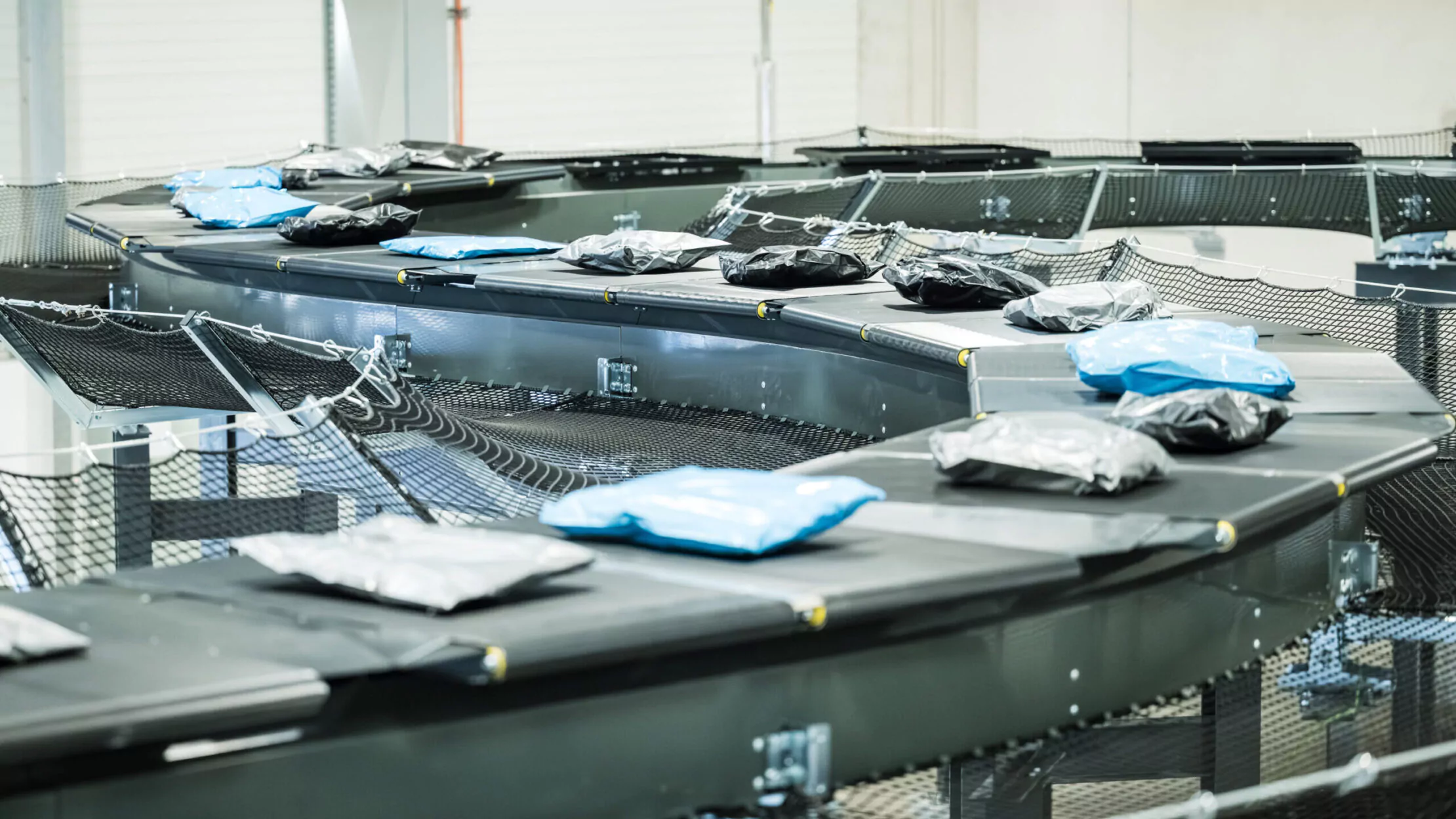
Understanding the Basics: What Is a Crossbelt Sorter?
Before diving into dual-deck configurations, it’s important to understand the core concept of a crossbelt sorter.
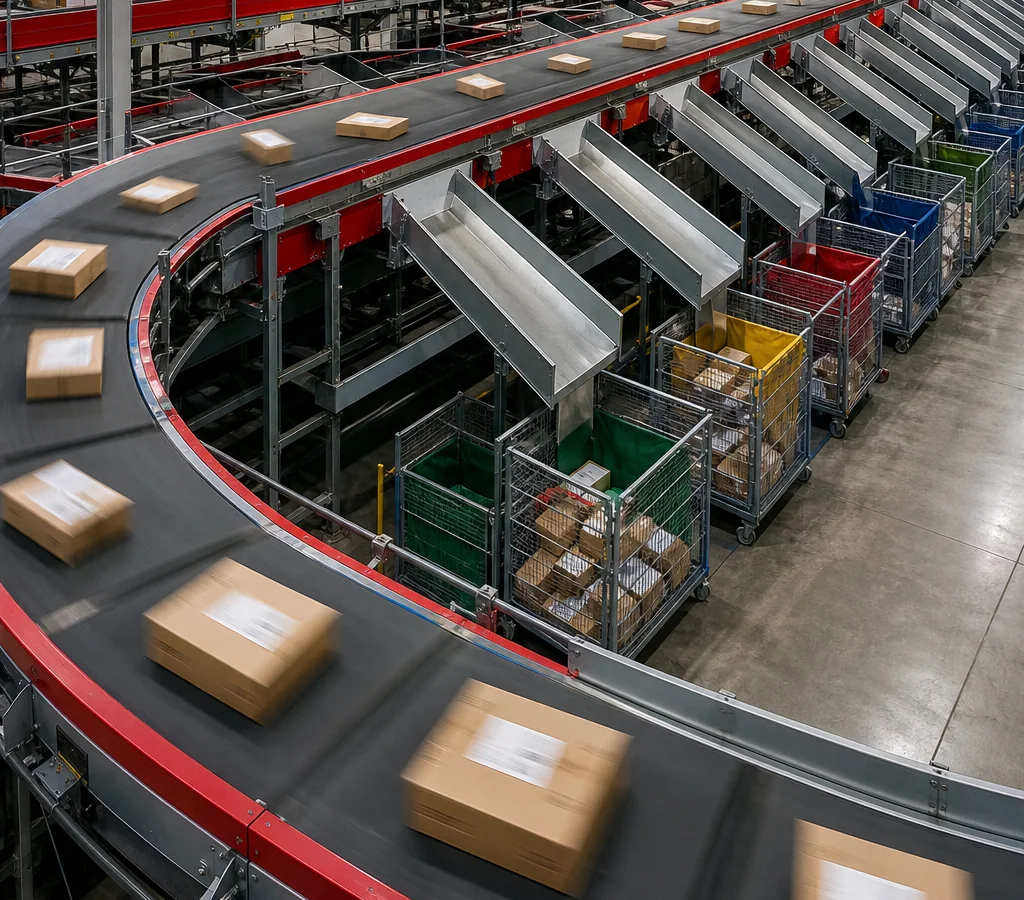
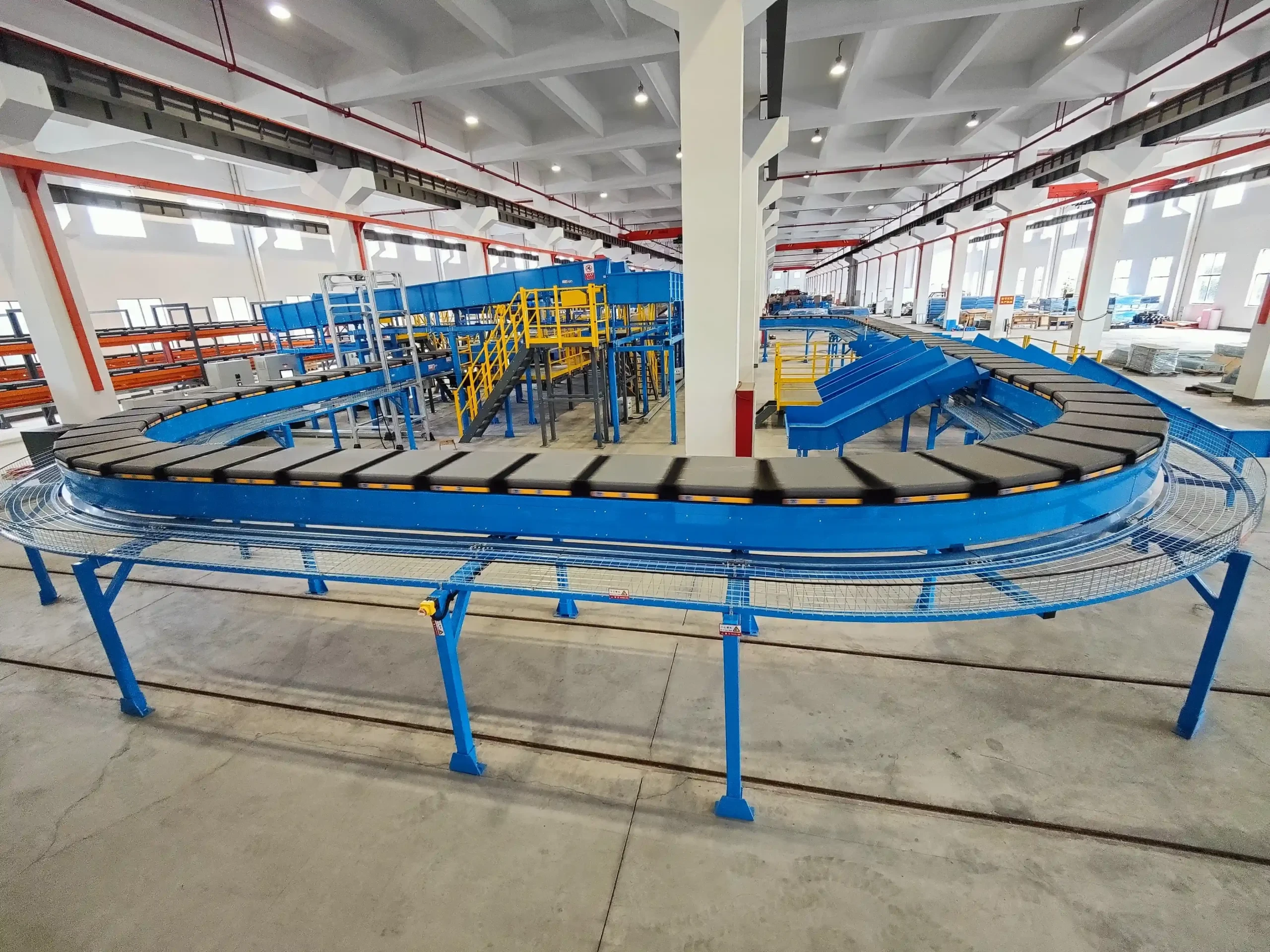
A crossbelt sorter is an automated sorting system where individual carriers—each equipped with a small belt—circulate along a loop. Items are inducted onto these carriers, and when they reach the correct destination chute, the belt activates to discharge the item either left or right.
Key advantages include:
- Gentle handling for fragile or irregular items
- High sorting accuracy
- Ability to handle a wide variety of package sizes and shapes
- Scalability in terms of sort destinations
Single-layer systems consist of one continuous loop of carriers, typically arranged horizontally. While effective, their throughput is constrained by:
- The number of carriers
- Belt speed
- Induction capacity
- Physical footprint
The Bottleneck Problem in Single-Layer Systems
Even well-optimized single-layer crossbelt systems eventually hit a ceiling. This usually shows up in several ways:
1. Carrier Saturation
As volume increases, carriers are occupied more frequently, reducing available capacity for new items entering the system.
2. Induction Limits
Human or automated induction stations can only feed items at a certain rate. Beyond that, congestion builds upstream.
3. Sort Destination Constraints
More SKUs or destinations require more chutes, which increases loop length and reduces cycle frequency.
4. Floor Space Restrictions
Expanding a single-layer system often means extending its footprint—something many facilities simply cannot afford.
These constraints create a classic operational dilemma: demand continues to grow, but the system cannot scale proportionally without major reconstruction.
Enter the Dual-Deck Crossbelt Sorter
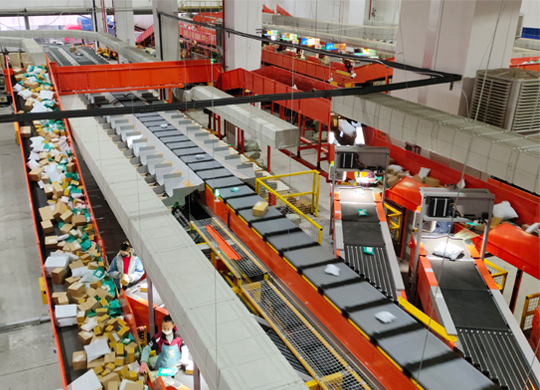
A dual-deck crossbelt sorter addresses these limitations by introducing a second sorting layer stacked vertically above or below the first.
Instead of one loop, there are two:
- Upper deck
- Lower deck
Each deck operates as an independent sorter, complete with its own carriers, belts, and discharge points. However, they are integrated into a unified system through shared induction zones, control software, and structural framework.
At a glance, this seems like a simple duplication. In practice, it’s far more sophisticated.
How Dual-Deck Systems Double Throughput
1. Parallel Processing in the Same Footprint
The most obvious advantage is parallelization.
Instead of increasing the speed of a single system—which introduces wear, vibration, and accuracy issues—a dual-deck sorter processes two streams simultaneously.
This allows:
- Twice the number of items in circulation
- Independent load balancing between decks
- Reduced congestion per deck
Crucially, this happens without expanding the building footprint. In high-cost urban logistics hubs, this is often the deciding factor.
2. Higher Carrier Density Without Longer Loops
In a single-layer system, increasing throughput often requires adding more carriers, which means extending the loop length. That increases cycle time—the time it takes for a carrier to complete a full circuit.
Dual-deck systems solve this differently:
- Each deck maintains an optimal loop length
- Carrier density is effectively doubled across two levels
- Cycle times remain short
The result is faster recirculation and more frequent discharge opportunities.
3. Optimized Induction Strategies
Dual-deck systems enable more flexible induction configurations:
Split Induction
Items are divided between upper and lower decks at the point of entry, based on:
- Destination
- Size or weight
- Priority level
Dynamic Allocation
Advanced control systems can assign items in real time to whichever deck has:
- More available carriers
- Shorter queue times
- Better routing efficiency
This prevents bottlenecks and keeps both decks operating at high utilization.
4. Reduced Recirculation Rates
In overloaded single-layer systems, items often miss their intended discharge window due to congestion, forcing them to recirculate.
Dual-deck systems reduce this by:
- Lowering carrier occupancy per deck
- Increasing available discharge opportunities
- Distributing load more evenly
Lower recirculation means:
- Faster order completion
- Less mechanical wear
- Lower energy consumption
5. Intelligent Zoning and Destination Mapping
Dual-deck sorters allow for smarter allocation of destinations.
For example:
- High-volume destinations can be assigned across both decks
- Low-volume destinations can be consolidated on one deck
- Priority shipments can be routed to a dedicated layer
This zoning flexibility improves flow efficiency and reduces conflicts between items competing for the same chute.
Structural and Mechanical Design Considerations
Building a dual-deck system isn’t just about stacking two machines. It requires careful engineering in several areas:
1. Frame and Load Distribution
The structure must support:
- Double the equipment weight
- Dynamic loads from moving carriers
- Vibration isolation between decks
2. Vertical Conveyance
Items must move efficiently between levels when necessary. This is typically handled by:
- Spiral conveyors
- Vertical lifts
- Incline belts
3. Maintenance Access
Technicians need safe and convenient access to both decks. This includes:
- Walkways
- Platforms
- Safety barriers
Control Systems: The Brain Behind the Operation
The real power of a dual-deck sorter lies in its control software.
Modern systems use advanced algorithms to:
- Balance load between decks in real time
- Optimize carrier assignment
- Predict congestion before it happens
- Adjust routing dynamically
This transforms the sorter from a mechanical system into an intelligent, adaptive network.
Labor Efficiency Gains
Doubling throughput doesn’t mean doubling labor.
In fact, dual-deck systems often reduce labor per unit processed:
1. Shared Induction Stations
Operators can feed both decks from a single workstation.
2. Reduced Manual Handling
Fewer recirculated items means less intervention.
3. Streamlined Staffing
Instead of expanding horizontally with multiple systems, a vertical solution centralizes operations.
Energy and Sustainability Benefits
At first glance, doubling the system might seem like doubling energy consumption. In reality, dual-deck systems are often more efficient per item processed.
Why?
- Shorter transport distances per item
- Reduced idle time
- Lower recirculation
- Optimized motor usage across two balanced systems
This results in lower energy cost per package—a key metric for large-scale operations.
Real-World Applications
Dual-deck crossbelt sorters are particularly effective in:
E-Commerce Fulfillment Centers
Handling massive SKU diversity and fluctuating order volumes.
Parcel and Courier Hubs
Managing high-speed sorting for time-sensitive shipments.
Apparel and Retail Distribution
Sorting lightweight, high-volume items with precision.
Third-Party Logistics (3PL)
Supporting multiple clients with varying requirements.
Challenges and Considerations
Despite their advantages, dual-deck systems are not a universal solution.
1. Higher Initial Investment
The upfront cost is significantly higher than a single-layer system.
2. Increased System Complexity
More components mean more potential failure points—though modern designs mitigate this.
3. Ceiling Height Requirements
Facilities must have sufficient vertical space.
4. Integration Complexity
Retrofitting an existing operation can be challenging.
When Does It Make Sense to Upgrade?
A dual-deck crossbelt sorter is most beneficial when:
- Throughput demand exceeds the limits of a single-layer system
- Floor space expansion is restricted or expensive
- Order volume is highly variable
- SKU diversity is high
- Labor costs are rising
If multiple of these conditions apply, the return on investment becomes compelling.
Future Trends: Beyond Dual-Deck
The evolution doesn’t stop at two layers.
Emerging innovations include:
- Multi-level sorting architectures
- AI-driven routing optimization
- Modular vertical expansion
- Integration with robotics and autonomous vehicles
These trends point toward a future where vertical space is fully utilized, and sorting systems become increasingly intelligent and adaptive.
Conclusion
Transitioning from a single-layer to a dual-deck crossbelt sorter represents a fundamental shift in how throughput is achieved. Instead of pushing a single system to its limits, the dual-deck approach embraces parallelism, balance, and vertical efficiency.
By doubling carrier capacity, optimizing induction, reducing recirculation, and enabling smarter routing, dual-deck systems can effectively double—or even exceed—traditional throughput benchmarks within the same footprint.
For operations facing rapid growth, space constraints, or increasing complexity, this isn’t just an upgrade. It’s a strategic transformation.
And in a world where speed, accuracy, and scalability define success, that transformation can make all the difference.