
In modern logistics and fulfillment operations, speed, accuracy, and scalability are no longer optional—they are survival requirements. With the explosive growth of e-commerce, same-day delivery expectations, and increasingly complex supply chains, warehouses and distribution centers are under constant pressure to process more packages in less time with fewer errors.
At the center of this transformation is one critical piece of automation technology: the cross-belt sorter.
While multiple sorting technologies exist—such as tilt-tray sorters, sliding shoe sorters, and manual or semi-automated systems—cross-belt systems have rapidly become the preferred choice for high-throughput logistics operations.
But why? What makes them stand out? And when do they outperform other solutions?
This guide breaks down the engineering principles, operational advantages, cost considerations, and real-world applications of cross-belt sortation systems so you can make an informed upgrade decision for your logistics operation.
1. The New Reality of Modern Logistics
The logistics industry has changed dramatically in the past decade.
Key drivers include:
- E-commerce dominance
- Same-day and next-day delivery expectations
- SKU explosion (millions of product variations)
- Global supply chain complexity
- Labor shortages in warehouse operations
- Rising cost of operational errors
Traditional sorting methods struggle to keep up.
Manual sorting is slow and error-prone. Semi-automated systems lack scalability. Even older automation systems often fall short in handling mixed-item environments.
Modern distribution centers now require systems that can:
- Process thousands of items per hour
- Handle diverse package shapes and sizes
- Reduce dependency on manual labor
- Maintain near-zero error rates
- Scale with business growth
This is where advanced sortation systems become essential.
2. What Is a Cross-Belt Sorter?
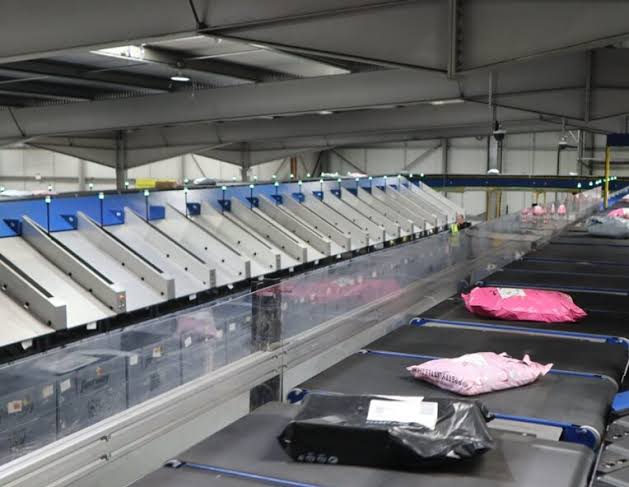
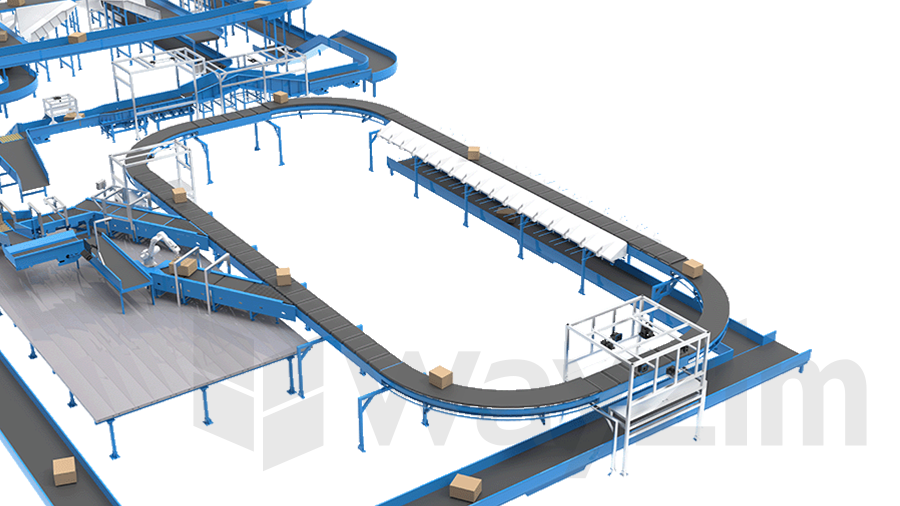
A cross-belt sorter is a high-speed automated material handling system designed to sort individual items into specific destinations using small, independently controlled conveyor belts mounted on carts.
Each cart moves along a looped track. When an item reaches its designated destination, the small belt on the cart activates and gently discharges the item into a chute or container.
This simple but powerful mechanism enables extremely precise, gentle, and fast sorting.
Key Components
A typical cross-belt system includes:
- Carrier carts
- Small conveyor belts on each cart
- Continuous loop track system
- Induction points (where items are loaded)
- Discharge chutes
- Control system software
- Sensors and tracking systems
Each element works together to ensure continuous, synchronized operation.
3. How Cross-Belt Sorting Works
The process can be broken into four stages:
Step 1: Induction
Items enter the system via manual or automated loading points.
Step 2: Identification
Barcode scanners, RFID readers, or vision systems identify each item.
Step 3: Transport
Items travel on individual carrier carts along the loop.
Step 4: Discharge
At the correct destination, the belt reverses direction and gently slides the item off the cart.
This method eliminates the need for mechanical pushing or dropping, reducing damage and improving accuracy.
4. Cross-Belt vs. Tilt-Tray Sorters
Tilt-tray sorters were once the industry standard for high-speed sorting. However, cross-belt systems now outperform them in many environments.
Tilt-Tray Advantages
- Simpler mechanical design
- Lower initial cost in some cases
- Proven technology in legacy systems
Tilt-Tray Limitations
- Less suitable for fragile items
- Limited control over discharge behavior
- Higher noise levels
- Reduced flexibility for mixed package types
Cross-Belt Advantages
- Superior gentle handling
- Higher precision in item placement
- Better for irregular or fragile items
- Improved throughput consistency
- Greater flexibility in item variety
Cross-belt systems are particularly strong in environments where product diversity is high.
5. Cross-Belt vs. Sliding Shoe Sorters
Sliding shoe sorters use a series of sliding mechanisms to push items off a conveyor.
Sliding Shoe Strengths
- Good for flat-bottom packages
- High-speed capability
- Relatively compact footprint
Sliding Shoe Weaknesses
- Less effective with irregular shapes
- Can struggle with delicate items
- Mechanical wear on push components
Cross-Belt Advantages Over Shoe Sorters
Cross-belt systems excel when:
- Packages vary widely in shape and weight
- Items require gentle handling
- High sorting accuracy is required
- Damage prevention is a priority
In mixed-SKU environments, cross-belt systems often provide more consistent performance.
6. Key Performance Advantages of Cross-Belt Systems
6.1 High Throughput Capacity
Modern cross-belt systems can process:
- 6,000 to 20,000+ items per hour (depending on configuration)
This makes them suitable for large-scale distribution centers.
6.2 Exceptional Accuracy
Because each item is individually controlled, sorting accuracy is extremely high.
This reduces:
- Mis-shipments
- Returns
- Customer complaints
- Rework costs
6.3 Gentle Product Handling
Unlike drop-based or push-based systems, cross-belt technology minimizes:
- Impact force
- Abrasion
- Compression damage
This is especially important for:
- Electronics
- Cosmetics
- Glass products
- Pharmaceutical items
- Fashion goods
6.4 Flexible Package Handling
Cross-belt systems can handle:
- Small parcels
- Irregular shapes
- Soft bags
- Rigid boxes
- Lightweight and medium-weight items
This versatility is a major advantage in modern fulfillment centers.
6.5 Continuous Operation
These systems are designed for:
- 24/7 operation
- Minimal downtime
- Automated fault detection
With proper maintenance, uptime can exceed 95% or higher.
7. Operational Efficiency Benefits
Labor Reduction
One of the most immediate benefits is reduced reliance on manual sorting.
Instead of dozens or hundreds of workers manually directing packages, a small team can oversee the system.
Reduced Training Requirements
Manual sorting requires:
- Training
- Experience
- Ongoing supervision
Automated systems reduce variability caused by human error.
Improved Workflow Predictability
Automation allows managers to:
- Forecast throughput
- Optimize staffing
- Reduce bottlenecks
Predictability is essential for scaling operations.
8. System Scalability
Cross-belt systems are modular.
This means businesses can:
- Add more induction points
- Extend track loops
- Increase destination chutes
- Upgrade control software
without replacing the entire system.
This scalability makes cross-belt technology suitable for both mid-sized warehouses and massive fulfillment centers.
9. Energy Efficiency and Sustainability
Modern systems are designed with energy optimization in mind.
Features may include:
- Regenerative braking systems
- Low-friction components
- Smart idle modes
- Energy-efficient motors
Compared to labor-heavy sorting operations or older mechanical systems, automated sorters can reduce long-term energy and operational waste.
10. Maintenance Considerations
No system is maintenance-free.
However, cross-belt systems are designed for predictable maintenance cycles.
Common maintenance tasks include:
- Belt inspection and replacement
- Sensor calibration
- Motor checks
- Software updates
- Lubrication of moving parts
Predictive maintenance systems increasingly allow operators to detect issues before failures occur.
11. Cost Considerations: Investment vs. Return
Cross-belt systems require significant upfront investment.
However, cost should be evaluated in terms of:
- Labor savings
- Reduced error rates
- Increased throughput
- Faster order fulfillment
- Lower damage rates
For high-volume operations, return on investment is often achieved through operational efficiency rather than direct cost savings alone.
12. Ideal Use Cases for Cross-Belt Sorters
Cross-belt systems are especially effective in:
E-commerce fulfillment centers
Handling thousands of diverse SKUs daily
Parcel distribution hubs
High-speed sorting of mixed parcel sizes
Retail logistics networks
Managing store replenishment efficiently
Postal and courier services
Large-scale mail and package distribution
Third-party logistics providers (3PLs)
Multi-client sorting environments
13. When Cross-Belt May Not Be the Best Choice
Despite its advantages, cross-belt systems are not ideal for every scenario.
They may be less suitable when:
- Throughput requirements are low
- Budget constraints are severe
- Operations involve only uniform packages
- Space limitations restrict installation
In such cases, simpler systems may be more cost-effective.
14. Integration with Warehouse Automation Ecosystems
Modern logistics operations rarely rely on a single system.
Cross-belt sorters often integrate with:
- Automated storage and retrieval systems (AS/RS)
- Warehouse management systems (WMS)
- Conveyor networks
- Robotics picking systems
- Vision-based scanning systems
This integration creates a fully automated fulfillment ecosystem.
15. Data and Intelligence in Modern Sorting Systems
Today’s cross-belt systems are not just mechanical—they are data-driven.
They collect and analyze:
- Throughput rates
- System utilization
- Bottleneck locations
- Error frequency
- Maintenance needs
This data helps operators continuously optimize performance.
16. Safety Improvements in Automated Sorting
Automation reduces:
- Workplace injuries
- Manual lifting strain
- Repetitive motion injuries
- Accidents in high-traffic areas
Cross-belt systems include safety features such as:
- Emergency stop mechanisms
- Light curtains
- Access control systems
- Real-time monitoring alerts
17. The Role of AI and Machine Learning
Modern logistics systems increasingly incorporate AI for:
- Predicting package flow
- Optimizing routing paths
- Reducing congestion
- Improving induction timing
As AI systems evolve, cross-belt sorters become even more efficient through adaptive learning.
18. Future Trends in Sorting Technology
The future of cross-belt and automated sorting includes:
- Fully autonomous distribution centers
- AI-driven dynamic routing
- Micro-fulfillment integration
- Higher-speed lightweight materials
- Self-diagnosing mechanical systems
- Cloud-connected logistics networks
Cross-belt technology is expected to remain a core infrastructure component due to its flexibility and reliability.
19. Key Evaluation Checklist Before Upgrading
Before investing in a sorting system, evaluate:
- Expected throughput volume
- Product mix complexity
- Available facility space
- Labor cost structure
- Maintenance capabilities
- Scalability requirements
- Integration needs
- Long-term growth projections
A successful upgrade depends on aligning technology with operational reality.
Conclusion: Why Cross-Belt Sorters Stand Out
In the evolution of logistics automation, cross-belt sorters represent a balance of speed, precision, flexibility, and reliability. While other sorting technologies have their strengths, few can match the combination of gentle handling, high throughput, and adaptability that cross-belt systems provide.
As supply chains become more complex and customer expectations continue to rise, the ability to sort accurately and efficiently at scale becomes a defining competitive advantage.
For many modern logistics operations, upgrading to cross-belt technology is not just an equipment decision—it is a strategic investment in the future of fulfillment performance.