


Every sorting system pitch includes an accuracy number, and almost every accuracy number is quoted as a percentage of reads rather than a count of failures. The difference matters enormously at scale. A system that reads 99.5 percent of labels and routes 99.5 percent of what it reads correctly produces roughly one error per hundred parcels. At twenty thousand parcels an hour, that is two hundred parcels an hour going to the wrong place, or two hundred that need a human to intervene.
This guide separates the two failure families, no-reads and missorts, because they have different causes and different fixes. It then covers the economics of accuracy, the design levers that actually move the number, and the metrics worth instrumenting so you can tell whether a change helped.
Where a Sort Decision Comes From
A sort is a chain of five steps, and any one of them can fail independently.
- Detect: a parcel arrives at the scan zone in the right position and orientation.
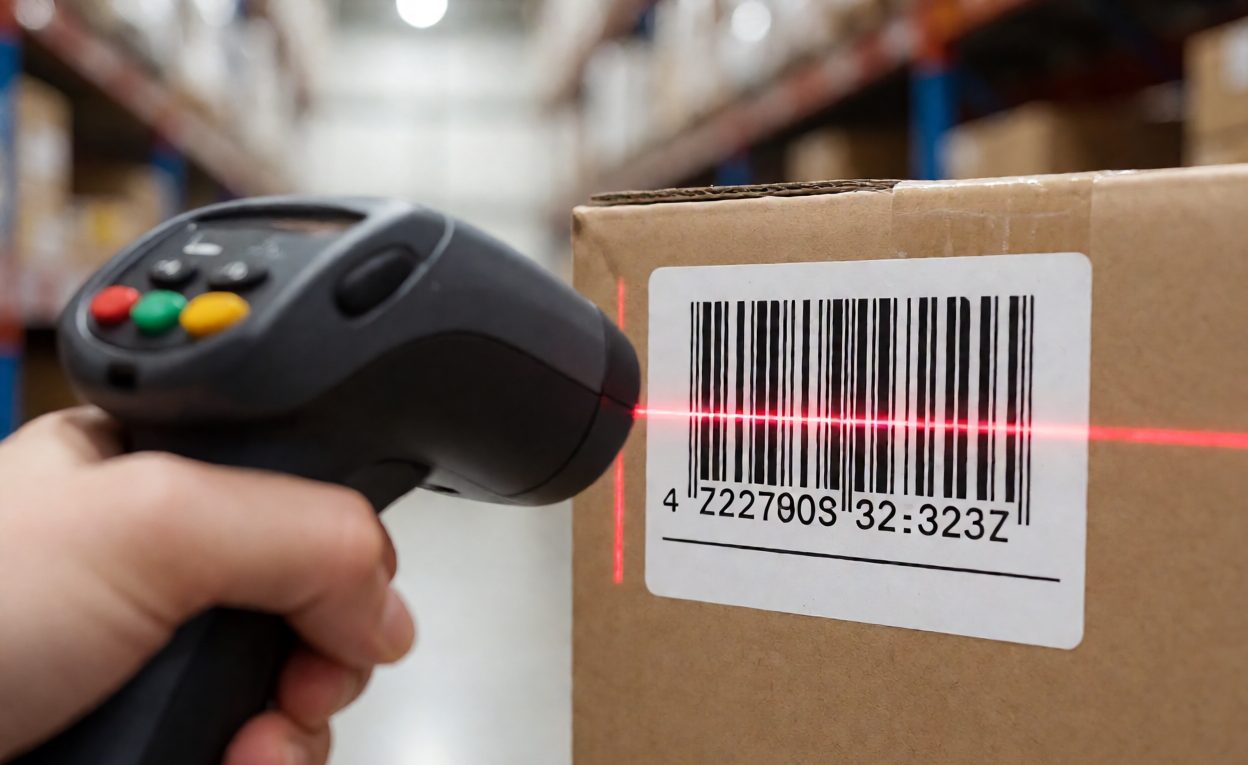
- Decode: the scanner reads a barcode and returns a valid string.
- Look up: the host system resolves that string to a destination, using a routing table, a carrier file or a WMS record.
- Assign: the control system allocates the parcel to a chute, respecting capacity and a destination-to-chute map.
- Divert: the cart or arm actuates at the right moment and the parcel lands in the intended chute.
A no-read is a failure at step two. A missort is a failure at step three, four or five, and it can happen even when the read was perfect. Conflating the two is the most common analytical error in sorting projects, and it leads to buying a better scanner when the real problem is a stale destination table.
No-Read Causes
No-reads cluster into label quality and scan geometry, and the split is roughly even in most facilities.
On the label side, the recurring causes are a barcode printed too small for the scan distance, low contrast from a worn thermal printhead, a label applied over a seam or a curved surface, a label creased by the parcel contents, and a label covered by tape that reflects the scanner’s light. A thermal printer that is past its service interval produces labels that look acceptable to a human and fail a machine, which is why printer maintenance belongs in the accuracy budget.
On the geometry side, the causes are parcels arriving at an angle, labels facing away from the camera, parcels too close together so two labels fall in one frame, and belt speed high enough that motion blur degrades the decode. A single-side scan tunnel reads roughly half of randomly oriented parcels. Adding top and side cameras, or a six-sided scan frame, typically lifts read rate by a large margin before any software change is considered.
A DWS tunnel that dimensions, weighs and scans solves geometry and label quality at the same time, because it forces a defined presentation of every parcel before the sort decision is made.
Missort Causes Beyond No-Read
Missorts are more varied and usually more expensive, because they are silent. A no-read goes to an exception lane and a human sees it. A missort travels.
Destination mapping errors. A carrier file changes, a postcode range moves, a new service level is added, and the routing table is not updated. Every parcel in that segment goes to the wrong chute until someone notices.
Chute assignment conflicts. When the destination-to-chute map assigns several destinations to one chute with a shared bin, the downstream separation step becomes the accuracy bottleneck. The sorter was right; the bagging step was not.
Exception handling. A parcel that no-reads twice is often pushed to a manual station. If the operator picks a destination by memory rather than by scanning, the error rate of that station becomes the error rate of the whole system for that parcel class.
Jam recovery. When a parcel is removed from a jam and re-induced without a rescan, the control system may still hold the previous assignment. Re-induced parcels need an explicit rescan step, not a manual override.
Divert timing. A cart that actuates a few milliseconds late drops the parcel into the gap between chutes. This is a mechanical and controls issue, and it shows up as a cluster of errors at specific chutes rather than spread evenly.
The Economics of Accuracy
Accuracy improvements are usually justified with labour savings, which understates the case. The real cost of a missort has four parts: the re-ship cost of moving the parcel again, the customer service contact, the refund or credit if the parcel is late or lost, and the handling labour to find and correct it. On a low-value parcel the re-ship dominates; on a high-value one the refund does.
A useful planning figure is to multiply the missort rate by parcel volume and by a blended cost per event that reflects your own mix. Facilities that do this usually find that a one percentage point improvement in accuracy is worth more than a comparable percentage improvement in throughput, because throughput gains are capital-intensive while accuracy gains are often procedural.
A five-year cost model should include error cost as a line item. Systems that look cheap on purchase price often carry a higher error rate, and the difference compounds over the asset life.
Design Levers That Move the Number
Five levers account for most of the achievable improvement, and they are listed roughly in order of return on effort.
- Scan coverage: add camera heads so every face can be read. Six-sided scanning is the single largest lever for randomly oriented parcels.
- Recirculation: give no-reads a second pass on the loop instead of pushing them straight to manual. A second pass at a different orientation converts a large share of no-reads into reads.
- Double verification: scan at induction and again before divert, and compare. A mismatch catches label swaps and re-induced parcels.
- Exception lane design: make the exception station scan-driven rather than memory-driven, and measure its accuracy separately.
- Destination table governance: treat the routing table as a controlled document with a change log and a test parcel set that is run after every change.
Chute count and throughput interact with accuracy in a way that is easy to miss: more chutes means finer destination granularity, which reduces downstream separation errors, but it also means shorter chutes and tighter divert timing.
Metrics Worth Instrumenting
You cannot improve what you do not measure per shift. Five metrics cover the system.
- Read rate: successful decodes divided by parcels scanned, measured per scan point rather than for the system as a whole.
- No-read rate: the complement, split by cause code so label and geometry problems can be separated.
- Missort rate: measured by audit, not by system logs, because the system believes it succeeded.
- Recirculation rate: the share of parcels taking a second pass, which is both a cost and a leading indicator of read problems.
- Exception rate: parcels reaching manual handling, split by reason.
Missort rate needs a physical audit method: a sampled bin check, a carrier-reported error feed, or both. System logs will always report high accuracy because they record intent rather than outcome. WMS and PLC integration is where the audit data has to land, otherwise the numbers exist but nobody acts on them.
Technical Background
Barcode decoding fails predictably when the image degrades. A barcode encodes data in the relative widths of bars and spaces, and a decoder needs enough resolution across the narrowest element plus a quiet zone on each side. Motion blur, low contrast and specular reflection from packaging tape all reduce the effective modulation until the decode fails, which is why scan tunnels use diffuse lighting and multiple exposures rather than a single bright lamp.
Where labels are damaged, secondary technologies fill the gap. Optical character recognition can recover a printed address or tracking number from the label image, and RFID removes the line-of-sight requirement entirely where the parcel carries a tag. Both raise the read rate but neither fixes a wrong destination table, which is why accuracy projects should start with the data chain rather than the sensor.

An Accuracy Improvement Checklist
Work through this in order; each step is cheap relative to the one after it.
- Audit a sample of bins physically and compare against system records to establish a true baseline missort rate.
- Split no-reads by cause code for one week and rank the causes by volume.
- Check printer service intervals and label stock against the scanner’s specified minimum element width.
- Map scan coverage against parcel orientation and add heads where blind spots exist.
- Enable recirculation with a rescan at a different orientation, and measure the conversion rate.
- Put the destination table under change control with a regression test parcel set.
- Make the exception station scan-driven and measure its accuracy separately.
- Instrument the five metrics per shift and review them weekly with the operations team.
What is a good missort rate for a parcel sorter?
Well-run systems operate in the region of one error per several thousand parcels. The number depends heavily on parcel mix and label quality, so benchmark against your own baseline rather than a vendor figure.
What is the difference between a no-read and a missort?
A no-read is a failed barcode decode. A missort is a parcel delivered to the wrong destination, which can happen after a perfect read if the routing data or divert timing is wrong.
Does six-sided scanning really help?
Yes, for randomly oriented parcels it is the largest single lever, because a one-sided tunnel simply cannot see a label facing away from it. It is a hardware cost with a direct and measurable return.
Why do missorts cluster at certain chutes?
Usually divert timing or chute geometry. If errors concentrate at specific destinations rather than spreading evenly, the cause is mechanical or controls-related rather than label quality.
How should accuracy be measured?
By physical audit of sorted bins or by carrier-reported errors, not from system logs. Logs record the intended destination, so they will always look better than reality.
Can software fix a low read rate?
Partly. Better decoding and OCR recovery help, but if the label is not in the camera’s field of view or is blurred by belt speed, no algorithm recovers it. Fix geometry first.
What does recirculation cost?
It consumes sorter capacity, because a recirculated parcel occupies a slot twice. The trade is usually worth it when the alternative is manual handling, but the capacity impact should be modelled.