
A put wall is a series of dedicated shelving that increase efficiency during the order consolidation process. Put walls can handle a large volume of orders in a small footprint. This paperless process streamlines the supply chain by increasing order accuracy and reducing walking to and from inventory storage. Put Wall applications decouple the picking and packing application of order fulfillment maximizing the efficiency of each applications.
How It Works
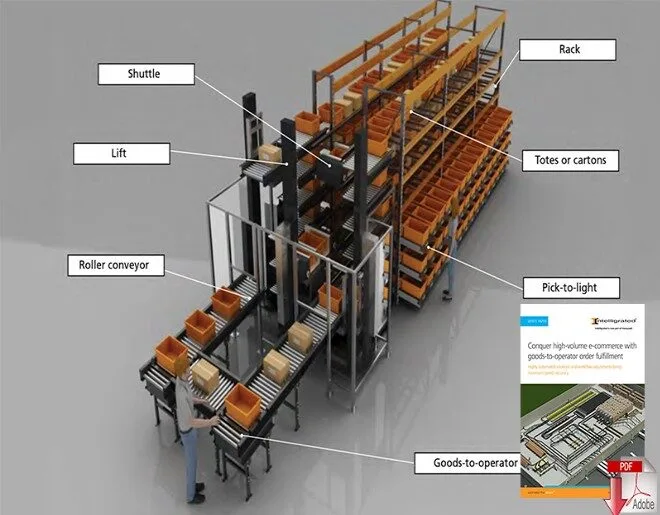
The wall itself consists of multiple compartments outfitted with light indicators, where each compartment represents a customer’s order. The operator receives a batch of items in totes or on a pallet, which they then scan individually. Scanned items are placed into the compartments directed by the light system until the order is fulfilled and ready to ship to the customer.
Once orders are completed, packing operators are notified via a light on the opposite side of the wall system. The process is completed once the packer loads the items into boxes, ready for shipment.
Benefits
- 100% paperless
- Modular and scalable
- Increased order efficiency
- Increased order accuracy
- Supports processing of single and multi-line orders
- Real-time visibility
Applications
Most popular with ecommerce, applications will vary based on clients’ needs and may include applications like:
- Medical devices
- Electronic components
- Small, packaged consumer goods
- Clothing and apparel
- Jewelry

Considerations
When considering automating your warehouse order picking process and evaluating various technology options, it’s important to consider the following:
- Product dimensions
- Labor availability
- Current and desired throughput rates
- Operation workflow
- Current and desired pick and pack needs
- Seasonal order fulfillment changes
Pick and Pack in One Place: The Merge Zone Where Cycles Compress
Picking and packing used to live in different postcodes of the warehouse. Merging them compresses the order cycle:
| Legacy handoff | Time it cost | Merge-zone replacement |
|---|---|---|
| Pick cart to packing bench | Travel and queue per order | Pack at the sorter’s packing wall |
| Packed box to sortation induct | Second handling, re-scan | Direct induct from pack bench |
| Error discovered at ship dock | Full retrieval cycle | Verify-at-pack catches it early |
| Two departments, two schedules | Shift-boundary idle time | One flow, one shift rhythm |
The error row is where the merge zone pays most visibly. Catching a wrong item at the pack bench costs seconds; discovering it at the ship dock costs a retrieval, a reprint, an apology and sometimes a reshipment — an order of magnitude apart, multiplied by every order. Compression also changes the management geometry: one merged flow means one queue to watch, one throughput number that means what it says, and shift handovers that transfer a running process rather than a pile of half-finished batches. Order fulfilment cycles compress accordingly, and the compression compounds with downstream sortation: packing straight onto the sorter means every parcel built is already on its path, and the warehouse’s promise-to-ship clock shortens by the length of every handoff it deleted. The mile-level flows this feeds are in serving both miles, and the resilience it builds in resilience through sorting. Reference: order fulfilment and packaging and labelling.
The merge zone has honest exceptions too: irregular or high-value orders sometimes pack better in a quiet specialist bay than at the wall. The discipline is choosing separation deliberately — by order class, reviewed seasonally — rather than by departmental inheritance. Reference: division of labour and batch logic.