
The logistics and warehousing industry is undergoing one of the most significant transformations in its history. Driven by e-commerce growth, rising customer expectations, and labor market pressures, companies are rapidly shifting toward intelligent, automated warehouse ecosystems.
At the center of this transformation are two powerful technologies:
- Cross-belt sorters
- AS/RS (Automated Storage and Retrieval Systems)
Individually, each system delivers substantial efficiency gains. But when integrated properly, they create a highly synchronized, end-to-end automation flow that dramatically improves throughput, accuracy, and scalability.
This article explores how these two systems work together, why their integration is becoming the backbone of smart warehousing, and what businesses need to consider when designing a fully automated fulfillment environment.
The Rise of Smart Warehousing
Traditional warehouses were built around manual labor and linear processes:
- Goods arrive
- Items are stored
- Orders are picked manually
- Products are sorted and shipped
This model worked when order volumes were low and customer expectations were flexible. But modern logistics demands:
- Same-day or next-day delivery
- High SKU complexity
- Seasonal demand spikes
- Real-time inventory visibility
- Near-perfect accuracy
To meet these requirements, warehouses are evolving into fully digital, interconnected systems powered by automation, robotics, and intelligent software.
At the heart of this evolution is the integration of storage automation (AS/RS) and sorting automation (cross-belt systems).
Understanding AS/RS: The Foundation of Automated Storage
AS/RS (Automated Storage and Retrieval Systems) are high-density storage solutions designed to automate the placement and retrieval of goods.
Core Components of AS/RS
- Storage racks (often multi-level, high-bay structures)
- Automated cranes or shuttles
- Conveyor or transfer interfaces
- Warehouse management system (WMS) integration
Key Benefits
- High-density storage utilization
- Reduced labor dependency
- Fast and precise item retrieval
- Improved inventory accuracy
- Better vertical space utilization
AS/RS systems are particularly valuable in environments with:
- Large SKU counts
- High inventory turnover
- Space constraints
They serve as the storage backbone of a smart warehouse.
Understanding Cross-Belt Sorters: The High-Speed Distribution Engine
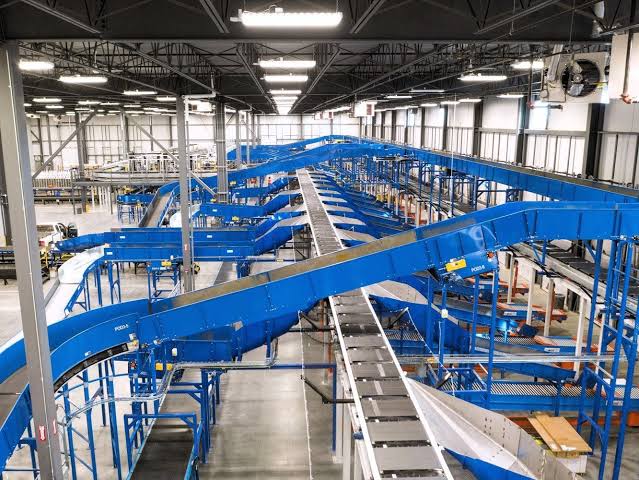
A cross-belt sorter is an automated sorting system that uses individually controlled belts mounted on a loop conveyor.
Each carrier can:
- Receive an item
- Transport it through the system
- Discharge it precisely into a designated chute
Key Advantages
- Extremely high sorting throughput
- High accuracy across diverse product types
- Ability to handle irregular shapes and sizes
- Continuous, non-stop operation
- Scalable destination configuration
Cross-belt sorters are commonly used in:
- E-commerce fulfillment centers
- Parcel distribution hubs
- Retail logistics operations
- Courier sorting facilities
If AS/RS is the “storage brain,” the cross-belt sorter is the “distribution engine.”
Why Integration Matters: Moving Beyond Isolated Automation
Many warehouses adopt automation in stages:
- First AS/RS for storage
- Later add sorting systems
- Then integrate software layers
But true efficiency is only achieved when both systems are tightly integrated into a unified workflow.
Without integration:
- Items move slowly between systems
- Manual intervention increases
- Bottlenecks form at transfer points
- Data synchronization issues arise
With integration:
- Storage and sorting become a continuous flow
- Inventory moves intelligently based on demand
- System-wide optimization becomes possible
The result is a fully synchronized fulfillment ecosystem.
The End-to-End Workflow: How AS/RS and Cross-Belt Systems Work Together
Let’s walk through a typical automated flow in a smart warehouse.
1. Goods Inbound and Storage Allocation
When inventory arrives:
- Items are scanned
- WMS assigns storage locations
- AS/RS cranes or shuttles store items automatically
High-frequency SKUs may be placed in faster-access zones, while slower-moving items go deeper into storage.
2. Order Generation and Retrieval Request
When customer orders are placed:
- WMS identifies required SKUs
- AS/RS receives retrieval commands
- System prioritizes picks based on urgency and batch optimization
3. Automated Retrieval from AS/RS
AS/RS units retrieve items and deliver them to a transfer interface:
- Conveyor belts
- Induction stations
- Buffer zones
This step eliminates manual picking entirely or reduces it significantly.
4. Induction into Cross-Belt Sorter
Retrieved items are fed into the cross-belt system:
- Each item is scanned
- System assigns a destination chute
- Carrier belts transport items at high speed
5. High-Speed Sorting and Consolidation
The cross-belt sorter distributes items into:
- Order bins
- Shipping lanes
- Carrier consolidation points
Multiple SKUs for the same order are automatically grouped downstream.
6. Packing and Shipping
Once sorted:
- Items move to packing stations
- Orders are verified and packed
- Shipping labels are applied
- Packages are dispatched
Key Benefits of Integration
When AS/RS and cross-belt systems operate together, the benefits multiply rather than simply add.
1. End-to-End Automation
The most obvious advantage is the reduction of manual labor across the entire process.
Tasks eliminated or minimized:
- Manual picking
- Manual sorting
- Long-distance walking in warehouses
- Repetitive handling operations
This leads to:
- Lower labor dependency
- Reduced operational fatigue
- More consistent performance
2. Dramatic Throughput Increase
AS/RS accelerates storage and retrieval, while cross-belt systems accelerate sorting.
Together, they enable:
- Continuous material flow
- High-volume order processing
- Reduced idle time between processes
The system becomes capable of handling peak demand without proportional labor increases.
3. Improved Order Accuracy
Automation reduces human error at multiple stages:
- Incorrect picking
- Mis-sorting
- Mislabeling
- Shipment mismatches
With integrated scanning and tracking:
- Every item is traceable
- Every movement is recorded
- Errors can be detected early
4. Space Optimization and Vertical Utilization
AS/RS maximizes vertical storage density, while cross-belt systems minimize horizontal sorting space requirements.
Combined effects:
- Smaller warehouse footprint
- Reduced need for expansion
- More efficient layout design
5. Real-Time Inventory Visibility
Integrated systems provide:
- Live inventory tracking
- Dynamic stock allocation
- Predictive replenishment capabilities
This enables smarter decision-making and reduces stockouts or overstock situations.
6. Scalability Without Structural Overhaul
One of the most powerful advantages is scalability.
Instead of expanding labor proportionally with order growth:
- Add more AS/RS modules
- Expand sorter lanes or destinations
- Upgrade software capacity
The core infrastructure remains stable while capacity increases.
System Design Considerations for Integration
Building a successful AS/RS + cross-belt system requires careful planning.
1. Throughput Matching
One of the most common mistakes is mismatched system speeds:
- AS/RS retrieval too slow → sorter underutilized
- Sorter too fast → upstream bottleneck
Balanced throughput design is critical.
2. Buffer Strategy Design
Buffers act as shock absorbers between systems:
- Prevent congestion
- Smooth peak demand
- Reduce idle time
Common buffer types:
- Conveyor buffers
- Vertical accumulation zones
- Dynamic staging lanes
3. Software Integration Layer
The Warehouse Management System (WMS) and Warehouse Control System (WCS) must coordinate:
- Order prioritization
- Item routing
- Real-time decision-making
Without strong software integration, hardware efficiency is limited.
4. SKU Profiling and Slotting Strategy
Not all items should be treated equally:
- Fast-moving SKUs near AS/RS retrieval points
- High-demand items prioritized for sorter flow
- Fragile items routed through gentle handling paths
Proper slotting improves both speed and safety.
5. Maintenance and Redundancy Planning
Automation increases efficiency but also introduces dependency on system uptime.
Best practices include:
- Redundant crane units
- Parallel conveyor paths
- Predictive maintenance systems
- Real-time diagnostics
Industry Use Cases
E-Commerce Fulfillment Centers
- High order variability
- Fast delivery expectations
- Large SKU catalogs
Integration enables same-day or next-day fulfillment at scale.
Retail Distribution Networks
- Multi-store replenishment
- Centralized inventory management
- Seasonal demand balancing
Courier and Parcel Hubs
- Extremely high throughput requirements
- Time-sensitive sorting
- Multi-destination routing complexity
Manufacturing and Spare Parts Logistics
- Precision inventory control
- Fast retrieval of components
- Reduced downtime in production lines
Challenges in Implementation
Despite its advantages, integration is not without challenges.
1. High Initial Capital Investment
Both systems require significant upfront cost, especially when integrated.
2. Complex Engineering Requirements
Designing smooth flow between systems requires:
- Mechanical engineering
- Software architecture
- Process optimization expertise
3. Change Management
Workforce adaptation includes:
- Training
- Role restructuring
- Operational mindset shifts
4. System Downtime Risk
Highly automated systems depend on:
- Stable software
- Reliable hardware
- Preventive maintenance
ROI Perspective of Integrated Systems
While costs are high, returns come from multiple layers:
- Reduced labor costs
- Increased throughput capacity
- Lower error rates
- Reduced facility expansion needs
- Faster order fulfillment cycles
In many high-volume operations, integration significantly shortens payback time compared to standalone systems.
The Future of Warehouse Automation
The combination of AS/RS and cross-belt systems is just the beginning.
Future trends include:
- AI-driven inventory optimization
- Autonomous mobile robots (AMRs) integrated with fixed automation
- Digital twin warehouse simulation
- Predictive demand-based storage allocation
- Fully lights-out fulfillment centers
In this evolution, AS/RS and cross-belt systems will remain foundational components of intelligent logistics infrastructure.
Conclusion: A Unified Automation Ecosystem
The integration of AS/RS and cross-belt sorter systems represents more than just an operational upgrade—it represents a fundamental shift in how warehouses function.
Instead of isolated processes:
- Storage becomes intelligent
- Retrieval becomes dynamic
- Sorting becomes instantaneous
- Fulfillment becomes continuous
Together, these systems form a smooth, high-performance logistics engine capable of meeting the demands of modern commerce.
For businesses aiming to scale efficiently, reduce operational friction, and improve service levels, the synergy between AS/RS and cross-belt sorting technology is not just an option—it is becoming a strategic necessity.