



Every sortation operator faces the same dilemma with spares. Hold too little and a single failed component takes the line down for weeks; hold too much and the storeroom fills with capital that sits still, ages out, and is eventually written off. Consignment and vendor-managed inventory are the two contractual mechanisms that split the difference – they keep the parts physically close while moving the ownership, and much of the risk, back to the supplier.
Both arrangements are common in capital equipment and both are frequently negotiated badly, because buyers focus on the headline question – who owns the part – and under-negotiate the terms that actually determine whether the arrangement works. This article sets out how each model operates and which terms deserve the attention.

Two Arrangements, Different Risk
Consignment stock means the supplier’s parts sit in your storeroom but remain the supplier’s property until used. You pay on consumption, not on delivery. The supplier carries the capital cost and the obsolescence risk; you carry the physical space and the discipline of accurate usage reporting. For expensive, slow-moving, high-consequence parts – drive modules, control boards, custom-machined items – it converts a capital purchase you may never need into an availability commitment you can test.
Vendor-managed inventory goes further. The supplier monitors stock levels and triggers replenishment itself, against agreed minimum and maximum levels, using consumption data you share. Ownership terms can vary – consignment-style pay-on-use, or purchase on delivery – but the defining feature is that replenishment decisions move to the supplier. Your storeroom staff stop counting and ordering; they receive, store and fit.
The two are often combined: VMI for the routine wear parts that flow steadily, consignment for the expensive items that almost never move but must be there.
How a Spares VMI Agreement Works
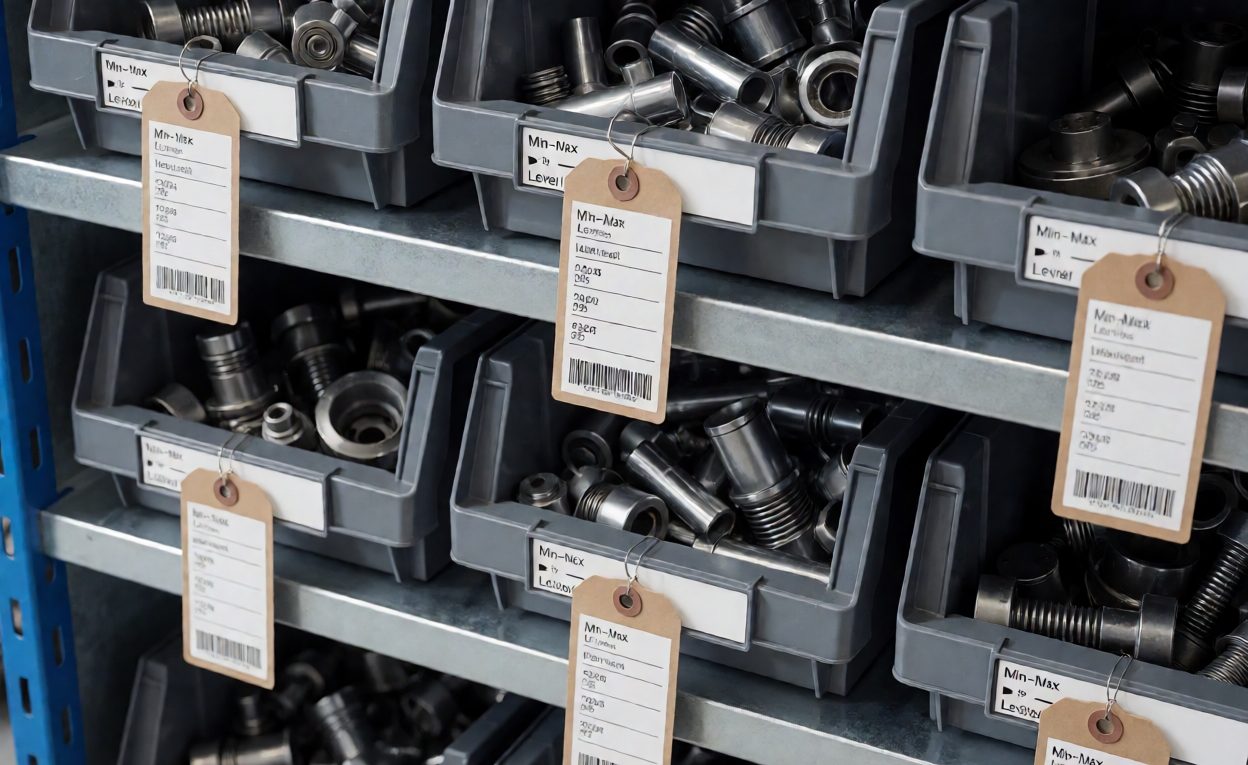
In operation the cycle is simple. Each bin or item carries agreed minimum and maximum levels. Consumption is recorded – scanned at the point of use is the reliable method – and reported to the supplier on a defined cycle. The supplier replenishes against the trigger, and a periodic review adjusts the levels against actual failure history rather than against the original estimate.
The design decisions are the levels and the review rhythm. Minimums protect against the lead time between consumption and replenishment; maximums prevent the storeroom quietly filling with parts the supplier finds convenient to ship in bulk. Levels set once at contract signature and never revisited describe a machine that no longer exists within two years, which is why the review obligation belongs in the contract rather than in good intentions.
The Terms That Decide Whether It Works
Five clauses carry most of the value:
- Ownership and payment point: exactly when title and payment transfer – on issue to the machine, on removal from the bin, or on delivery. Ambiguity here becomes an invoice dispute within a year.
- Replenishment lead time: the commitment that makes low minimums safe. A min-max system is only as good as the lead time behind it.
- Obsolescence and machine changes: who owns parts superseded by component revisions, and how substitution is agreed. This is the clause that prevents a storeroom of parts that no longer fit.
- Response commitment: for consigned high-consequence parts, the availability promise – delivery from your shelf is only the first half; technical response is covered separately.
- Audit and data rights: your right to verify stock counts and the supplier’s access to consumption data, both defined narrowly enough to be acceptable.

Technical Background
The practice of suppliers monitoring and replenishing buyer stock is vendor-managed inventory, originally developed in retail and now standard in industrial supply. The ownership mechanism is consignment, where goods remain the consignor’s property until used or sold. The stock logic underneath both – buffer levels sized against demand variability and lead time – is safety stock theory, and it explains why a supplier’s commitment on lead time is what lets your minimums fall.
Whether an item belongs in a VMI programme at all is decided by the criticality classification set out in the critical spares list – consignment suits the high-consequence, slow-moving quadrant precisely because it removes holding risk from parts you hope never to use. The broader maintenance-side context is in maintenance planning and spare parts strategy, and the response commitments that complement on-shelf availability are examined in warranty and service response terms. Where the question extends to who fits the parts, it connects to the build-versus-buy decision in maintenance contract versus in-house team.
When to Choose Which
The selection logic is short. For high-value, slow-moving, high-consequence parts, consignment is usually the right instrument: the supplier is better placed to carry obsolescence risk across its customer base than you are to carry it alone. For steady-flow wear parts with predictable consumption, VMI reduces transaction load and stock-outs at once, and the supplier gains forecast visibility that helps its own planning. For cheap, generic items available from any industrial supplier, neither is worth the administration – buy them on demand.
The one arrangement to avoid is the informal version: parts left on site after installation with ownership never stated. It works until the first dispute over an invoice, a superseded part, or the machine’s disposal, and then it works against everyone. Whatever the model, write it down – and review the levels annually against failure data, because a VMI agreement that outlives its assumptions degrades into exactly the over-holding it was designed to prevent.
Frequently Asked Questions
What is the difference between consignment and VMI?
Consignment is an ownership arrangement – you pay only when parts are used. VMI is a replenishment arrangement – the supplier monitors and restocks. They are often combined.
Which parts suit consignment stock?
Expensive, slow-moving, high-consequence items such as drive modules, control boards and custom-machined parts that must be on site but may rarely be used.
Which parts suit VMI?
Steady-flow wear parts with predictable consumption, where automatic replenishment reduces both stock-outs and administrative load.
Who owns obsolete consigned parts?
Under a well-drafted agreement, the supplier – which is precisely why the obsolescence clause must state how superseded parts are handled and replaced.
What is the most important term to negotiate?
Replenishment lead time. The min-max levels that keep stock low are only safe if the lead time behind them is contractual.
How often should levels be reviewed?
At least annually, against actual failure and consumption data – component revisions change which parts the machine really needs.
Is pay-on-use always the payment model?
No. Consignment is typically pay-on-use, but VMI can be structured as purchase on delivery; the ownership and payment point must simply be stated precisely.