A few years ago, the intralogistics industry was polarized. Tech purists predicted that swarm robotics and autonomous mobile robots (AMR) would completely replace fixed conveyor systems. Meanwhile, traditionalists argued that AMRs could never match the raw throughput velocity of fixed machinery. As we analyze the hard operational data in May 2026, we see that both extremes were wrong. The true future of warehousing lies in hybrid architecture. Leading global e-commerce and 3PL fulfillment centers are successfully integrating the ultimate flexibility of automated warehouse robotics with the unmatched heavy-duty volume processing of fixed sorters. In this data-driven report, the engineering analytics team at Truelisort dissects the throughput metrics, cost variables, and ROI horizons of the modern integrated robotic warehouse.
- Throughput Multiplier: Facilities integrating AMRs as dynamic induction feeders for fixed high-speed sorters report a 45% higher peak volume capacity compared to isolated AMR fleets.
- Footprint Optimization: Hybrid designs reduce the required fixed conveyor steel footprint by 30%, utilizing AMRs to navigate tight mezzanine spaces.
- ROI Acceleration: The payback period for a hybrid automated warehouse has dropped to 1.8 years in 2026, down from 2.5 years in 2024.
- Downtime Resilience: Fault-tolerance improved by 88%; if an AMR fails, the swarm routes around it, ensuring the fixed sorter is never starved of product.
*Data Source: 2026 Global Material Handling Automation Index & Truelisort proprietary deployment metrics. Data updated: May 2026.
1. The Mathematical Bottleneck: Why Pure AMR or Pure Fixed Systems Struggle
To understand the synergy, we must analyze the statistical limitations of using a single technology in an isolated environment.
The Limitation of Pure Fixed Systems
Traditional fixed sorters are incredibly fast but completely rigid. If the product profile changes or a new shipping door is added, altering the steel layout costs hundreds of thousands of dollars. Furthermore, fixed conveyors require “Man-to-Goods” induction, binding the speed of the machine to human walking speeds.
The Limitation of Pure AMR Fleets
While an autonomous mobile robot (AMR) fleet is infinitely flexible, it suffers from a mathematical throughput ceiling. If a facility needs to sort 25,000 parcels per hour, relying solely on sorting robots moving at 1.5 m/s across a vast warehouse floor causes severe traffic jams and battery depletion bottlenecks.
2. Trend Analysis: The Hybrid Performance Matrix
When you combine both systems, the mathematical constraints disappear. The AMRs act as the flexible “capillaries” of the warehouse, while the fixed sorter acts as the high-speed “aorta.” Here is how the 2026 performance data compares:
| System Architecture | Max Throughput (PPH) | Layout Flexibility | Labor Dependency |
|---|---|---|---|
| Pure Fixed Conveyors | High (up to 30,000) | Very Low (Rigid steel) | High (Manual induction) |
| Pure AMR Swarm | Low/Medium (1,500 – 5,000) | Extremely High | Low |
| Hybrid Robotic Warehouse (Synergy) | Very High (30,000+) | High (Dynamic induction zones) | Extremely Low |
3. Practical Application: How the Synergy Operates
How does this data translate to the warehouse floor? A highly optimized robotic warehouse in 2026 follows a synchronized workflow:
- Dynamic Transport (AMR): Goods-to-Person (G2P) AMRs transport mobile shelving units or bulk totes directly from the high-density storage zones to the induction stations.
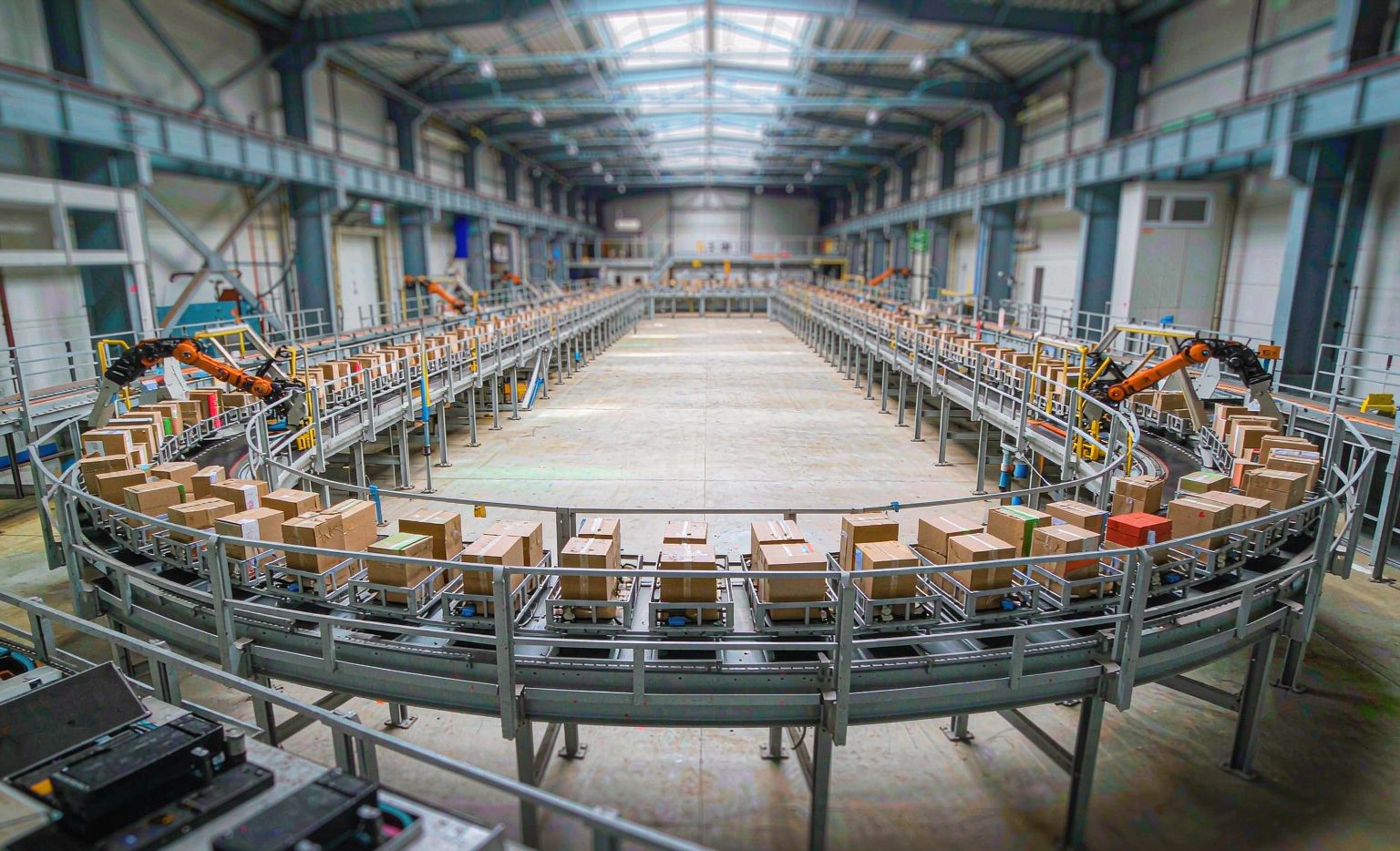
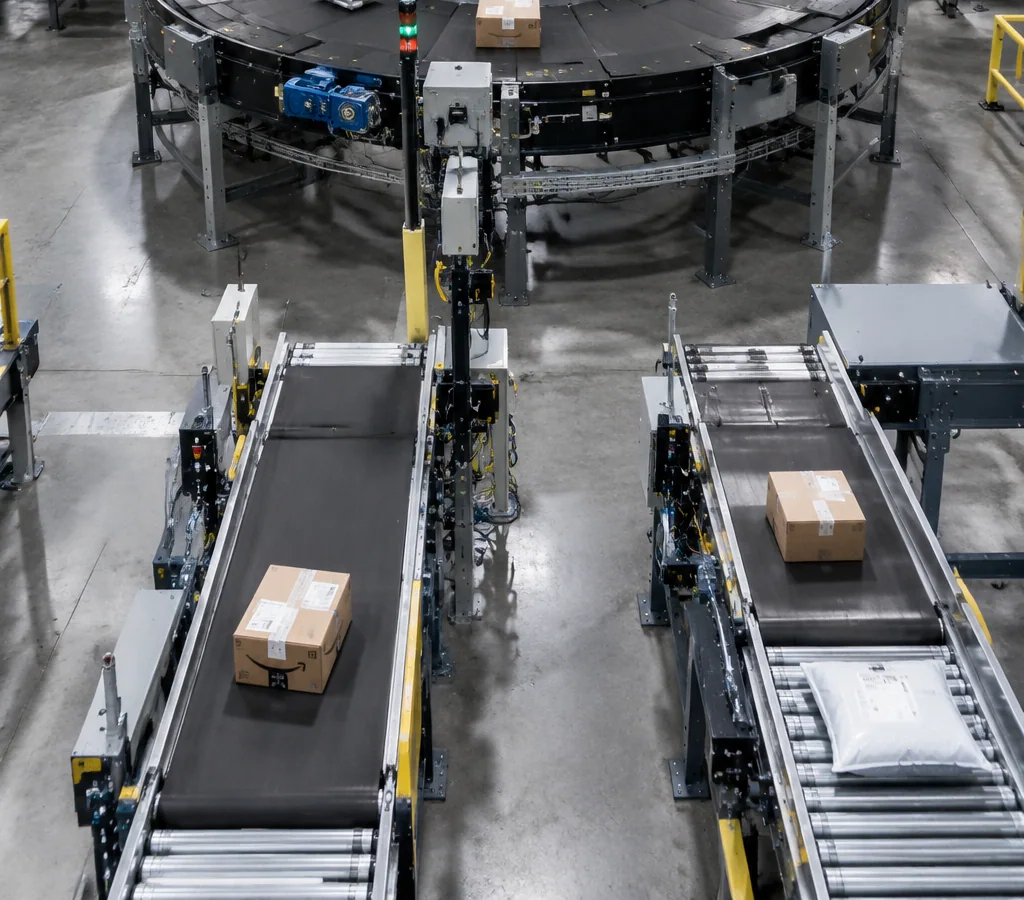
- Automated Induction: Robotic arms (or human operators acting strictly as stationary pickers) transfer the items from the AMR delivery tote onto the induction belt of the fixed sorter.
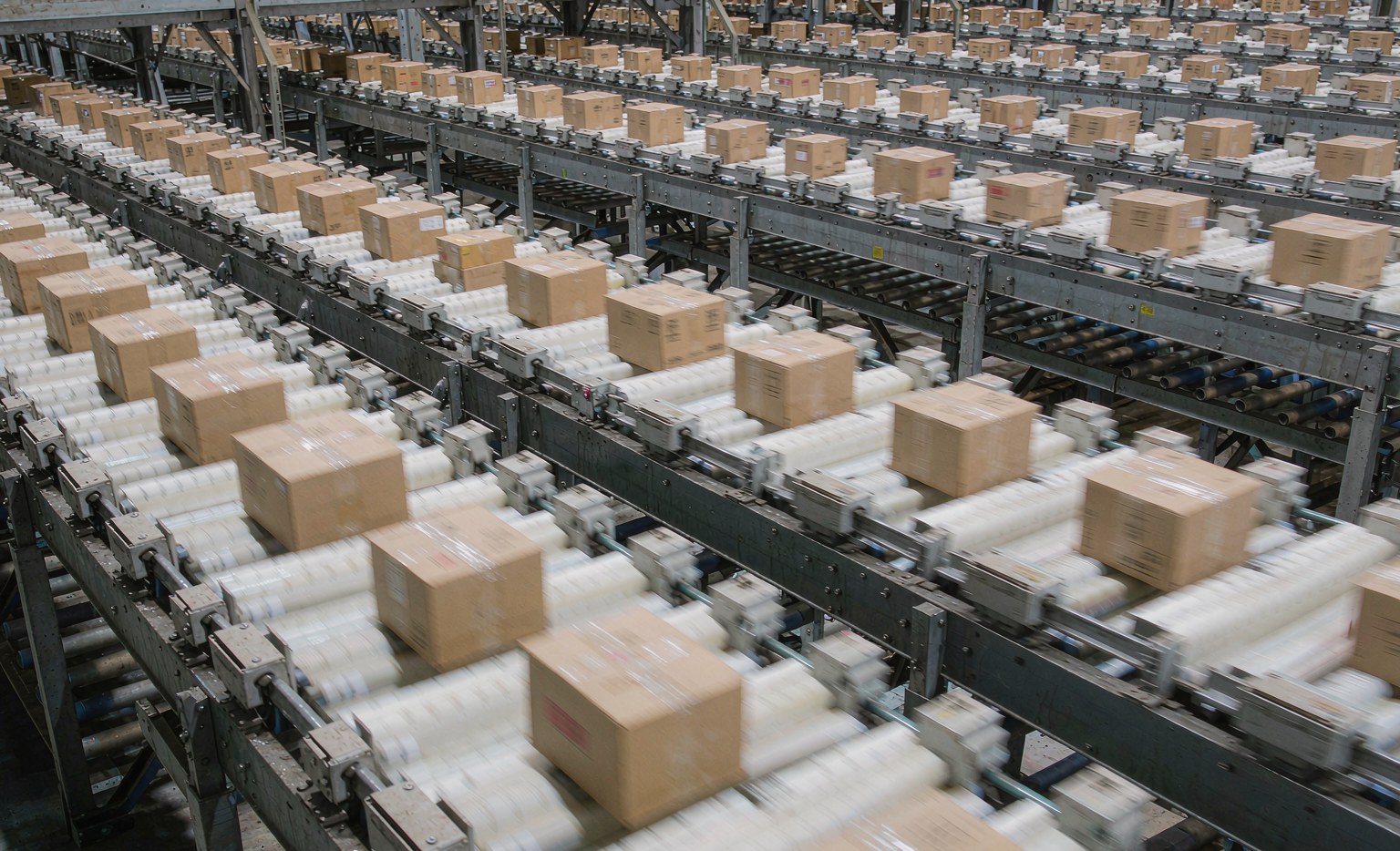
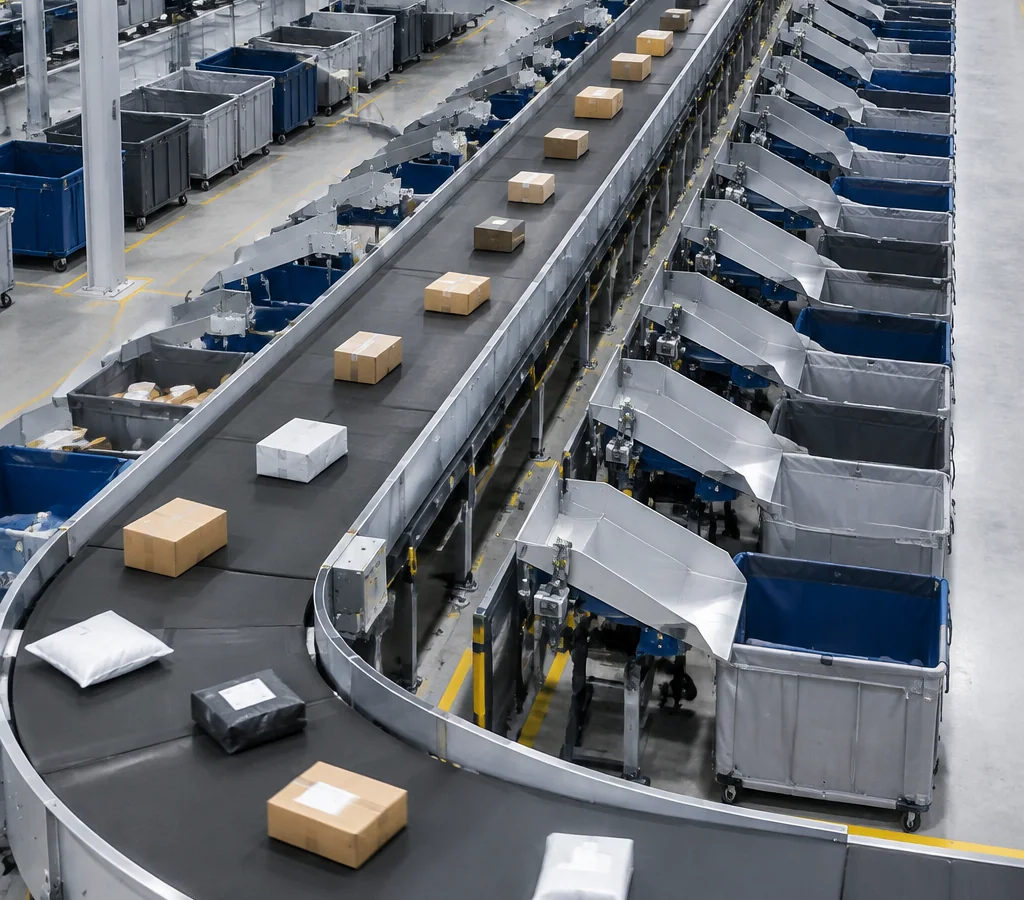
- High-Speed Sortation (Fixed System): The cross belt sorter takes over. It scans, weighs, and routes the parcels at 2.5 meters per second, distributing them to hundreds of distinct shipping chutes simultaneously.
- Automated Consolidation: At the destination chutes, smaller AMRs or AGVs automatically collect full shipping sacks and transport them to the outbound trailer doors.
4. Hardware Case Study: The 3D Put Wall Sorter
One of the most profound examples of this technological synergy is the 3D Put Wall Sorter TR350100. It epitomizes the blend of robotics and fixed infrastructure. Instead of a massive steel loop or a purely free-roaming fleet, this system utilizes a fixed multi-level vertical framework. Inside this framework, specialized carrier robots (a form of captive AMR) travel horizontally and vertically at immense speeds to deposit items into hundreds of specific order cubbies. This hybrid equipment delivers the accuracy and space-saving verticality of a fixed system, with the independent redundancy and intelligent routing of automated warehouse robotics.
5. Frequently Asked Questions (FAQ)
Q: Which should I invest in first: AMRs or a fixed automated sorting system?
A: Data suggests investing in the fixed sorting system first. Establish your high-speed “highway” using a cross-belt or narrow-belt sorter to instantly relieve outbound bottlenecks. Once your baseline throughput is secured, you can incrementally deploy AMRs to automate the inbound induction and point-to-point transport tasks.
Q: Can legacy warehouse control systems (WCS) manage both AMRs and conveyors?
A: Most legacy systems cannot natively synchronize the two. You will need an upgraded Warehouse Execution System (WES) or a modern WCS that acts as an orchestration layer, translating task commands between the AMR fleet management software and the PLC controls of the fixed sorter.
Q: Do AMRs really reduce fixed infrastructure costs?
A: Yes. By using AMRs for long-distance transport within the facility, you eliminate the need to purchase, install, and maintain thousands of feet of non-value-adding transport conveyors, reserving your capital strictly for high-value automated sorting machinery.
6. Conclusion: Engineering the 2026 Facility
The future of warehousing demands a departure from binary thinking. The data clearly shows that autonomous mobile robots (AMR) are not the enemy of fixed automation—they are its ultimate compliment. By feeding high-speed fixed sorters with the boundless flexibility of AMR fleets, businesses create an agile, high-throughput robotic warehouse capable of weathering any labor shortage or volume spike. Are you ready to analyze how a hybrid automated architecture can multiply your facility’s ROI? Explore our comprehensive warehouse solutions, and contact Truelisort’s data engineering team today. Let us run a data simulation on your current material flow to design your future-proof facility.

Truelisort Systems
Global pioneers in intralogistics data analytics, AMR integration, and high-speed automated sortation technology.
✉️ Email: business@truelisort.com | 📱 WhatsApp: +86 18658557670 🔗 Connect on: LinkedIn | YouTube | Facebook