Automated sorting systems are the backbone of modern high-volume fulfillment centers, 3PL warehouses, and courier networks. Among the various automated sorting technologies available, the cross belt sorter is highly valued for its speed, routing accuracy, and gentle handling of diverse package profiles.
To design an efficient facility or manage ongoing system maintenance, operations directors and procurement teams must understand the mechanical and electrical sub-assemblies of these platforms. This guide provides a detailed technical breakdown of what are the components of a cross belt sorter, explaining how each component contributes to sustained throughput and long-term system reliability.
—
Section 1: The Core Components of a Cross Belt Sorter
A cross belt sorting system is an integrated assembly of mechanical hardware and electronic controls. Let’s examine the five primary modules that drive the sortation cycle.

1. The Sorter Carrier Assembly
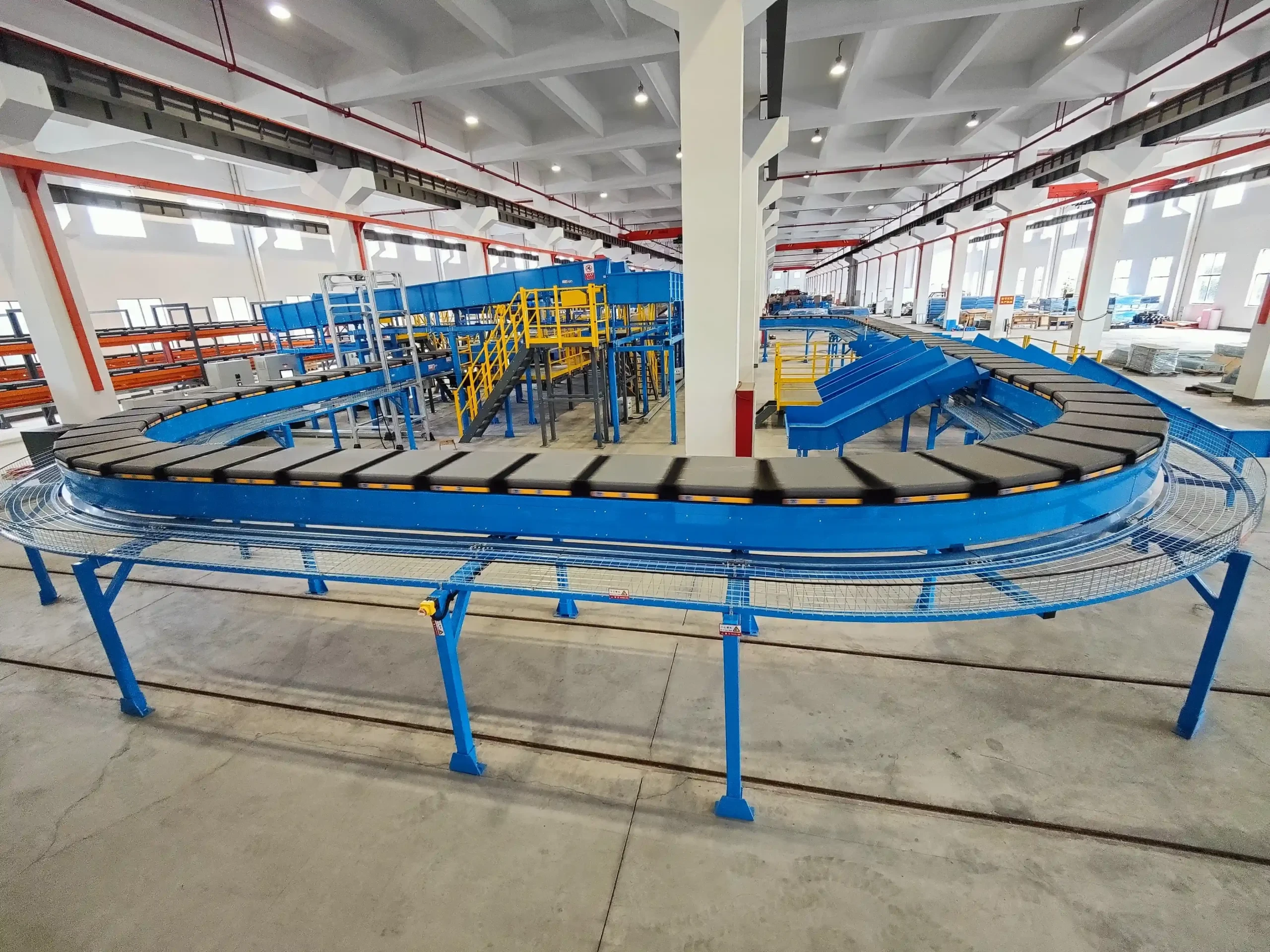
The sorter carrier is the individual carriage that transports the parcel along the track. In a loop or linear cross-belt system, hundreds of these carriages are coupled together using high-strength connecting links or chains to form a continuous loop.
The carrier is a self-contained mechanical module consisting of:
- The Carrier Frame: An ultra-lightweight, high-strength aluminum or steel chassis designed to minimize system weight and reduce energy consumption.
- The Onboard Belt Conveyor: A high-friction, anti-static belt that carries the package. This belt remains completely stationary relative to the carrier during transport, preventing the package from slipping or spinning.
- The Drive Roller and Motor: A compact 24V or 48V DC brushless motor located inside the carrier’s drive roller. When triggered, this motor runs the carrier’s belt perpendicular to the main track, discharging the package into its target chute.
- polyurethane Wheels: High-durability, precision-molded wheels that ride along the steel track rails, delivering smooth, low-noise transport at high speeds.
For operations processing a wide range of parcel sizes, systems like the TrueliSort TR500-1100 Cross Belt Sorter feature robust carrier frames designed to handle payloads up to 35 kg while maintaining precise carriage stability.
2. The Main Drive System
The main drive system propels the continuous chain of carriers along the structural track. In the global parcel automation market, there are two primary drive technologies:
- Motorized Friction Drives: Traditional drives that use motorized polyurethane friction wheels pressed against the carrier chassis to push the loop along the track. They are highly reliable and cost-effective but generate moderate physical wear and friction dust, requiring regular track maintenance.
- Linear Synchronous Motors (LSM): Modern, high-speed systems utilize non-contact LSM drives. These motors use magnetic fields generated by stationary stator blocks along the track to pull permanent magnets mounted on the underside of each carrier. Because there is no physical contact or moving parts in the drive mechanism, LSM drives are silent, highly energy-efficient, and require virtually zero mechanical maintenance.
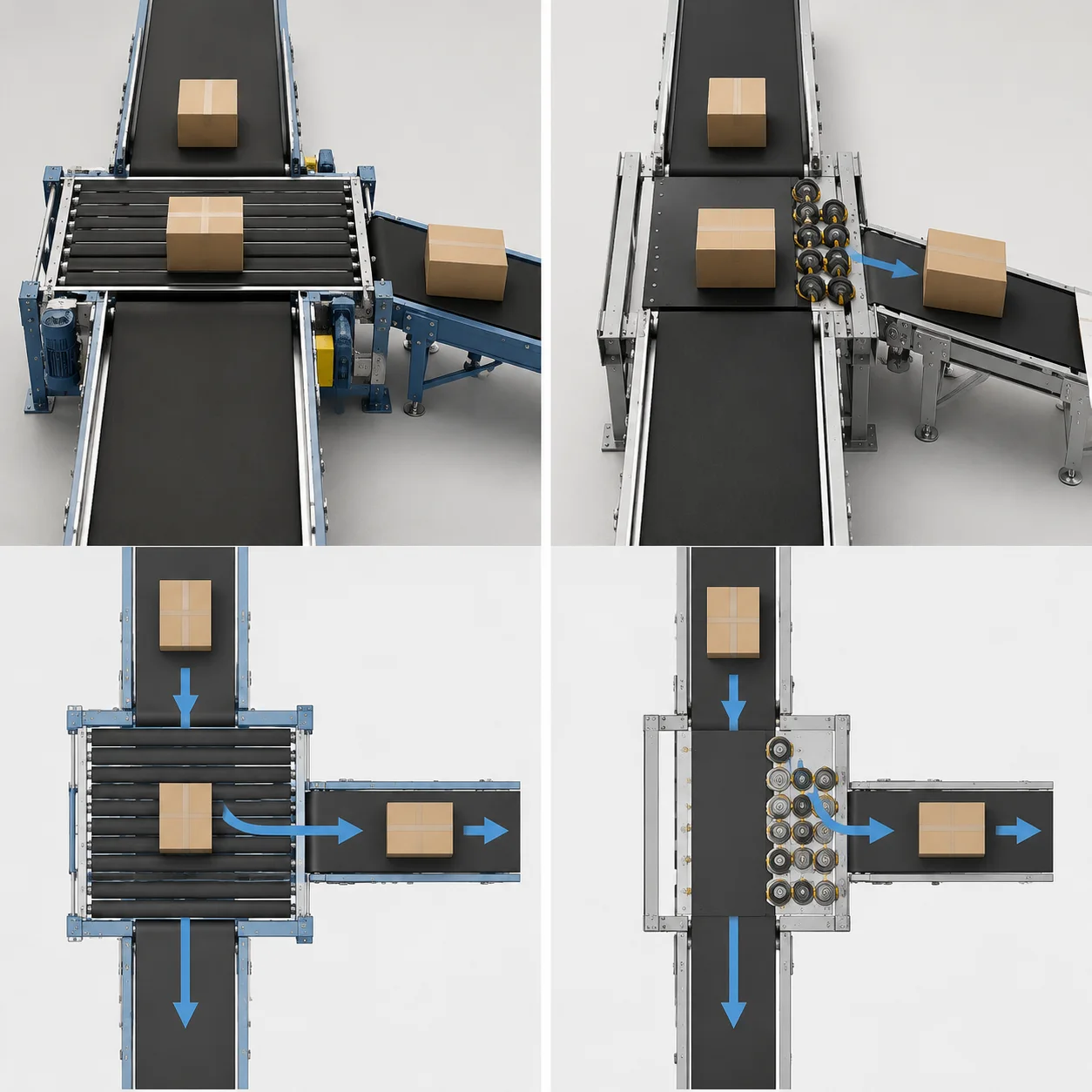
3. The Induction Conveyor System
The induction conveyor is the feeding system that places incoming packages onto the moving carriers. To ensure high-speed sorting accuracy, the induction line must be highly synchronized with the sorter’s linear speed.
A typical automated induction zone consists of a multi-stage conveyor system:
- The Infeed & Singulation Conveyor: Receives a stream of packages, separates side-by-side items, and aligns them into a single-file line.
- The Spacing & Gapping Conveyor: Uses photo-eye sensors and variable-speed belts to adjust the precise physical gap (pitch) between adjacent packages.
- The Vector Acceleration Conveyor: The final stage of the induction line. It reads the package’s weight and dimension data and accelerates the belt to match the linear speed and angle of the passing carrier carriage, depositing the package precisely in the center of the target carrier.
4. The Discharge Chute Zone
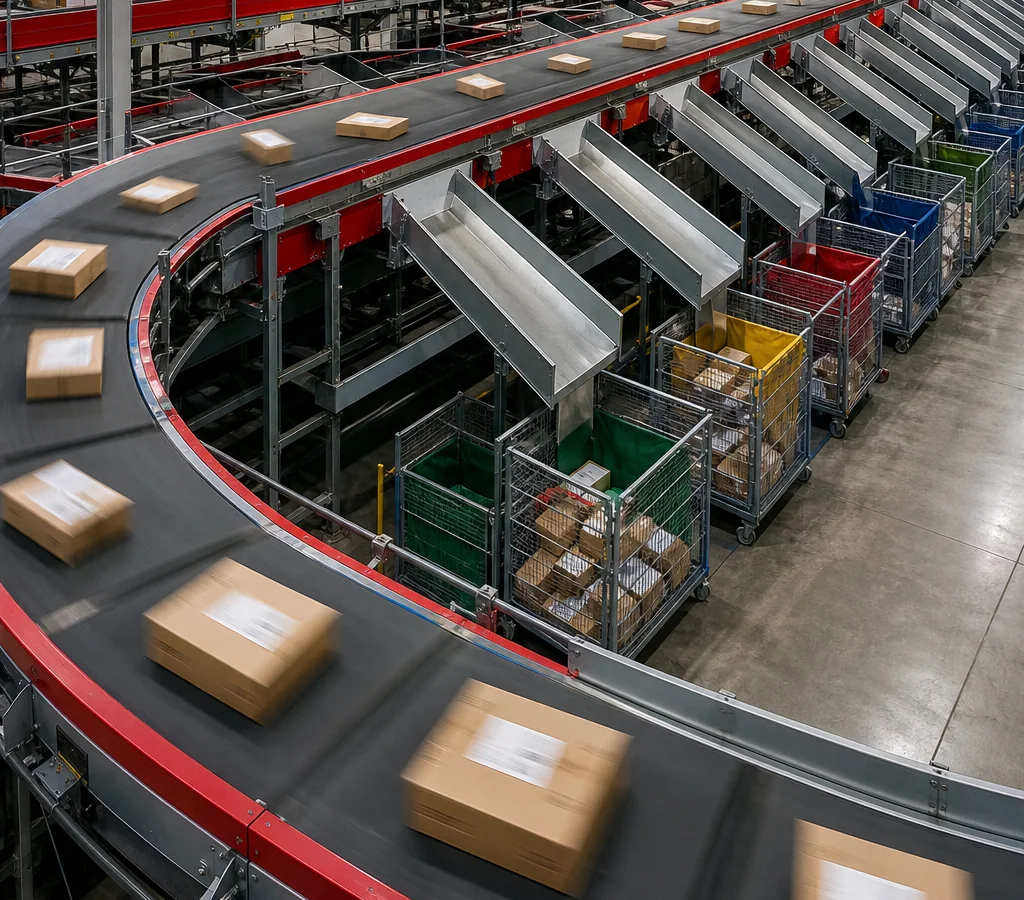
The discharge chute is the destination outlet where sorted packages are collected. Depending on your facility’s layout and shipping volume, chutes are configured in several ways:
- Gravity Slide Chutes: Standard, low-maintenance chutes lined with low-friction stainless steel or high-density polyethylene. Packages slide down the chute under gravity directly into postal bins or shipping bags.
- Motorized Powered Chutes: Used for fragile or heavy items. These chutes incorporate active belt or roller conveyors that slow down or speed up packages to prevent collisions and damage.
- Dual-Chute Configurations: Feature a split-gate mechanism that routes packages into two separate bins from a single discharge point, maximizing sorting capacity in tight physical layouts.
5. Control and Communication Systems
The entire physical sortation cycle is managed by a synchronized control network:
- Programmable Logic Controllers (PLCs): Manage the physical inputs and outputs, tracking carrier positions along the rails and triggering the onboard carrier motors at the precise microsecond they align with target chutes.
- Non-Contact Power Transfer: Onboard carrier motors receive power either through continuous copper busbars with sliding carbon brushes or via non-contact Inductive Power Transfer (IPT) systems.
- Wireless Communication Controllers: Infrared or RF wireless modules transmit real-time discharge commands from the central control PLC to each individual moving carrier, ensuring instant communication.
—
Section 2: Component Selection & Maintenance Guide
The table below compares the primary choices for key cross belt sorter components, assisting procurement teams in selecting the optimal configuration for their facility.
| Component Module | Standard Market Choice | Advanced/High-Speed Choice | Key Maintenance Indicator |
|---|---|---|---|
| Main Propulsion Drive | Motorized Friction Wheels (Friction-based) | Linear Synchronous Motors (LSM – Non-contact) | Check friction wheel wear patterns; monitor LSM magnetic air-gap clearance. |
| Carrier Power Delivery | Copper Busbars with sliding carbon brushes | Inductive Power Transfer (IPT – Non-contact) | Measure carbon brush wear rates; clean busbar tracks monthly. |
| Carrier Belt Motor | Mechanical gear-actuated belts | Brushless DC (BLDC) motorized drum rollers | Check carrier belt tension; monitor motor current draw anomalies. |
| Induction Method | Manual Operator Station | Multi-Stage Dynamic Vector Acceleration Conveyor | Clean photo-eye sensors weekly; calibrate induction belt speed encoders. |
Performance Note: Sorter component selection directly impacts system-level reliability. While friction-drive systems are highly cost-effective, high-speed operations running 24/7 typically utilize LSM drives and IPT power transfer to minimize wear, reduce noise, and lower overall maintenance costs.
—
Section 3: Key Technical Specifications to Evaluate during Procurement
When reviewing technical specifications from automated sorting system manufacturers, your engineering and procurement teams should focus on several core parameters:
- Carrier Pitch Spacing: The physical center-to-center distance between adjacent carriers. A shorter pitch spacing allows for a higher concentration of carriers along the track, directly maximizing your potential throughput (PPH) at any given line speed.
- Wheel Polyurethane Durometer: Track wheels should utilize high-grade, noise-damping polyurethane with a hardness rating of 92 to 95 Shore A. This durometer provides the optimal balance of wear resistance, load capacity, and quiet operation along the steel guide rails.
- Integrated Chute-Full Sensors: Every discharge chute should incorporate photoelectric retroreflective sensors. When a chute becomes full, these sensors instantly alert the control WCS to route subsequent packages to the recirculation loop, preventing system jams.
Partnering with an experienced manufacturer that specializes in custom engineering—such as TrueliSort—ensures that every mechanical and electrical component of your sorting system is selected and scaled to match your specific package profiles, throughput targets, and warehouse footprint constraints.
—
Frequently Asked Questions
Q1: What are the core mechanical components of a cross belt sorter?
The core mechanical components include the carrier assembly (with wheels, frame, and belt), the induction conveyor system, the discharge chutes, the structural track/rails, and the main drive system (which typically utilizes friction wheels or non-contact Linear Synchronous Motors).
Q2: How does a carrier belt receive power to run perpendicular to the main track?
Onboard carrier motors receive power either through continuous copper busbars with sliding carbon brushes or via non-contact Inductive Power Transfer (IPT) systems. When the carrier aligns with its target chute, the WCS triggers the onboard controller to power the 24V or 48V DC brushless motor located inside the carrier’s drive roller.
Q3: Why are Linear Synchronous Motors (LSM) preferred over friction drives?
LSM drives utilize non-contact magnetic forces to propel the carriers, completely eliminating physical contact, drive-wheel wear, and friction-induced dust. They deliver silent operation, precise speed control, higher energy efficiency, and lower long-term maintenance costs than traditional motorized friction wheels.
Q4: What is the function of a dynamic vector acceleration conveyor in the induction zone?
The vector acceleration conveyor is the final stage of the induction line. It reads the package’s weight and dimension data and accelerates the belt to match the linear speed and angle of the passing carrier carriage, depositing the package precisely in the center of the target carrier.
—
Plan Your Parcel Sorting Automation Project
Ready to design an optimized, high-reliability automated sorting system or replace aging sorter components in your existing facility? Our experienced engineering team can help you analyze your operational requirements and select the right components for your system.
TrueliSort is a manufacturer and system solution provider specializing in customized parcel sorting systems, offering factory-direct design, manufacturing, and on-site support.
Contact our engineering team to plan your project or email us directly at business@truelisort.com to schedule a technical consultation.