
The choice between a cross belt sorter and a narrow belt sorter depends entirely on your sortation center’s throughput and item profile. A cross belt sorter is best for high-speed, diverse item sorting (up to 30,000+ parcels per hour), including fragile items and polybags. A narrow belt sorter is a highly cost-effective solution designed for medium-speed environments (up to 10,000 pph) handling standard cartons, boxes, and flat bottom items.
As e-commerce continues to evolve in 2026, modern sortation centers are facing unprecedented pressure. With consumer demands for next-day and same-day delivery skyrocketing, choosing the right automated sorting systems for e-commerce is no longer just an operational upgrade—it is a survival necessity.
According to the 2026 Intralogistics Modernization Report by Material Handling Institute (MHI), fulfillment centers that upgraded their automated sortation saw a 34% increase in daily throughput. But when it comes to upgrading, facility managers frequently encounter a critical dilemma: Cross Belt Sorter vs. Narrow Belt Sorter. Which one actually delivers the best ROI for your specific operations?
In this comprehensive guide, we will break down the working principles, performance metrics, and cost-efficiency of both systems to help you make an informed decision.
1. Side-by-Side Comparison: At a Glance
Before diving into the deep technical details, let’s look at how these two dominant technologies compare across key dimensions. This table provides a clear performance baseline for any modern sortation center.
| Comparison Metric | Cross Belt Sorter | Narrow Belt Sorter |
|---|---|---|
| Throughput Capacity | Very High (10,000 – 30,000+ pph) | Medium to High (3,000 – 10,000 pph) |
| Item Profile Compatibility | Excellent (Polybags, fragile, odd shapes) | Good (Cartons, totes, flat-bottom boxes) |
| Footprint / Space Needed | Large (Often requires loop or long linear space) | Compact (Easily integrates into existing conveyors) |
| Initial Capital Investment | High ($$$) | Moderate ($$) |
| Maintenance Complexity | High (Complex individual carrier mechanics) | Low to Moderate (Standard belt/roller maintenance) |
2. Deep Dive: The Cross Belt Sorter
How Does a Cross Belt Sorter Work?
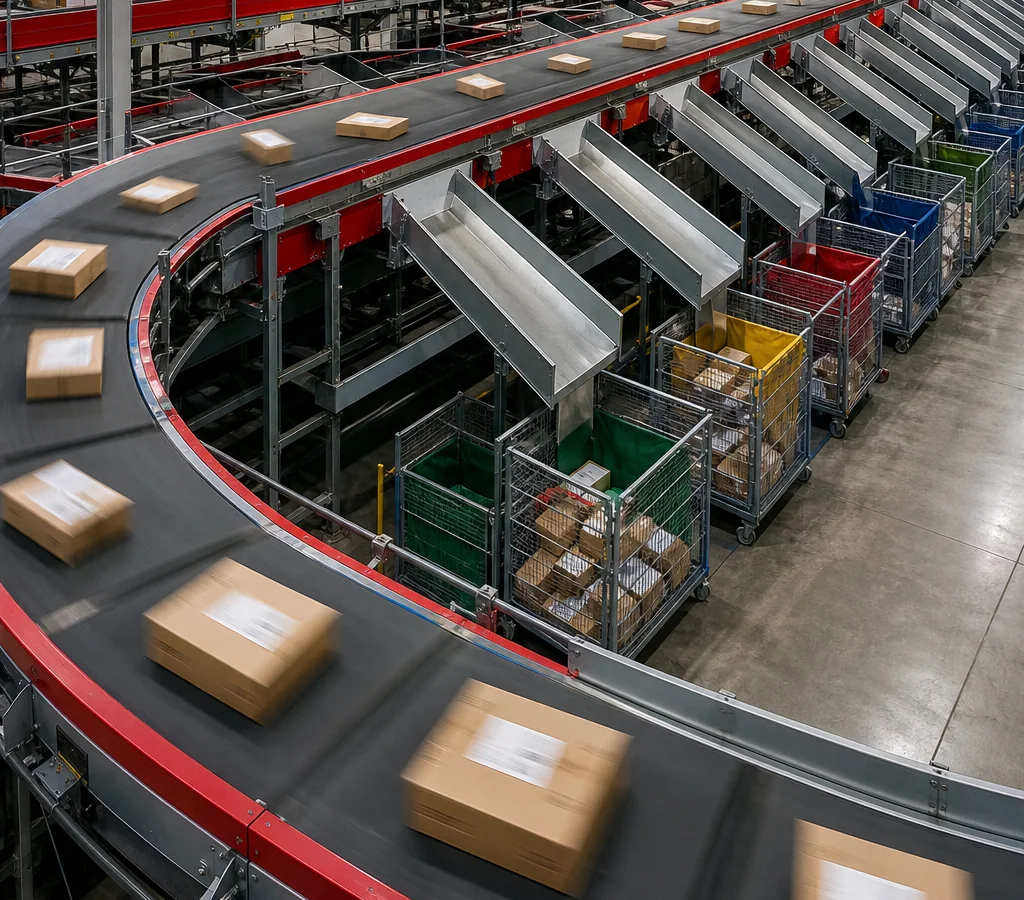
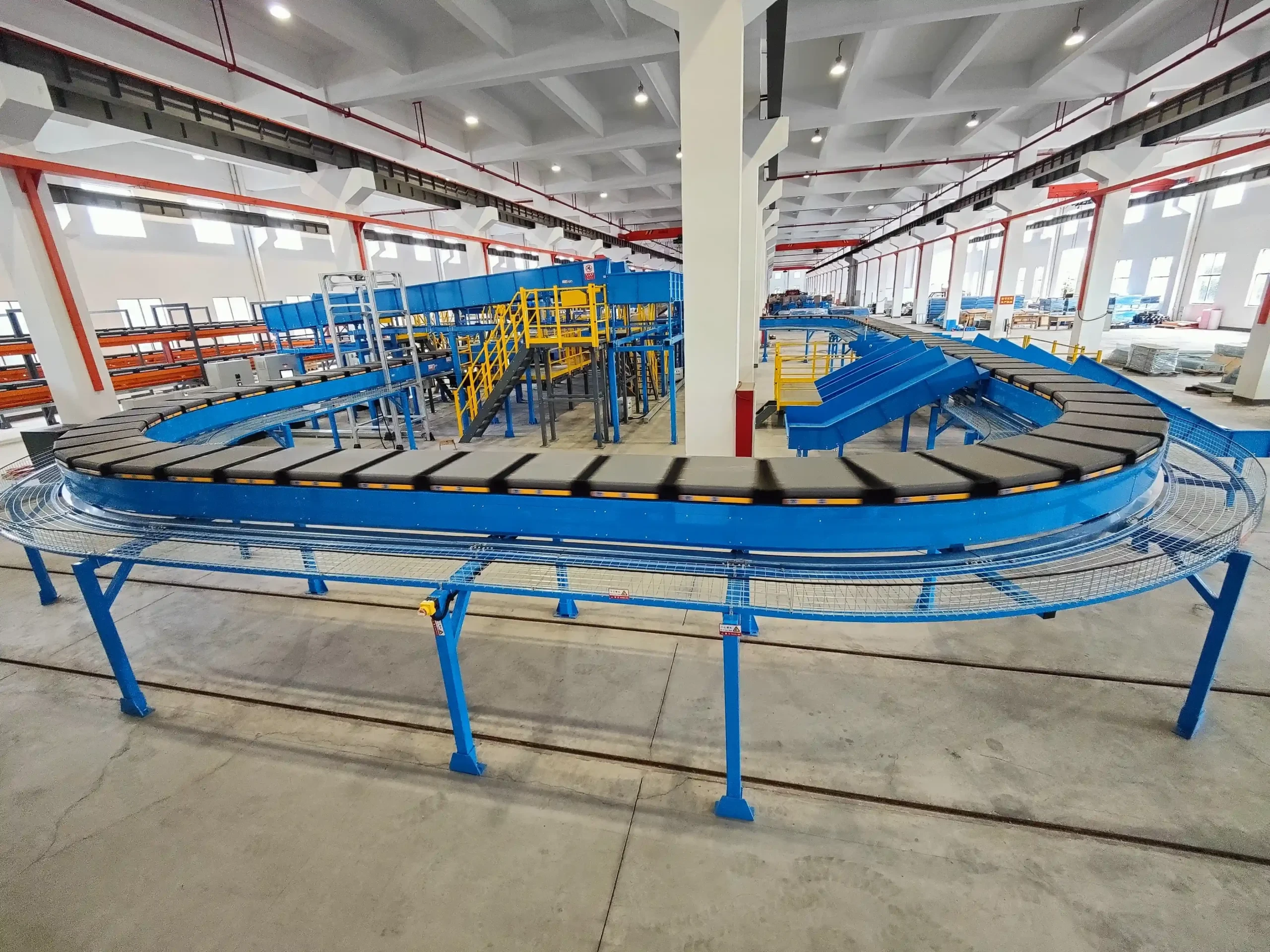
A cross belt sorter utilizes a train of individual, mechanically independent carrier carts moving along a continuous track (either in a linear or loop configuration). Each cart is equipped with a short, bi-directional conveyor belt. When the cart reaches the designated destination chute, the mini-belt activates perpendicular to the travel direction, gently discharging the item.
Pros of Cross Belt Systems
- Ultimate Versatility: Because items rest completely on the individual carrier belts rather than sliding across rollers, this system can handle 99% of e-commerce packaging, including flimsy polybags, cylindrical tubes, and extremely fragile goods.
- Unmatched Throughput: Modern cross belt sorter systems can achieve blazing speeds, easily surpassing 20,000 to 30,000 items per hour, depending on the induction method and loop size.
- High Accuracy: The precise motor control reduces mis-sorts to nearly zero, making it ideal for high-volume postal and express courier operations.
Cons of Cross Belt Systems
- High Initial Cost: The sophisticated engineering of individual motorized carts makes this a heavy capital expenditure.
- Space Requirements: Loop configurations require substantial warehouse floor space, which might not be viable for smaller fulfillment centers.
If your facility handles massive volumes of varied B2C e-commerce orders, equipment like the TR400-700 Cross Belt Sorter by Truelisort provides the robust durability and high-speed precision required to meet strict shipping cut-off times.
3. Deep Dive: The Narrow Belt Sorter
What is a Narrow Belt Sorter?
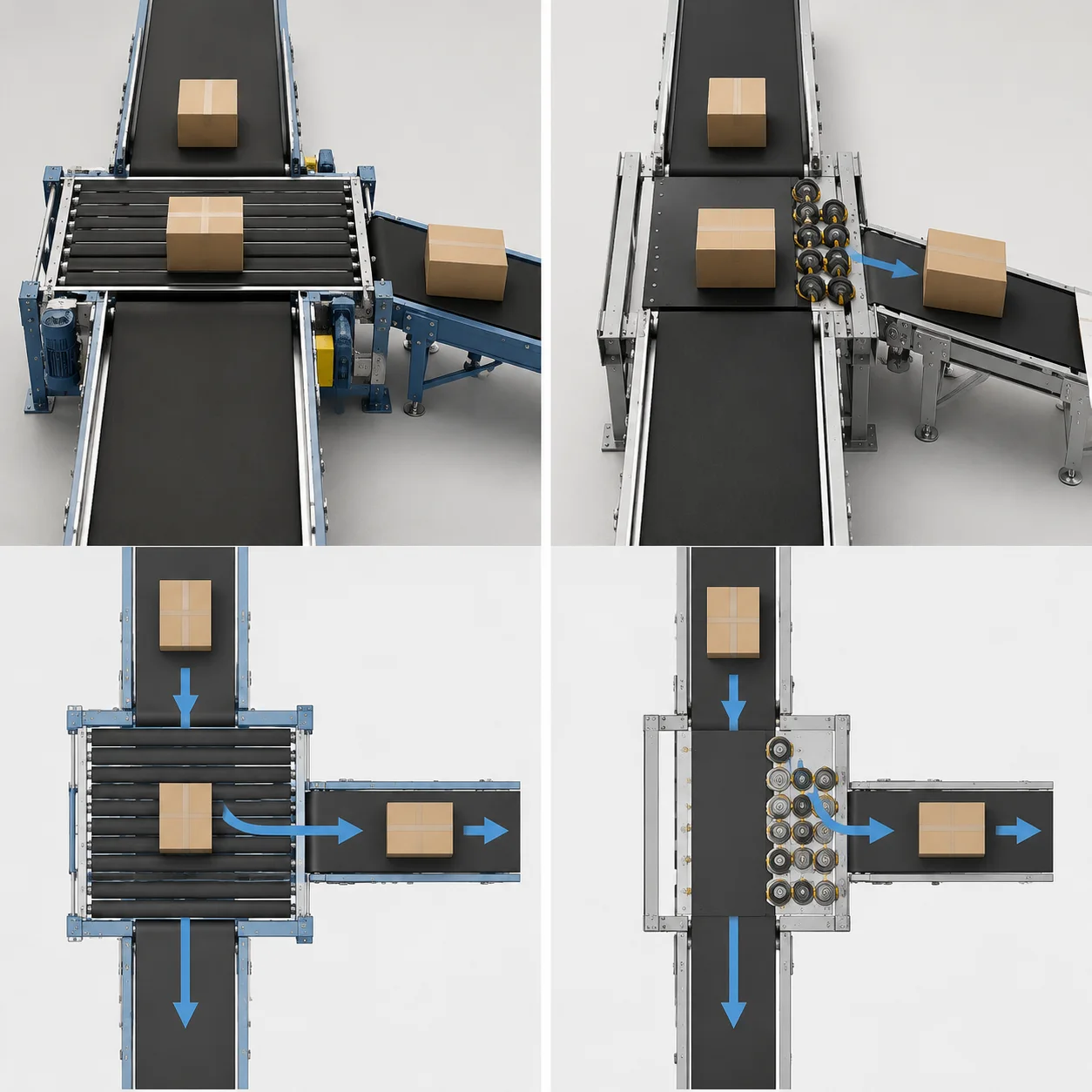
A narrow belt sorter features multiple parallel, narrow conveyor belts operating continuously. When a parcel needs to be diverted, pop-up rollers (or steerable wheels) located between the narrow belts rise up pneumatically or electrically. These rollers make contact with the bottom of the parcel, lifting it slightly and diverting it at specific angles (usually 30, 45, or 90 degrees) down a sortation lane.
Pros of Narrow Belt Systems
- Cost-Effective: Significantly lower initial investment compared to cross belt systems, making it accessible for mid-sized logistics centers.
- Seamless Integration: These systems boast a modular design. A narrow belt sorter can be easily retrofitted into existing conveyor lines without massive facility redesigns.
- Quiet & Low Maintenance: With fewer individual moving motors compared to a cross-belt loop, maintenance is straightforward, relying on standard belt tracking and roller lubrication.
Cons of Narrow Belt Systems
- Item Restrictions: The pop-up divert mechanism requires items to have a flat, rigid bottom. They struggle with thin polybags, envelopes, or highly irregularly shaped items, which can get caught between the belts.
- Lower Speed Ceiling: While efficient, narrow belt sorter capacity generally caps out around 5,000 to 10,000 parcels per hour.
For operations primarily dealing with standard boxes, cartons, and totes, the TR200-1750 Narrow Belt Sorter delivers exceptional cost-to-performance ratio and reliable multi-angle diverting.
4. How to Choose the Right System for Your Sortation Center
When our engineers at Truelisort consult with warehouse managers in 2026, we typically use the following 4-step decision matrix to determine the perfect automated sorting systems for e-commerce:
- Analyze Your Packaging Mix: Look at a month of historical data. If more than 20% of your outbound shipments are in polybags, jiffy mailers, or irregular items, a cross belt sorter is almost mandatory to prevent jams. If 95% of your volume is rigid corrugated boxes, a narrow belt system is more than sufficient.
- Calculate Peak Throughput Needs: Don’t buy for average days; buy for Black Friday and Cyber Monday. If your peak hour requires sorting over 12,000 items, you are entering cross-belt territory.
- Evaluate Floor Layout: Measure your available intralogistics space. Narrow belt sorters can be installed in tight, linear configurations. Cross belt systems often require dedicated mezzanine levels or wide loop setups.
- Budget & ROI Horizon: Narrow belt sorters offer a faster ROI for medium-volume centers (typically 18-24 months). High-volume centers will see a longer ROI on cross-belt systems (3-5 years) but will save massively on labor costs in the long run.
5. Frequently Asked Questions (FAQ)
Here are some of the most common questions facility operators ask when comparing sorting technologies.
Q: Can narrow belt sorters handle polybags?
A: Generally, no. Standard narrow belt systems use pop-up rollers that require a rigid, flat surface. Polybags tend to sag into the gaps between the belts, causing jams, tearing, and system downtime. For polybags, cross-belt or shoe sorters are highly recommended.
Q: What is the maximum narrow belt sorter capacity?
A: Depending on the parcel length and conveyor speed, a high-quality narrow belt sorter capacity ranges between 3,000 and 10,000 units per hour. Pushing it beyond this limit often results in sorting errors and missed diverts.
Q: Are cross belt sorters louder than narrow belt sorters?
A: Historically, yes. However, thanks to 2026 advancements in frictionless linear induction motors (LIM) and premium polyurethane wheels used by top manufacturers like Truelisort, modern cross belt systems operate at a surprisingly low decibel level, comparable to standard conveyors.
6. Conclusion & Next Steps
Both the cross belt sorter and the narrow belt sorter are highly effective intralogistics tools, but they serve different operational realities. If your sortation center thrives on high-speed, diverse B2C e-commerce fulfillment containing polybags and fragile items, investing in a cross belt system is the definitive path forward. Conversely, if your operation focuses on standard cartons, totes, and B2B distribution, a narrow belt sorter provides unmatched value and easy integration.
Still unsure which technology aligns with your growth projections? Contact the experts at Truelisort today. Our team will analyze your material flow, throughput data, and facility layout to engineer the perfect automated sortation solution for your business.