




A sortation line does not need less maintenance because it was specified well; it needs its maintenance scheduled better. Most operators treat downtime as an interruption to be minimised in isolation – shorten the window, work faster, skip the task that looks optional – and pay twice: once in rushed work, and again in an unplanned stop on the busiest day of the quarter.
Planned downtime behaves differently from unplanned downtime in one decisive way: you choose when it happens. That choice is worth designing deliberately, and the design is not complicated – it is a calendar, a task list and an honest view of your volume curve.
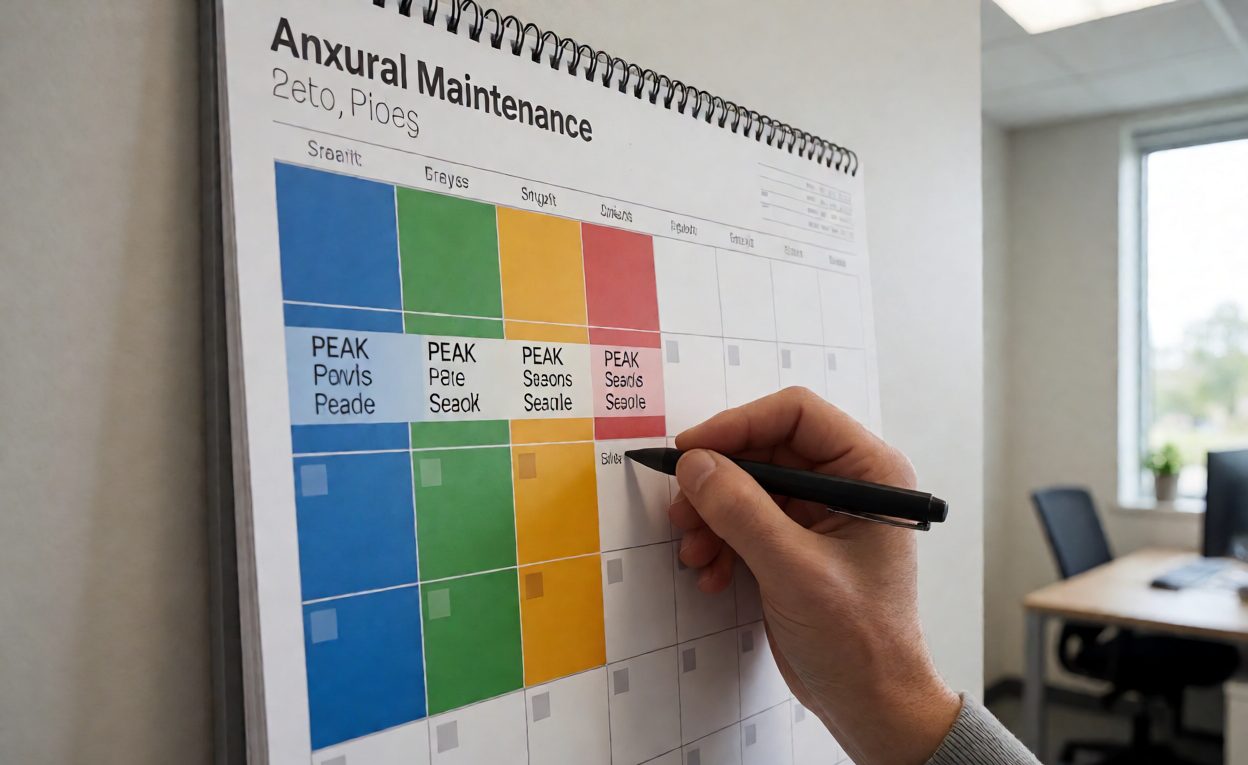
Start From the Volume Curve, Not the Checklist
The first step is not listing maintenance tasks; it is drawing the demand the site actually sees. Most parcel operations have pronounced peaks: intra-week peaks around weekend cut-offs, monthly or promotional peaks, and seasonal ones that can double typical volume. Overlay the shift pattern and the candidate slots become obvious – the quietest part of the quietest day.
Taking a window whenever the line happens to be free produces maintenance done in fragments, without the parts or people to complete it. A monthly window protected by policy outperforms a flexible approach every year.
Tiering the Work
Maintenance tasks differ enormously in the downtime they need, and mixing them in one window wastes expensive time. Four tiers cover a sortation line:
- Shift-level tasks, two to fifteen minutes, done at natural breaks: visual inspection, clearing sensor fouling, emptying reject positions, checking belt tracking.
- Daily and weekly tasks, thirty minutes to two hours: lubrication routes, filter changes, chasing loose fastenings, cleaning photo-eyes and carrier contact surfaces.
- Planned periodic stops, half a shift to a shift, typically monthly or quarterly: wear measurement, alignment checks, belt tensioning, control cabinet servicing and the corrective items accumulated since the last stop.
- Annual or multi-year shutdowns, one to several days: component replacement, major overhauls, upgrades, and anything requiring access normally blocked by the operating configuration.
The discipline is that each task is assigned to a tier in advance and carries an estimated duration. Work that habitually overruns its tier belongs in the next one up, not in overtime.

What Happens During the Window
A well-run window looks boring, which is the intended result. The sequence that works: a published work list with task, owner and estimated duration; parts staged and verified as present before the line stops; lockout and isolation applied properly with named responsible people; execution against the list with deviations recorded rather than absorbed; a short restart and verification run before handover; and a written close-out that feeds next window’s list.
Two habits do most of the work. First, never cancel the whole window because volume is inconvenient – a protected minimum block protects the machine from the drift that produces unplanned stops. Second, keep a rolling deferral list; tasks pushed at the last minute should be visible, because persistent deferral is the earliest indicator that too little maintenance time has been bought.
How Much Downtime to Buy
How much planned downtime is reasonable follows the operating pattern. Continuous high-utilisation operations – three shifts, six days – need daily micro-windows plus a substantial protected periodic stop, or redundancy that lets part of the line run while the rest is serviced. Single-shift operations have it easier: overnight is a natural window, and the constraint becomes labour cost rather than availability.
Either way the agreement matters. Window length, frequency, notice for changes, and who may authorise overtime running that eats into a window belong in the arrangement described in warranty and service response terms, alongside the commitments covering whatever the window does not.

Peak Season Rules
Peak changes the rules but not the principle. Two standard approaches work: a maintenance embargo during the defined peak weeks, preceded by a heavier window immediately before it, and a reduced-frequency regime during peak with only essential tasks permitted, where essential means failure-mode-driven rather than comfort-driven. What does not work is running through peak with everything deferred and nothing tracked, because that debt arrives in January as a cluster of faults.
Parts availability is the companion decision. Peak windows need spares on the shelf, not on order, which is precisely the argument for the arrangements in consignment and vendor-managed inventory, and the specific items are chosen through the critical spares list. The annual heavy window should be scheduled from carrier and chain wear monitoring rather than from the calendar, so the shutdown lands when the measurements say it is needed.
Technical Background
Routine work performed before failure to preserve function is preventive maintenance, and its value depends almost entirely on the interval being right for the failure mode rather than being as frequent as possible. Scheduling against measured condition rather than elapsed time is the principle behind condition-based maintenance, which is what turns a fixed calendar into a responsive one. The whole practice rests on reliability engineering, where availability is understood as a function of both failure rate and repair time – which is why shrinking the repair path matters as much as preventing the failure.
Putting this into practice means connecting the window plan to the task content in the preventive maintenance checklist and setting intervals with the method in building a scientific maintenance schedule. Whether the work is done by your own people or by a contracted team is examined in maintenance contract versus in-house team, and either route needs the cadence in lean preventive maintenance strategies to keep windows honest.
Frequently Asked Questions
How much planned downtime does a sorter need?
It follows utilisation. Multi-shift operations typically need daily micro-windows plus a protected monthly or quarterly stop; single-shift sites can use overnight periods.
Should maintenance stop entirely during peak?
Essential tasks should not stop. Reduce frequency, reserve parts, and run a heavier window immediately before the embargo, then clear the deferrals in January.
Who should be present during a window?
A named work owner plus the trades each task needs, with parts staged and verified before the line stops, and a clear isolation responsible person.
What if a window is overrunning?
Record the deviation, finish safety-critical items, move the remainder to the deferral list, and review whether the task belongs in a longer tier.
Should windows be fixed or flexible?
Fixed and protected. Flexible windows get consumed by production pressure, and maintenance performed in fragments rarely gets completed.
How do we know the intervals are right?
Track failures and wear measurements against them. Condition-based triggers beat calendar intervals for most wear-driven components.
Can part of the line run during maintenance?
Yes if the design provides redundancy or isolation by section, which is a procurement-stage question rather than an operational one.