
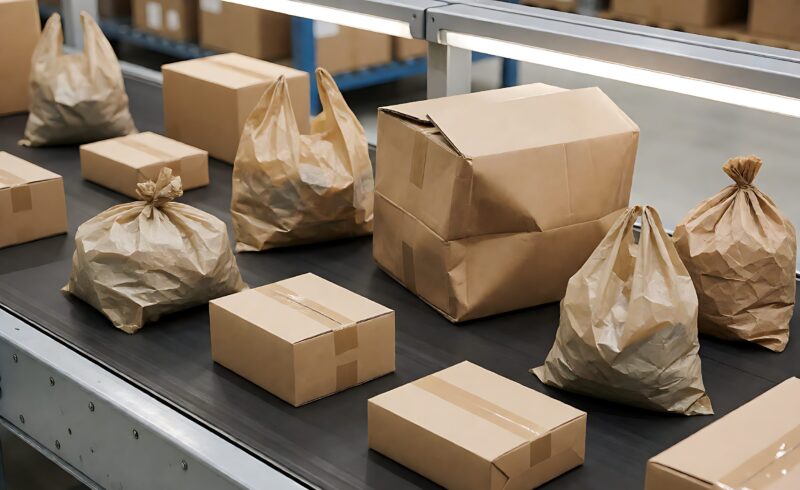

With the rapid growth of e-commerce, the demand for faster and more accurate order fulfillment has become a major challenge for logistics providers. Automated sorting systems are now at the forefront of warehouse modernization, enabling businesses to handle high volumes of parcels with precision and efficiency.
Modern sortation solutions like TRUELISORT’s Narrow Belt Sorter and Parcel Swivel Sorters are designed to process diverse package sizes and weights, ensuring smooth handling from inbound to outbound operations. These systems significantly reduce manual labor, minimize sorting errors, and increase throughput capacity.
Moreover, intelligent software integration allows real-time tracking, dynamic routing, and system scalability, making automated sorting an essential investment for companies aiming to stay competitive in the evolving logistics landscape.
Four Order Profiles, Four Sorting Problems
E-commerce sorting is not one problem but four, one per order profile. Systems that treat them identically disappoint on all of them:
| Order profile | Sorting challenge | What handles it well |
|---|---|---|
| Single-line orders | Raw speed; the parcel mix is predictable | High-rate loop with automated induction |
| Multi-line orders | Items arrive scattered across waves | Consolidation logic synced to wave planning |
| Returns | Unknown item until opened; condition grading | Dedicated return lane with inspection bench |
| Oversize / irregular | Singulation and tracking on odd geometry | Profile-tolerant trays and manual exception path |
Returns deserve the emphasis they rarely get in planning meetings: the day after a promotion, the return wave can match the outbound wave in volume while carrying none of the predictable structure. Operators who route returns through the outbound sorter as an afterthought discover that inspection, grading and re-stock decisions need dwell time the loop does not offer — and the exception queue grows until it jams the line. A return lane with its own induction and destinations turns that chaos back into a process. The resilience angle of this is covered in supply chain resilience through smart sorting, and the measurable efficiency gap in how smart sorting revolutionizes efficiency. Reference: e-commerce and order fulfilment.
Wave Planning: The Quiet Half of E-commerce Sorting
Order profiles describe what arrives; wave planning decides when it arrives at the sorter, and the two together determine performance. Releasing every order at once floods induction and starves destinations in the same minute; releasing too slowly protects the loop but misses cut-offs. The workable middle is profile-aware release — single-line orders flow continuously while multi-line orders batch into consolidation waves, and returns wait for their own scheduled window rather than competing with outbound. None of this requires new hardware; it requires the WMS and the sorter to share a clock and a vocabulary, which is exactly the interface contract worth specifying early. Sites that master wave planning often report the strangest metric improvement: the same sorter, same parcels, same staffing, finishing earlier — because the loop finally spends its hours sorting instead of buffering. The hardware side of that handshake is covered in the sorting anatomy article, and the returns-window logic in the resilience discussion above.
The E-commerce Ledger
For e-commerce operations specifically, the arithmetic here compounds across peak season: accuracy rates multiply through thousands of parcels per hour, and small percentage gains become hundreds of saved re-ships. The parcel-level economics are quantified in the parcel sorting economics, where the decisive shift framing gets its numbers.