

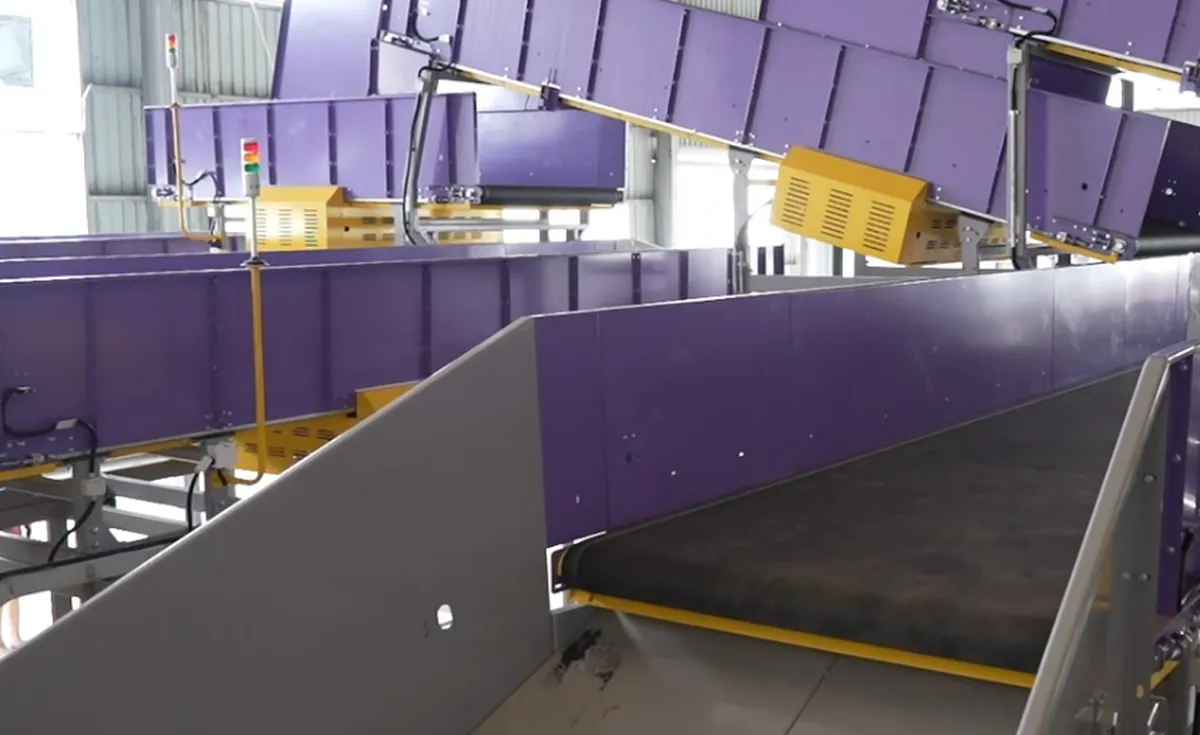
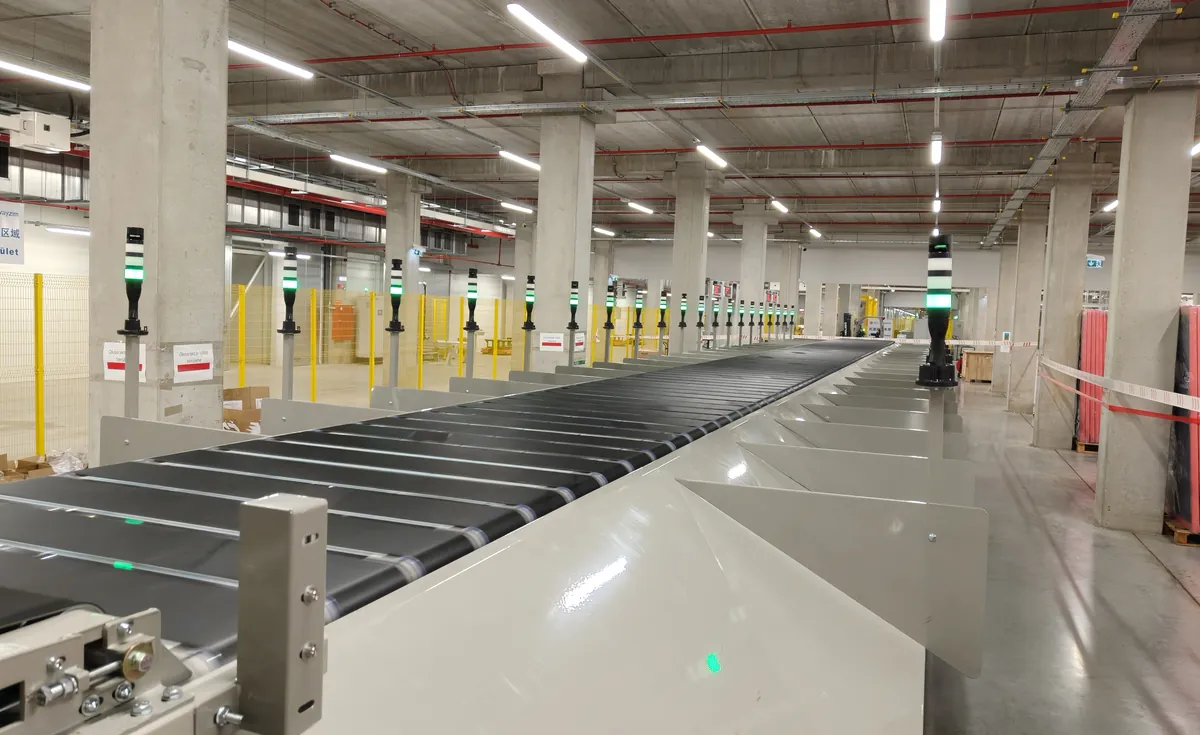
In the age of “same-day delivery” and rising customer expectations, speed and accuracy are critical in logistics operations. Manual sorting is labor-intensive and error-prone, making it increasingly unsustainable for high-volume order fulfillment. Automated sorting technologies have become an essential part of modern warehouses.
By automatically identifying parcel information and directing items to designated destinations, these systems can process over 6,000 parcels per hour, dramatically increasing throughput while minimizing human error and labor costs. Integration with ERP and WMS platforms ensures seamless data exchange and full process visibility.
A wide range of equipment — such as linear sorters, narrow-belt sorters, sliding shoe sorters, and telescopic conveyors — can be customized for different warehouse sizes and layouts, from large distribution centers to compact e-commerce fulfillment sites.
More than just a hardware upgrade, automation in sorting represents a strategic move toward digital transformation, empowering logistics operators to scale efficiently and remain competitive in a fast-changing market.
The Standard Is Set: What “From Manual to Intelligent” Costs Now
Intelligent automation has crossed from differentiator to standard, and standards change the arithmetic. What the crossing means in concrete terms:
| Dimension | When automation was optional | Now that it is standard |
|---|---|---|
| Labour market | Hiring was the flexibility lever | Shrinking applicant pool each season |
| Customer expectation | Delivery windows were negotiable | Next-day is the quote, not the aspiration |
| Cost position | Manual cost per parcel was viable | Wage curve outruns manual productivity |
| Competitive tender | Automation was a differentiator | It is a qualification criterion |
The last row is the quiet one with loud consequences. Contracts — especially retail and marketplace tenders — increasingly ask about peak capacity and error rates in the questionnaire, and “we hire harder” no longer scores. Facilities discovering this at tender time face the worst version of the investment decision: capital spent under deadline pressure, vendors chosen on availability rather than fit. The standardisation of automation rewards those who moved early not because the equipment was cheaper but because the transition was unhurried — process redesigned, staff retrained, profiles tested over quiet months instead of commissioned in panic. The maturity ladder for pacing that transition is in find your maturity level, and the four curves it bends in the curves automation reshapes. Reference: business process automation and competitive advantage.
The standard also moves whenever a competitor adopts. A capability that distinguished an operation in 2020 becomes the quotation baseline in 2025, which reframes the buy decision: the alternative to investing is not the status quo but a slow slide down the tender scorecards of customers who have already recalibrated. Reference: best practice diffusion and benchmark baselines.
The Warehouse-Scale View
Zoom out from the sorter and the warehouse-scale picture appears: induction feeds, singulation, sortation, dispatch waves — a chain whose rate is its slowest honest link. The warehouse-level framing of that chain, and where sorting sits inside it, is in the warehouse automation solutions.