

The mechanical heart of a cross-belt sorter is its chain and its carriers, and both wear in ways that are measurable long before they are expensive. Chain stretches as pins and bushings erode; carriers develop play in wheels and pivots; the track itself wears where thousands of load cycles pass over the same sections. None of this announces itself through a fault code. It shows up gradually, as alignment drift, increasing noise, occasional tracking problems – and eventually as a failure that takes the whole loop down at the worst possible moment.
The alternative is a wear monitoring plan: a short list of measurements, taken at defined intervals, recorded against thresholds, and reviewed as a trend. It needs no special equipment and perhaps an hour per month. This article sets out what to measure and how to turn the numbers into decisions.
What Wears and Why
Four elements dominate the wear budget:
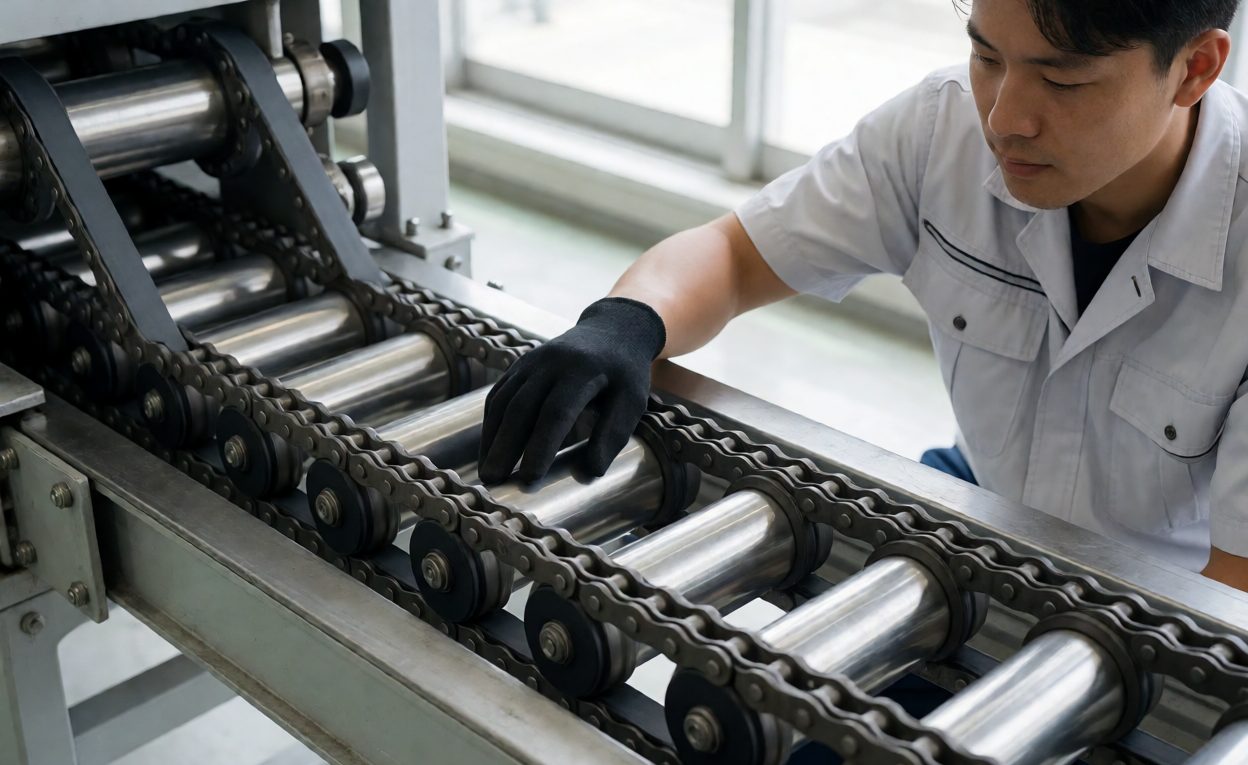
- Chain pins and bushings, which erode with every articulation around the loop’s curves. The visible result is elongation – the chain’s pitch grows as clearances open up.
- Carrier wheels and pivots, which develop play. Play means the carrier starts to rock and misalign on curves, and the belt underneath follows.
- Track and rail surfaces, which wear where load concentrates – typically on curves and at drive and corner sections rather than uniformly.
- Belts and their fasteners, the most frequently replaced items, whose wear is visible and usually handled as routine consumption.
The first three are the slow, structural ones. They are also the ones that interact: a stretched chain loads the track differently, worn carriers strike the rail, and each accelerates the others. That is why the monitoring plan covers all of them together rather than treating the chain as the supplier’s problem and the rest as everyone’s.
Measuring Chain Elongation
Elongation is the primary structural indicator and the easiest to measure consistently. The method is fixed: select marked measurement points around the loop – straight sections and both curves, because curves elongate faster – and measure pitch across a fixed number of links with a gauge or a calibrated rule, at the same tension state each time. Compare against the manufacturer’s pitch specification, and record the percentage elongation.
Thresholds are supplier-specific, but the decision logic is general. Small elongation is normal wear and needs only watching. When readings approach the supplier’s replacement threshold, the plan shifts from monitoring to scheduling: replacement gets programmed, parts ordered, and the work slotted into a planned window rather than an unplanned one. Beyond the threshold, continued running does not just risk a break – it accelerates wear on sprockets and track, converting a chain replacement into a multi-component overhaul.

Carrier and Track Wear Indicators
Carriers are checked for play and geometry. The practical tests are simple: rock each sampled carrier and feel for wheel play, check belt tracking visually at curves, and listen – a carrier that clicks through a curve is telling you something a gauge will confirm later. Sampling works better than measuring everything: check a defined percentage each month on rotation so the whole loop is covered quarterly, with extra attention to positions that run heavier loads.
Track wear shows in three places: visible wear steps or scoring on rail surfaces, section-to-section alignment that drifts as mounts settle, and the noise profile of the running loop, which is often the earliest instrument the site has. Any spot where a recurring jam or tracking problem appears deserves a measurement record of its own, because recurring local symptoms usually mean local wear rather than global degradation.
Turning Readings Into Decisions
A measurement without a record is a rumour. The plan earns its keep through trending: each reading plotted against time for its location, so the question shifts from “is it worn” to “how fast is it wearing and when does it cross the line”. Trending changes decisions in two directions. Components wearing fast get scheduled early, before they damage neighbours. Components wearing slowly get deferred with confidence – which is where the monitoring plan pays for itself, because blanket replacement by calendar wastes perfectly good parts.
Ownership keeps the plan alive. Assign the measurement routine to named roles inside the maintenance structure, put the interval on the schedule in the scientific maintenance schedule guide, and review the trends in the same forum that reviews the rest of the machine’s condition – the structure for that review is in the maintenance checklist. The component knowledge behind the measurements – what each part does and why it wears – is set out in sorter components explained, with deeper mechanical detail in the maintenance essentials of carts, belts and motors.
Technical Background
The component being measured is a roller chain family member, where elongation is the standard wear signature – pitch grows as pins and bushings erode, and percentage elongation is the accepted severity metric. The general process being tracked is wear, the progressive loss of material from contacting surfaces. And the discipline of measuring machine health on a schedule to plan intervention is condition monitoring, of which this plan is the simplest practical form: a handful of repeatable measurements, honestly recorded, trended over years.
Wear monitoring is also the foundation the other reliability practices build on. The routines it feeds into are in the preventive maintenance checklist, the failure modes it helps avoid are catalogued in common failures and troubleshooting, and when wear data eventually argues for more than repair, the framework for that decision is in the retrofit versus replacement decision guide.
Frequently Asked Questions
How often should chain elongation be measured?
Typically monthly at fixed points around the loop, including both curves, with the same measurement method each time so the trend is comparable.
Where does chain wear the fastest?
On curves, where articulation is greatest. Measurement points should always include the curve sections, not just straight runs.
What does carrier play actually cause?
Rocking and misalignment through curves, which degrades belt tracking, increases noise and accelerates wear on both the carrier and the rail.
Do I need special instruments?
No. A pitch gauge or calibrated rule, calipers, a consistent method and a record are enough. Consistency matters more than sophistication.
When should a chain be replaced?
When elongation approaches the manufacturer’s threshold, schedule it proactively. Beyond the threshold, wear accelerates on sprockets and track and the repair grows.
Why trend instead of just measuring?
Trending shows wear rate, which lets fast-wearing parts be scheduled early and slow-wearing parts be deferred with confidence instead of replaced by calendar.
Who should own the monitoring plan?
Named roles inside the maintenance team, with the interval fixed on the schedule and trends reviewed alongside the rest of the machine’s condition.